A client sat down and said, "I do not want a diamond, and I do not want a blue sapphire. My mother had a blue sapphire." That brief closes off about 90% of the engagement-ring market. It is also the most interesting brief we get, because it sends us into colored stones most retail counters never stock. The right unusual stone is not about being obscure for its own sake. It is about finding a stone that is durable enough for daily wear, available in the size the budget allows, and unusual enough that the wearer does not see it on three of her friends.
The hardness filter comes first
An engagement ring or daily ring lives on a finger that types, washes dishes, and opens doors. Mohs hardness decides whether the stone survives. Diamond is 10, sapphire and ruby are 9. Below 7, the surface abrades over years and goes dull. That rules out opal (5.5-6.5), pearl (2.5-4), and most organic gems for a daily ring. The IGI gem grading standards treat natural and laboratory stones the same way on durability; the cut and setting matter as much as the species. For the wear-and-tear math, see choosing a gemstone for daily wear.
Five unusual stones we actually commission
Morganite. A pink-to-peach beryl at 7.5-8 Mohs. It reads soft and warm, pairs with rose gold, and costs roughly 60-70% less than a diamond of the same carat. The catch: it is softer than sapphire, so we bezel it or set it low. Budget $400-900 for a 1.00 ct clean stone.
Tsavorite garnet. A vivid green garnet at 7-7.5 Mohs, no heat treatment. It is greener than peridot and harder than emerald. The catch: it rarely appears above 1.50 ct, and clean 1.00 ct stones run $800-1,500. For unusual cuts, see unusual gemstone cuts in custom rings.
Tourmaline. At 7-7.5 Mohs, tourmaline takes daily wear. Bi-color stones (green on one end, pink on the other) make a one-of-a-kind setting. A 1.50 ct clean bi-color runs $500-1,200.
Aquamarine. 7.5-8 Mohs, clear and pale blue. It is one of the few unusual stones that reaches 3-5 ct clean without breaking the budget ($300-700). The trade-off: a pale stone can look washed out against a large face-up setting, so we pair it with a darker accent.
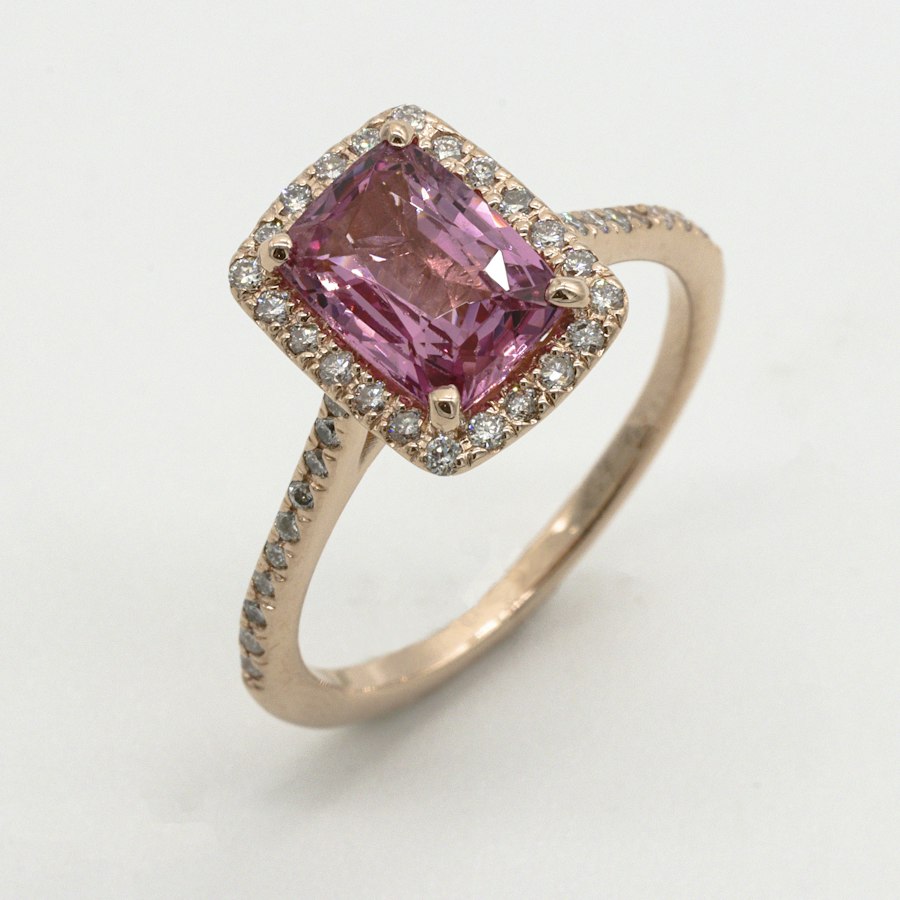
Spinel. 8 Mohs, available in lavender, gray-blue, hot pink and near-black. It is the most underrated durable gem: a 1.20 ct hot pink spinel runs $600-1,100 and looks like a ruby at a third of the price. For the broader selection logic, see choosing a gemstone for a custom ring.
Sourcing and certification
Unusual stones are bought per stone, not per catalogue. We source 3-5 candidates per brief and send photos on hand so the client sees the actual color in daylight, not a studio shot. Stones over 1.00 ct ideally carry a lab report; smaller accent stones are usually uncertified but checked in-house. And we avoid stones with undisclosed treatment: fracture-filled emerald and heavily oiled stones fail over time. For the birthstone-combination angle, see custom birthstone combinations.
Color over consistency
Unlike diamonds, colored stones are not graded to a single standard target. Two "same" tsavorites from different mines can read as yellow-green and forest-green. That is why we never sell an unusual stone from a catalogue photo. We send 3-5 candidates in hand, photographed in natural daylight on the wearer's own skin tone, because the stone that reads as vivid on a dealer's white card can read as muddy next to a warm complexion. The on-hand comparison is the whole product. Clients who buy unusual stones sight-unseen are the ones who return them.
FAQ
Will an unusual colored stone hold its value?
Less predictably than diamond, yes. Tsavorite and fine spinel have tightened in price over the last decade; morganite and aquamarine are more stable. Buy it because the wearer loves it, not as an investment.
Can I set an unusual stone in a solitaire?
Yes, but choose the cut carefully. Step cuts show inclusions more; brilliant cuts hide them. For a first unusual stone, a round or oval in a bezel is the forgiving choice.
What is the cheapest durable colored gem?
Sapphire, which is why it is common. Among genuinely unusual stones, chrome tourmaline and aquamarine give the most carat per dollar while staying above 7 Mohs.
How big can an unusual stone realistically be?
Tsavorite tops out around 2-3 ct clean. Spinel reaches 5 ct but cost climbs fast above 2 ct. Morganite and aquamarine reach 5-10 ct without trouble.
Want a stone no one at the office will already own? Book a 20-minute sitting. Tell us the colors you like and the budget; we will source 3-5 candidates and send them on-hand for a 48-hour comparison. Trade retail partners: our unusual-stone swatch set ships with hardness and treatment notes your team can quote from directly.