A client came in last spring wearing a 1.2 ct emerald solitaire she loved. Within eight months, one corner had chipped on a door handle. She did not want to replace the stone; she wanted to know why no one had warned her. That question sits at the centre of choosing a gemstone ring for daily wear: beauty matters, but hardness and toughness decide whether the stone survives the hand it lives on.
Hardness is not the same as toughness
Hardness, measured on the Mohs scale, is scratch resistance. Toughness is resistance to chipping under a knock. A stone can be hard and brittle. Sapphire is Mohs 9 and tough; emerald is Mohs 7.5-8 but has natural fractures that make it chip-prone; opal is Mohs 5.5-6.5 and splits if dropped. When we help a client choose, we look at both numbers, plus the job and hobbies of the wearer. A nurse, chef, or guitarist needs a tougher stone than someone who works at a desk. The GIA framework for diamond quality is the starting point for white stones; for coloured stones we extend the same logic to hardness and inclusions.
Everyday wear: the stones that belong on a hand
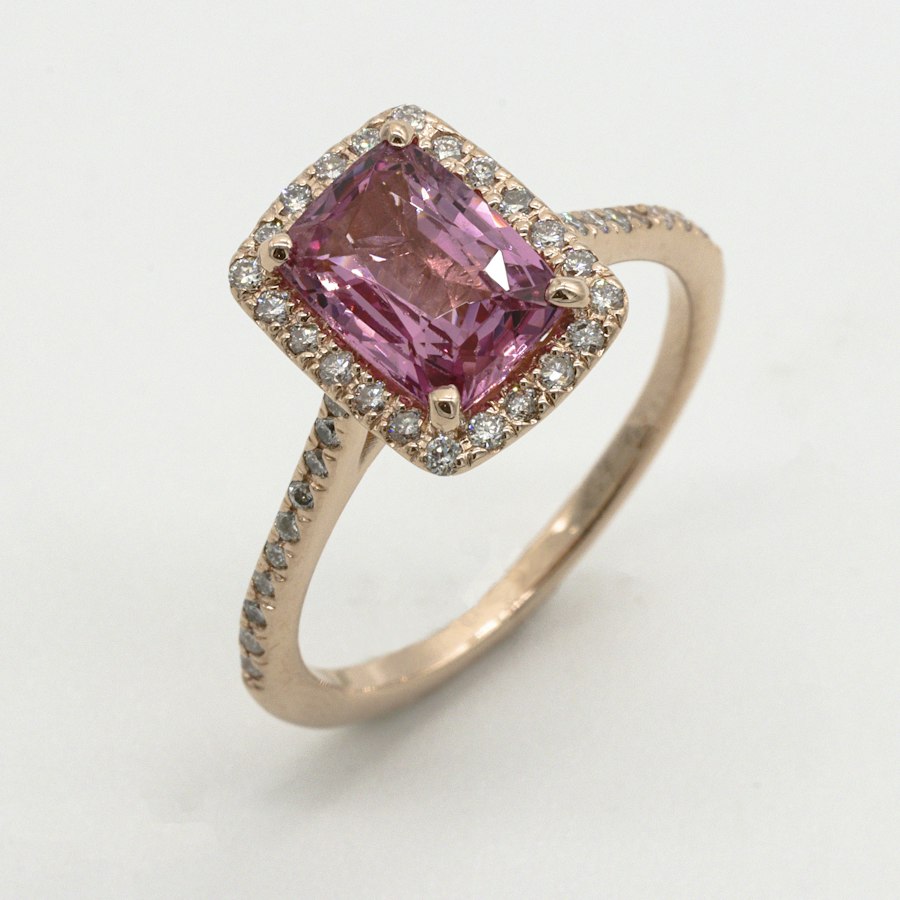
For a ring worn every day, we recommend stones at Mohs 8 and above: diamond (10), sapphire and ruby (9), morganite and aquamarine (7.5-8), spinel (8), and topaz (8). These can take a 4 mm band and a low-profile setting without daily drama. Compare this with our notes on choosing a gemstone for a custom ring, which covers colour and budget before durability.
Stones that need a protective setting
Emerald (7.5-8), garnet (6.5-7.5), amethyst and citrine (7), peridot (6.5-7), and moonstone (6-6.5) can be worn daily, but they need a bezel or a half-bezel rather than a four-prong high setting. A bezel wraps a metal wall around the girdle and absorbs knocks that would otherwise hit the stone edge. We also recommend a lower profile for these stones: 4-5 mm off the finger instead of 7-8 mm. If the heart is set on an emerald, we quote a bezel build rather than fight the setting.
Stones we usually steer to pendants and earrings
Pearl (2.5-4), opal (5.5-6.5), tanzanite (6.5-7), and fluorite (4) are better on necklaces and earrings, which live inside hair and away from door handles. That is not a value judgement; a fine opal pendant is one of the most beautiful pieces we build. It just should not be a daily ring. We also set birthstones accordingly; read our birthstone combinations note if the brief is sentimental rather than hard-wearing.
Care changes with hardness
Softer stones need different home care. Ultrasonic cleaning can shake a loose emerald fill out of its fractures; we recommend warm soapy water and a soft brush for Mohs under 8. Chlorine in a hot bath attacks the copper in rose gold faster than the stone itself, so we remind clients to take rings off before swimming. Full routine is in our care guide for handmade jewellery. We check prong tightness on all rings at the free three-month service, because a loosened prong is the fastest way to lose a stone.
What we ask before we quote the stone
Before we put a stone in a ring design, we ask three questions. Do you wear gloves, type, or do manual work with your hands? Do you take the ring off at night or sleep in it? Do you already own a softer piece that sits next to this one? The answers decide whether we lean toward a Mohs 9 stone, a bezel on a Mohs 7.5 stone, or a pendant instead of a ring. We have placed clients who refused to take rings off on sapphires, and clients who wanted emeralds on pendants. The stone is the easy part; matching it to the life is the work.
FAQ
Is a sapphire really as hard as people say?
Sapphire rates 9 on the Mohs scale, second only to diamond. It is one of the most durable choices for a daily engagement ring and takes colour beautifully.
Can I still wear an emerald every day?
Yes, if it is bezel-set and kept low on the finger. We will tell you honestly if the cut you love is too shallow for a bezel, and propose a slightly different stone.
Does a harder stone never chip?
No. Diamond can chip along a cleavage plane if hit at the right angle. Hardness reduces scratches; a well-built setting protects against knocks. Both matter.
What about moissanite?
Moissanite rates 9.25 on Mohs, between sapphire and diamond. It is durable for daily wear. See the Wikipedia entry on moissanite for the technical comparison if a client asks.
Not sure which stone survives your day? Tell us your job, your hobbies, and the colour you love. We will narrow it to two stones, quote both in the same setting, and tell you which needs a bezel. Trade partners: our stone-hardness reference sheet gives your counter staff the same daily-wear triage we use.