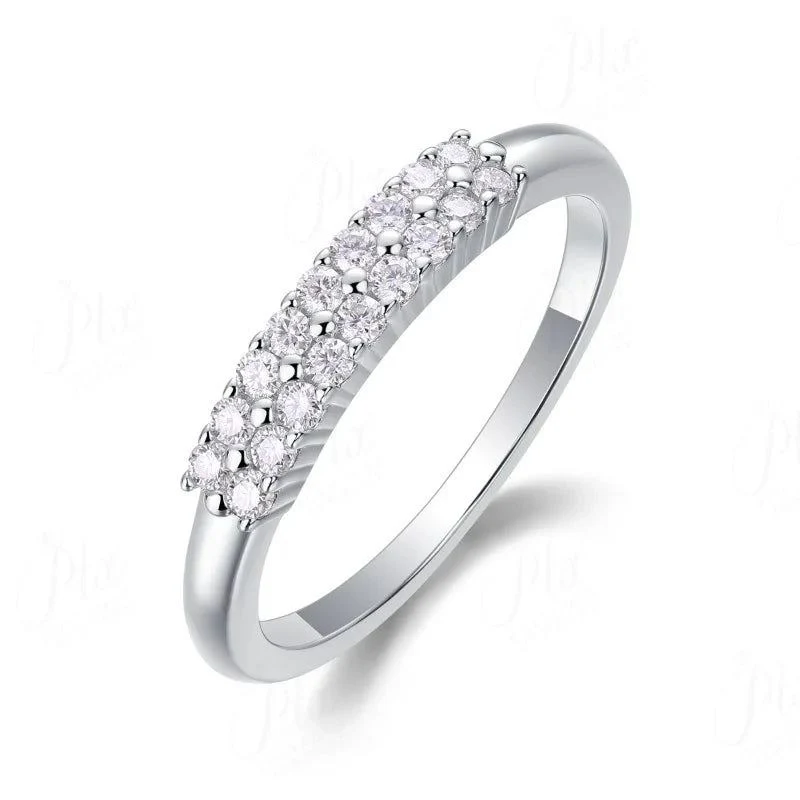
The most common family commission is a ring or pendant with the birthstones of the wearer's children. It is also the commission most likely to be designed badly. A soft peridot next to a hard sapphire in the same shared prong is a recipe for the peridot chipping within a year. Birthstone jewelry that lasts is built around the Mohs scale, not the color wheel. Here is how we do it.
IKnow the Mohs ranking before you lay out the stones
Birthstones are not equally hard. Diamonds (10), sapphires and rubies (9) are daily-wear stones. Emeralds, aquamarines and other beryls (7.5 to 8), topaz and spinel (8) are fine with care. Pearls, opals, moonstones and turquoise (2.5 to 5) are special-occasion stones. The rule we use: never put a stone below 7 in the same setting as a stone above 8 unless the softer one is fully bezel-set and protected.
When stones of different hardness sit in shared prongs, the harder edge rubs the softer one every time the hand moves. Bezel-set the softer stone, or choose a ring where the stones sit in separate bezels on a horizontal bar.
IIColor combinations that read as intentional
Three birthstones on a single band look best when one is the anchor. Common layouts: a central larger stone (the wearer's own birthstone) flanked by two smaller stones (the children's). If the colors clash, garnet red next to peridot green, for instance, we separate them with a small bezel of metal or a row of tiny diamonds so the eye reads three jewels, not a single loud stripe.
For a family of four, a pendant with four stones in a square, or a ring with a horizontal bar, works better than a cluster. A cluster of four 4 mm stones on a 6 mm band looks crowded and the prongs fight each other. Our piece on choosing a center stone for a custom design explains the proportion rules that apply here: the center stone should carry the visual weight, and the flanking stones should read as accents rather than equals.
IIISetting choices by stone type
Bezel setting suits soft stones and irregular shapes. Prong setting suits hard, faceted stones that need light to pass through. Tension setting suits round, hard stones only. For pearls and opals, we always bezel or cage them, and we warn clients that these stones need to come off before swimming, showering or applying perfume. Care guidance is the same as our notes on caring for a handmade piece.
When the commission is an engagement-adjacent piece, clients often ask whether a birthstone can replace a diamond. We point them to the Wikipedia entry on moissanite for a durable, affordable diamond alternative, and to the GIA 4Cs for the framework that tells them what to look for in any colored center stone.
IVMetal and budget
A three-stone family ring in 14k gold with small 3 mm birthstones typically lands between 650 and 1,400, depending on the stone quality. Upgrading to sapphires or rubies pushes the price up; choosing lab-grown or simpler faceted stones brings it down. A pendant with four 4 mm stones in sterling silver starts around 280. To understand what drives the cost, read our breakdown of bespoke jewelry pricing.
For a gift timing angle, birthstone commissions are popular for Mother's Day and milestone birthdays; see gifting a bespoke experience: vouchers and timing for the lead times you need to plan around.
FAQ
Can I put my children's birthstones in a ring I already wear?
Sometimes. A plain band can be set with small flush stones if the wall is thick enough. If the band is thin, we will tell you the honest answer: it needs a new setting, not an add-on.
Which birthstones are best for everyday wear?
Sapphire (September), ruby (July), diamond (April) and spinel are the most durable. Emerald (May), pearl (June) and opal (October) are beautiful but need more care and are best in pendants or rings worn on special occasions.
Can I use lab-grown stones for a family ring?
Yes. Lab-grown sapphires and rubies are chemically identical to mined stones, considerably cheaper, and consistent in color. We disclose them as lab-grown in line with the FTC Jewelry Guides so the piece is sold honestly.
How far in advance should I order?
Four to six weeks. Family stones sometimes need sourcing if you want a particular shade, and that can add a week. Vouchers solve the timing problem; see the gifting guide linked above.
Want a family piece that will outlive the children's childhood? Book a consultation and bring the months, not the stones. We will map the birthstones, check the hardness compatibility, and sketch a setting that protects the softest one. Retailers: our wholesale birthstone programme includes small calibrated stones and pre-designed settings; ask for the catalog.
VFrequently Asked Questions
How does the custom OEM process work?
Send a reference, sketch or CAD file. We quote, produce a 3D render, then a wax or resin model for approval before casting. Nothing goes to bulk without written sign-off.
How long does a custom sample take?
Production timelines depend on the design and order size and are agreed before we start. Production timelines depend on the design and order size and are agreed before we start.
What is the custom MOQ?
100–300 pieces per design depending on the mold and stone setting complexity.
Do you sign NDAs for private label?
Yes. Private-label clients get an NDA and exclusive mold use for the agreed term.


