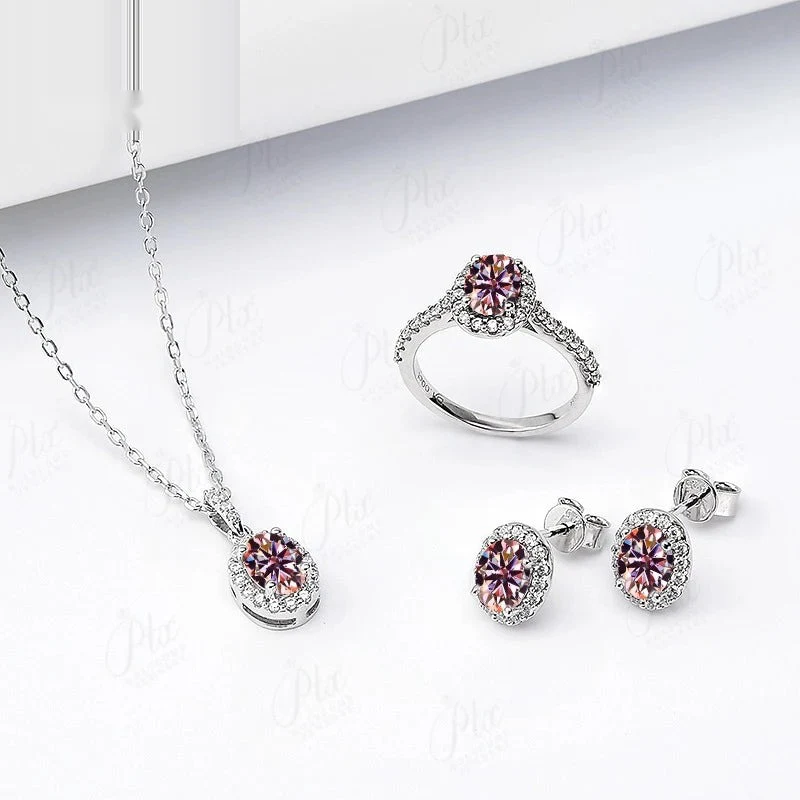
Clients arrive with a number in mind: "I want a carat and a half." The number is usually the wrong place to start. A center stone decision is not about weight alone. It is about cut quality, stone category, certification, and how the stone will sit in the setting you are designing. Choose the stone last, after the setting is decided, and you will either compromise the design or overpay for a weight that reads the same on the hand.
IThe four factors that actually move the needle
The GIA 4Cs grade a diamond on carat, cut, color, and clarity. In a custom setting, cut is the one you cannot compromise on. A poorly cut 1.2 carat stone leaks light through the sides and looks dark on the hand, no matter how clean the grade report says it is. Spend on cut first, then pick a color that pairs with your metal. In yellow or rose gold, a G to I color stone looks perfectly white because the warm metal already tints its surroundings.
Clarity is the most over-purchased grade. Eye-clean SI1 stones in round brilliant cuts look identical to VS1 stones under normal lighting and cost 20 to 30 percent less. Save the money and put it into cut.
IIMined, lab-grown, or moissanite
You now have three credible categories. Mined diamonds carry a GIA or IGI report and a resale market, but cost the most. Lab-grown diamonds are optically and chemically the same, carry an IGI or equivalent report, and cost 30 to 50 percent less per carat; the trade-off is a thinner resale market. Moissanite is a separate, doubly-refractive stone that out-sparkles diamond at a fraction of the cost, though it reads slightly more rainbow; the moissanite entry on Wikipedia covers its composition and durability. Hardness matters: diamond ranks 10 on Mohs, moissanite about 9.25, both suitable for daily wear.
Whichever you choose, require a written disclosure of the stone type. The FTC jewelry guides are explicit that lab-grown and imitation stones must be labeled honestly, and a trustworthy atelier will name the category on the quote rather than just writing "diamond."
IIIHow the stone shape drives the setting
Shape dictates the setting geometry. A round brilliant is set in a six-prong solitaire or a halo. An oval or pear shape needs a north-south orientation and a slightly longer basket to protect the pointed tips. A cushion or emerald cut reads well in a bezel, which protects the corners and modernizes the look. A fancy yellow or pink stone usually wants a yellow or rose gold bezel to intensify the color. This is why stone choice precedes CAD: the seat depth and prong layout are built around the exact stone dimensions.
Production timelines depend on the design and order size and are agreed before we start. We cover where sourcing sits in the timeline in the process from sketch to setting.
IVBudget math that keeps the design intact
As a rule, the center stone should be 55 to 75 percent of the total budget. If your total budget is $4,000, plan $2,400 to $2,800 for the stone and $1,200 to $1,600 for a custom setting. Stretching the stone to 90 percent of the budget leaves you a thin, generic setting that undercuts the whole point of going bespoke. The full line-item math is in how much does bespoke jewelry actually cost.
Should I buy the stone separately or through the atelier?
Through the atelier is simpler and usually cheaper, because ateliers buy from trade dealers at near-wholesale. Buying your own stone works only if you already understand certification and cut grading.
Does a lab-grown diamond look fake?
No. To the naked eye, and even to most jewelers without testers, a well-cut lab-grown diamond is indistinguishable from a mined one. See the lab-grown diamond overview for the technical comparison.
What is an eye-clean stone?
A stone whose inclusions are not visible to the naked eye at arm's length. For round brilliants, an SI1 eye-clean stone is the best value on the market.
Can I change the center stone later?
Yes, if the setting seat is sized for a range. A custom solitaire can be built to accept a different head later, which is useful if you want to upgrade the stone on an anniversary.
VWhere color stones fit in
Diamonds are not the only center. A sapphire, an emerald, or a morganite shifts the character of the whole piece and often costs less per carat than a diamond of the same size. Whatever stone you pick, the seat is built to its exact dimensions, so read how the CAD stage turns a chosen stone into a setting before you lock the purchase.
Choose the stone that will sit in your hand for decades, not the carat number on a page. Book a stone consultation; we will pull three certified options that fit your setting and your budget.
VIFrequently Asked Questions
How does the custom OEM process work?
Send a reference, sketch or CAD file. We quote, produce a 3D render, then a wax or resin model for approval before casting. Nothing goes to bulk without written sign-off.
How long does a custom sample take?
Lead times for samples and bulk orders are stated on your quote and reconfirmed on the PO. Production timelines depend on the design and order size and are agreed before we start.
What is the custom MOQ?
100–300 pieces per design depending on the mold and stone setting complexity.
Do you sign NDAs for private label?
Yes. Private-label clients get an NDA and exclusive mold use for the agreed term.


