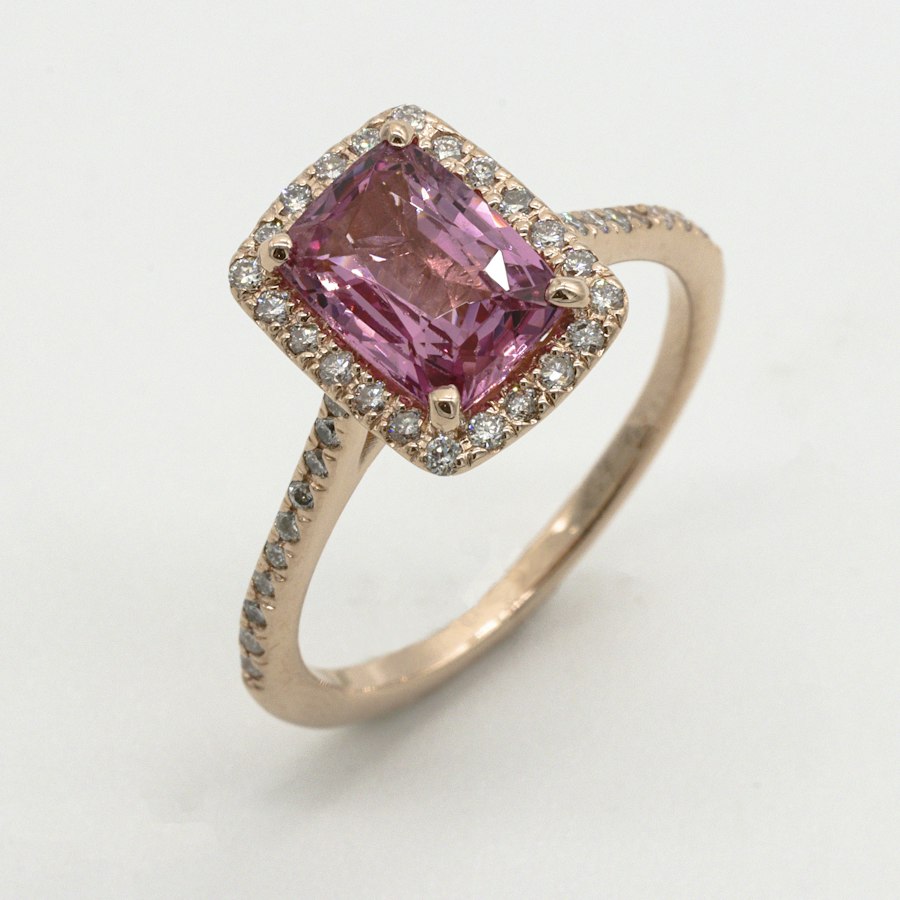
A client came in wanting a sapphire engagement ring and rejected every oval and round we showed her. "They all look like engagement rings," she said. She was right. The fancy shapes in a typical showcase are the same eight cuts repeated across every store. The cuts that actually read as a specific person are the ones the stores do not stock, because the demand is too thin for inventory. A bespoke commission is the place to order those cuts to spec.
What "unusual cut" means in the trade
Every cut on a diamond or colored stone is a "fancy" cut except the round brilliant. Within that category, the trade stocks ovals, pears, cushions and emerald cuts as commodity shapes. The unusual cuts are the ones cutters produce in small batches to order: trillions, hearts, marquises, old-mine cushions, rose cuts and briolettes. They cost more per carat to source because the cutter runs them one at a time, and they are harder to set because the prongs have to be custom-cut to the facet geometry.
The payoff is that they look like nobody else's ring. A trillion sapphire, a rose-cut diamond or a briolette tourmaline on a pendant is a conversation the client will have at every dinner party for the next decade.
Six cuts clients actually commission
Trillion. A triangular brilliant, usually 8-12 mm on each side. The trillion maximizes surface area for carat weight, so a 1.00 ct trillion reads larger than a 1.00 ct oval. The downside is the points: three corners that chip on impact, so we bezel trillion centers or half-bezel them. We most often see trillion sapphires and trillion tsavorites.
Rose cut. A flat-backed, domed stone with triangular facets on top, no pavilion. The rose cut is a 16th-century design that reads as antique without being a vintage stone. It does not "sparkle" in the modern sense; it glows. We pair it with a thin bezel and a matte finish for a quiet, architectural look. The GIA 4Cs framework applies less cleanly to rose cuts, because light return is not the target; the cut is graded on symmetry and dome proportion.
Briolette. A teardrop-shaped stone cut like a bead, drilled at the top to hang on a chain or ear wire. Briolettes move when the wearer moves, which is why they read as jewelry rather than as architecture. They are too fragile for a ring; we use them on pendants and earrings.
Marquise. An elongated pointed oval, the cut Louis XIV popularized. A 1.00 ct marquise looks like 1.30 ct on the finger because of the length. The risk is the "bow tie" again, stronger on a marquise than on an oval, and the two points which need V-prong protection. We recommend marquises over 1.50 ct only; smaller ones look thin.
Old-mine cushion. A chunky, square cushion with a high crown and a small table. It reads as 1920s without being a vintage stone, and it pairs naturally with milgrain edges. Budget-wise, an old-mine cut costs about 15-25% more than a modern cushion of the same weight, because the cutter wastes more rough.
Half-moon or trapezoid. Usually used as side stones flanking an emerald or asscher center, the half-moon and trapezoid produce a geometric shoulder that reads as tailored. We source them to match the center stone's color within one grade. For hardness pairing, see choosing a gemstone for daily wear by hardness.
Light return and daily-wear trade-offs
Unusual cuts trade light return for silhouette. A trillion returns light well but chips at the points. A rose cut returns almost no fire but shows color beautifully. A briolette moves and catches light from every angle but cannot be set in a ring. We match the cut to the wearer: a client who types for work gets a bezel trillion or a cushion; a client who wears gloves gets a rose-cut diamond in a pendant.
Budget-wise, an unusual cut costs 15-35% more per carat than a commodity oval, and setting labour adds another $80-180 because the prongs are custom. The total on a 1.00 ct commission is usually $600-1,200 higher than an oval solitaire, but the stone is one a competing store cannot pull off a shelf. We cover the cost split in the cost factors breakdown, and the birthstone angle in custom birthstone rings: selecting the stone. For comparison, moissanite is available in the same fancy cuts at a fraction of the diamond price, and we cut moissanite trillions and rose cuts as a budget option.
FAQ
Which unusual cut looks biggest on the finger?
The trillion, then the marquise, then the oval. All three spread surface area for carat weight. The trillion wins because the triangle covers the most square millimeters per carat.
Do unusual cuts hold value?
Less well than rounds and ovals, because the secondary market is thinner. If resale matters, buy an oval. If the ring is for keeps, the unusual cut is the better emotional choice.
Can a trillion or marquise be set in a solitaire head?
No. The prongs have to be custom-fitted to the points. We build a new basket for every trillion and marquise commission, which is part of the labour premium.
What colored stone looks best in a rose cut?
Sapphire, especially in padparadscha or Montana tones. The rose cut shows the color as a wash rather than as flashes, which suits softer, lower-saturation stones. For center-stone selection, see choosing a center stone.
Want a stone cut nobody on your street already owns? Book a 20-minute sitting with our gem buyer. Bring a color preference and a budget; we will source three unusual cuts to spec and photograph them side by side in our studio. We will quote the stone, the custom prongs and the setting in writing within 48 hours. Trade retail partners: our white-label fancy-cut one-pager lists the six cuts we source most, with the per-carat premiums your sales team will be asked about.