A client pulled a 1998 solitaire out of a velvet pouch and said, "I never wear this. It feels like someone else's ring." She was right. The high four-prong head, the thin 2mm shank, and the stone that yellowed next to her skin were a design that belonged to the 1990s, not to her life now. The stone was fine. The setting was the problem. That is the starting point for most redesigns: the gemstone has decades of life left, and the mounting has not.
Why unworn rings end up in drawers
We see three patterns. First, the finger size changed after weight gain or weight loss and the ring has not been resized in 20 years. Second, the client's taste moved on-a 1990s solitaire is not the ring a 45-year-old with three kids reaches for. Third, the ring was never hers to begin with: an inherited piece in a style she would never choose. In every case, the gold and the stone are recoverable. The question is what to make next. The GIA grading report on the original stone tells us what we are working with, and whether it is worth resetting as-is or re-cutting.
Six redesign directions
Reset into a bezel. The lowest-effort, highest-payoff move. Take the stone out of the prong head and seat it in a thin bezel on a 4-5mm comfort band. It drops the profile, reads modern, and stops the snags on sweaters. This runs $220-380 in labour.
Widen and reshape the shank. A thin 2mm band that pinches the finger can be split, gold added, and reshaped into a 4mm band with a soft taper. We reuse the original gold as much as the alloy allows. See reimagining an old anniversary band for the before-and-after.
Split one ring into two. A cluster ring or a three-stone can be broken into a solitaire plus a pair of studs, or a pendant plus a band. Clients love this because one inherited piece becomes two gifts across two generations.
Reset horizontally. Turn a vertical oval or pear on its side and set it across the knuckle. It reads as a cocktail ring, not an engagement ring, and drops the emotional weight of the original. For the pendant route instead, see turning a ring into a pendant.
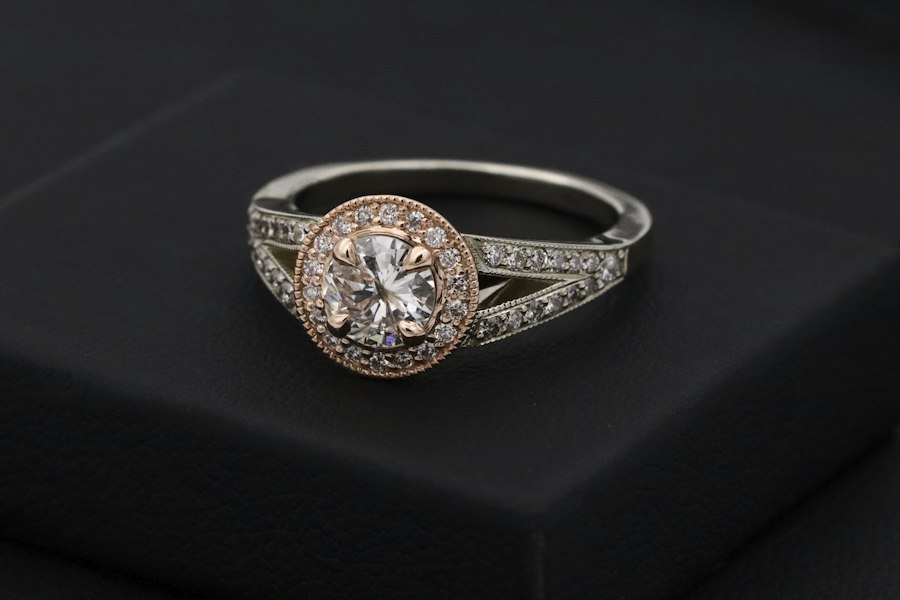
Add side stones. A tired 0.50 ct center reads larger and more current in a micro-pave halo. We usually add 0.15-0.25 ct total weight in melee, which lifts the look without doubling the cost.
Recast the whole thing. When the original mounting is too thin, too worn, or badly soldered, we melt down the gold, re-alloy it to 14k or 18k, and cast a fresh design around the saved stone. See when to repair versus when to remake for the decision line.
What we can and cannot reuse
Diamonds and most sapphires reset cleanly. We always inspect the stones under 10x magnification first: a chipped girdle or a cracked pavilion means a re-cut or a bezel, not a prong. Gold can be recycled but rarely at 100%-we usually retain 80-90% of the weight and top up with certified alloy. Platinum cannot be mixed with gold. And engraving from the old band is almost always lost in the recast, so we photograph it first if the client wants it copied by hand onto the new piece.
The emotional question before the technical one
Before we sketch, we ask what the ring means to the wearer. A redesign of a wedding ring carries weight that a redesign of a gift ring does not. If the goal is to keep the memory alive, we preserve one element-the engraving, the stone, even the original profile-as an anchor, and change everything around it. If the goal is simply to stop a piece sitting in a drawer, we are freer to redesign boldly. That conversation takes five minutes and it is the difference between a remake the wearer loves and one she quietly resents.
FAQ
Does redesigning devalue the ring?
If the stone is certified, no. The value of a diamond sits in the stone, not in a retail mounting. A fresh bezel on a GIA-graded 1.00 ct does not reduce the stone's report. What loses value is the original retail box and paperwork tied to a brand.
Can you reuse the exact gold from my ring?
Mostly. We melt and filter it, then top it up with certified alloy to reach a clean 14k or 18k. Expect to retain 80-90% of the original weight; the rest is solder, patina and filings that cannot be recovered.
How long does a redesign take?
3-5 weeks. Faster than a fresh commission because the stone is already in hand and we skip the stone-sourcing round.
What if the stone is chipped?
We either re-cut it (losing 5-15% carat but removing the chip) or bezel it so the chip sits under the metal. The choice depends on the cut and how much weight the client can afford to lose.
Have a ring in a drawer you never wear? Bring it in for a free inspection. We will measure the stone, photograph the engraving, and sketch two redesign directions before you commit. Trade retail partners: our redesign intake form gives your customers a clear "keep, reset, or recast" decision tree on the first visit.