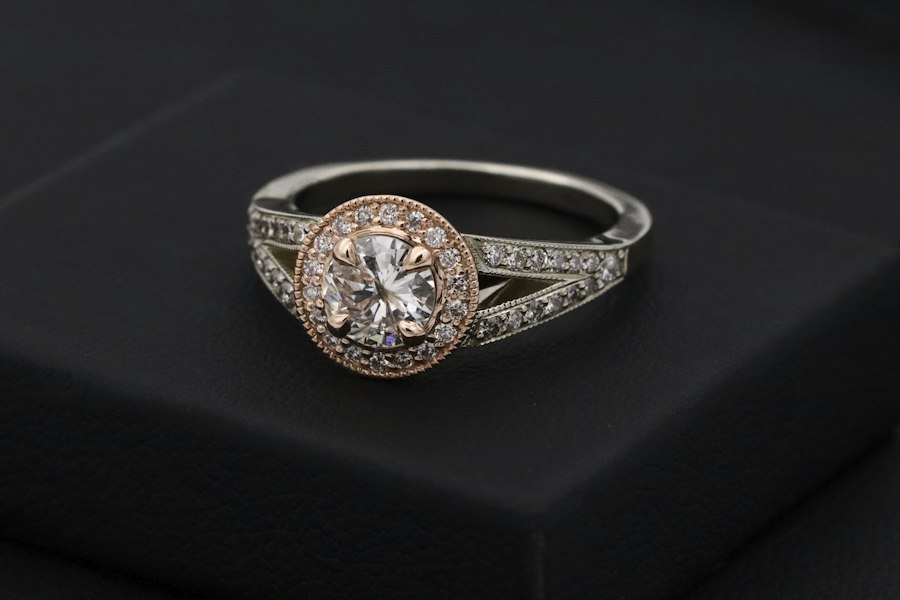
A client brought in a 1980s diamond ring her mother had worn for 30 years. She loved the stone; she would never wear the ring. The head was a thick yellow-gold halo, the shank was sized for a finger two sizes larger than hers, and the style was, in her words, "my mother's ring, not mine." The question was not whether to redesign. The question was whether to reset it into a new ring or turn it into a pendant. We usually steer clients toward the pendant when the stone is over 0.75 ct, because a pendant puts the stone where the wearer can actually see it, and where it will not catch on door frames.
When a ring should become a pendant
The conversion makes sense in four situations. First, when the center stone is large enough to read as a pendant but too small to be the focal point of a new ring. Second, when the client does not wear rings at all. Third, when the original ring has sentimental side stones that look fussy on the hand but elegant on the chest. Fourth, when the ring has a damaged shank that would cost more to repair than to recycle.
It does not make sense when the stone is under 0.30 ct: a 0.25 ct diamond on a chain reads as a speck, and the client is disappointed within a week. For stones that small, we usually suggest upcycling the stone into a new ring instead, or pairing it with a small diamond pair.
Engineering the conversion: basket, bail and chain weight
A ring head is built to sit on a finger. A pendant is built to hang on a chest. The two loads are different, and the conversion is not as simple as soldering a bail on the original head.
First, the basket. A ring head has prongs tuned to the stone girdle and a base shaped to sit flush on the shank. For a pendant, we usually cut the original head free, re-bezel or re-prong the stone in a custom basket, and add a small backplate so the stone does not twist on the chain. The backplate also protects the pavilion, which on a ring sits against the skin and rarely sees impact but on a pendant bangs against collarbones and phone screens.
Second, the bail. A bail is the loop the chain passes through. We use a hollow box bail for pendants over 3 grams because it sits flat on the chest and does not flip. A thin wire bail looks light but turns the pendant sideways within a month. The bail has to be soldered at two points, and the solder joint has to be polished to match the alloy; we cover the step-by-step in bespoke pendant and necklace sketch to wax.
Third, the chain weight. A 3 gram pendant needs a chain at least 1.2 mm wide in the same alloy, or the pendant wins the leverage war and the chain stretches. We recommend a 16-18 inch chain for daily wear, and we size the bail so the chain slides freely; a bail that grips the chain will nick it within a year. For chain-length proportions, see pendant design ideas and chain length proportions.
Stone care during the reset
The stone leaves the original setting only once. We take a clear graded photograph before the cut, weigh the head, and note any existing chips on the pavilion. A stone that has sat in a ring for 30 years often has a chip at a prong point that was invisible in the setting; we flag it before the reset so the client is not surprised later. The GIA 4Cs grading stays valid after a reset, because the stone is unchanged; only the setting moves.
We also re-examine whether the original ring should be melted down or kept. Most clients choose to melt the old shank into the new bail, so the pendant carries the exact metal from the original ring. The melted gold is about 1.5-2 grams of the finished pendant, which is enough to make the story literal. The decision between repair and redesign is the topic of repair versus redesign: when to remake a piece.
FAQ
How much does a ring-to-pendant conversion cost?
Typically $350-650 in labour, plus the chain and any new metal. The stone is your own, so there is no stone cost. The wide range reflects whether we reuse the original head or build a new basket from scratch.
Will the diamond look different in a pendant setting?
The stone is the same, so the light return is the same. What changes is the angle: a pendant sits higher on the chest and catches light from above, which most clients say makes the stone look brighter than it did on the hand.
Can I keep the original ring head as a keepsake?
Yes. We usually cut the head free and return it to the client in a small box, alongside the new pendant. About 30% of our pendant-conversion clients keep the old head on a shelf; the rest choose to melt it.
What chain length should I pick?
16 inches sits high on the collarbone, 18 inches falls just below it, and 20 inches sits on the sternum. For a single pendant, 18 inches is the most versatile. We walk through the proportions in necklace design with inherited diamonds.
Have a ring you will never actually wear? Book a 20-minute sitting with our redesign lead. Bring the ring; we will weigh it, photograph the stone, and sketch two pendant options on the spot. We will quote the conversion, the bail and the chain in writing within 48 hours, and we will return the old head to you in a labeled box. Trade retail partners: our white-label ring-to-pendant conversion sheet gives your sales team the same basket-and-bail language we use in-house.