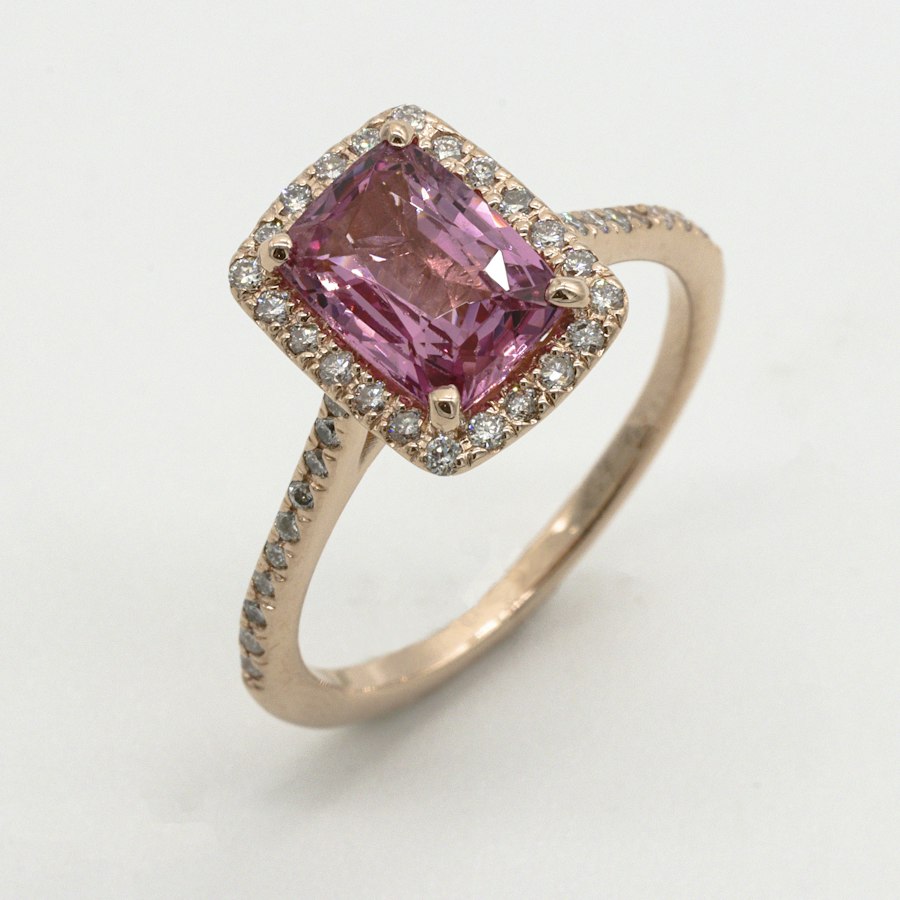
A December baby walked in last month and said she wanted a tanzanite ring she could wear to work. We had to have the conversation we have every week: the birthstone list is a marketing chart, not an engineering spec. The stone for your month is a starting point, not the stone you should set in a daily ring. Selecting the actual gem is where the bespoke work begins.
Start with hardness, not color
The Mohs scale decides whether a birthstone belongs in a ring at all. Diamonds, sapphires and rubies sit at 9-10 and survive decades of desk work. Emeralds sit at 7.5-8 but are heavily included and chip along their axis; they belong in pendants, not on the finger. Pearls and opals sit below 5 and should never be set as a daily ring. We walk through the hardness logic in choosing a gemstone for daily wear, and it is the filter we apply before we talk about color.
The traditional birthstones, by month, split into three wear tiers. Ring-safe (January garnet, April diamond, May emerald with a protective setting, July ruby, September sapphire, November topaz, December blue zircon). Pendant-safe (June pearl or alexandrite, August peridot, October opal). Needs an alternative for daily wear: March aquamarine is fine in a bezel, but February amethyst and December tanzanite are softer than most clients expect, and we usually suggest a protective bezel or a harder alternative in the same color family.
Color range beats the catalog swatch
Every birthstone has a color range, not a color. A "ruby" can be pinkish red or brownish red, and the price moves with the saturation. A "sapphire" can be pale cornflower or inky blue. We send two or three stones in the target range before the client commits, because the swatch on a chart and the stone on the hand are two different objects. The GIA Gem Encyclopedia is the reference we use for color grading and treatment disclosure, and we mark any heated or clarity-enhanced stone on the invoice consistent with the FTC Jewelry Guides.
Treatments to ask about
Most birthstones on the market are treated, and most treatments are stable. Sapphires are routinely heat-treated to deepen color; that is permanent and normal. Emeralds are oiled to fill surface-reaching fractures; the oil can dry out in 5-10 years and need re-oiling. Rubies may be glass-filled, which we avoid in ring settings because the fill can crack under prong pressure. We tell you which treatment your stone has, and we price untreated stones separately when the client asks. We pair this with choosing a gemstone for a custom ring for the broader decision.
Carat and budget by month
A realistic starting budget for a 0.7-1.0 ct center birthstone runs from $300 for amethyst or garnet to $3,000+ for a fine Burma ruby or a no-heat sapphire. Most clients land in the $500-1,200 range for a 0.8-1.0 ct, well-matched stone. We also commonly combine two birthstones in one ring: the wearer's and a partner's, or a mother's and a child's. We cover that in custom birthstone combinations.
Setting choice by stone
Hard stones (sapphire, ruby, diamond) take prongs and look open. Softer or included stones (emerald, tanzanite, peridot) should be bezel-set to protect the girdle. A bezel adds roughly 10-15% to the setting labour but can add years to the stone's life. We spec the setting around the stone, not the other way around. The broader design decision is in choosing a center stone.
FAQ
Is my birthstone always the right stone for my ring?
No. The birthstone list is a 1910s marketing chart updated by trade associations. If your month's stone is too soft for daily wear, we suggest a harder stone in the same color, or a protective bezel. We will tell you which.
Do I have to use my actual birth month stone?
No. Clients choose stones for color, for a child's birth month, or for a family anniversary. The birthstone label is a way into a decision, not a rule.
Are treated birthstones a bad buy?
No. Heat-treated sapphires are standard and stable. We avoid glass-filled rubies in ring settings and we flag oiled emeralds as needing re-oiling. Treatment is not a defect; undisclosed treatment is.
Can we set more than one birthstone in one ring?
Yes. A common commission is a mother's ring with up to five small birthstones, one per child. We size the stones 2.5-3 mm so the band stays slim, and we alternate shapes for visual rhythm.
Want a birthstone ring you actually wear? Book a 20-minute sitting. Bring the month (or months) you want represented, and we will lay out three stone options in your budget, with treatment notes and a setting recommendation. We quote in writing within 48 hours. Trade retail partners: our birthstone hardness chart gives your staff the same wear-tier guidance we use, so you never set an opal in a ring by accident.