A lot of clients arrive at the bench with a screenshot of a 1920s engagement ring saved on their phone and a budget that does not include buying the actual antique. That is a much better starting point than they think. A vintage-inspired ring does not have to be old to feel old. It has to repeat the specific design decisions that jewelers made in the period you love. Distressing a new ring to look worn usually just looks dirty. The authenticity comes from structural details, not from aging the finish.
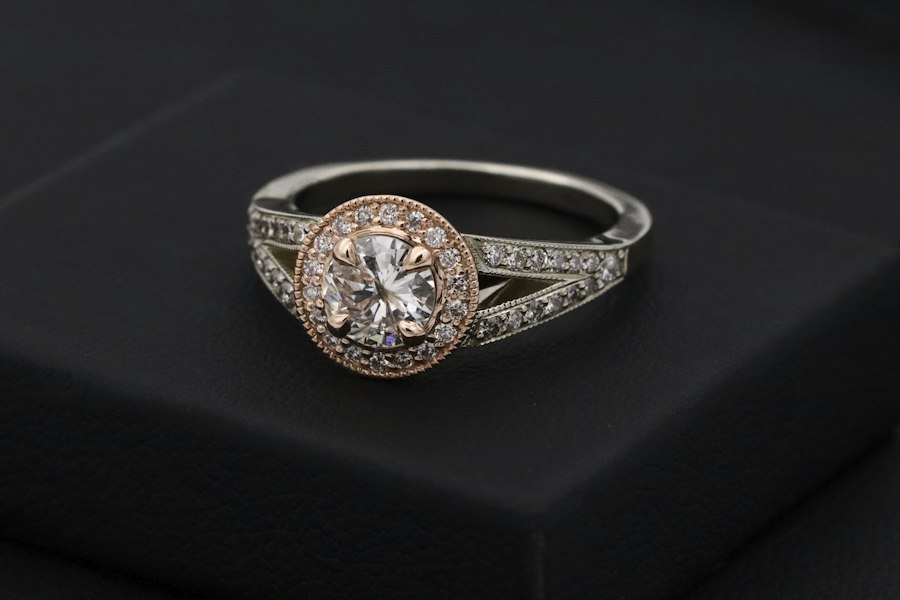
The single most effective detail is millgrain. That row of tiny, uniform beads running along an edge, the kind you see on Art Deco and Victorian rings, is applied by hand with a steel tool called a milgrain punch. It takes minutes per inch and it wears more gently than a sharp polished edge. A clean rail with no bead reads modern. The same rail with a millgrain edge immediately reads as old. We use it on the outer rails of halos, on the edges of shanks and around bezels. It is a small cost that changes the entire voice of the ring.
Filigree and open gallery work are the next layer. Antique rings were often built with visible wirework underneath the stone, because stones were set by hand and metal was intentionally light. A modern mass-produced ring tends to have a solid, closed basket under the center stone, which reads heavy. Open gallery rails, delicate scrolls and small heart-shaped or circular cut-outs under the basket make a new ring feel airy and period-correct. This is also where the ring catches more light, so the sparkle improves at the same time.
Engraved shoulders are the third detail. On a vintage ring, the shank near the setting often carries hand-engraved scrolling, leaf motifs or tiny floral patterns that fade as the band widens. Machine engraving can approximate this, but the depth and rhythm of hand engraving cannot be rushed. Clients who want the Victorian look almost always benefit from hand-engraved shoulders even if they keep the rest of the band plain. It is the detail people lean in to notice.
The stone itself carries a lot of the period feeling. A modern round brilliant cut is mathematically optimized for white light return and reads bright and sharp. An Old European cut or an Old Mine cut, by contrast, has a smaller table, a thicker culet and softer, less uniform sparkle. If you want a 1920s feel without buying a real antique diamond, choosing an antique-style cut moissanite or diamond in a lower-profile setting is faster than trying to make a modern cut look period. The cut does most of the work.
Halo and cluster arrangements also shift by era. Art Deco halos are square, geometric and tightly set, often with baguette side stones forming a step on either side. Victorian clusters are organic, clustered like a flower, with mixed stone sizes. Edwardian rings use delicate open metalwork and often omit a halo entirely in favor of a high collet setting. Picking one era's language and staying inside it is what keeps the ring coherent. Mixing a Deco square halo with Victorian scroll engraving can work, but it needs an experienced hand to balance.
Patina is where people often overshoot. A new ring should not be intentionally dulled. Antique rings look warm because the high points have been polished by eighty years of hands and the recesses have darkened. You can approximate that with a light oxidation in the crevices of engraving, but the broad surfaces should still be bright. If the whole ring looks gray, it reads costume, not antique.
Maintenance is the honest trade-off. Millgrain wears down over decades and may need refreshing. Open gallery work catches on things more than a solid shank. Hand engraving is deeper than laser engraving, which is good, but it means the ring has more places where soap and lotion can build up. We tell clients who want this look that they are signing up for a piece that benefits from a once-a-year professional clean, which is true of any fine ring but slightly more noticeable on detailed work.
The reason vintage-inspired rings hold up in a market flooded with solos and ovals is that they carry reference. A ring with millgrain and engraved shoulders feels like it has a story even on day one, which is the whole point of a bespoke commission. You are not copying an antique. You are borrowing its grammar and writing a new sentence.
If you are deciding between styles, our guide on choosing between engagement ring styles will help you pin down which era fits, and our piece on hand-engraving ideas for a custom ring shows the shoulder motifs most clients end up choosing.