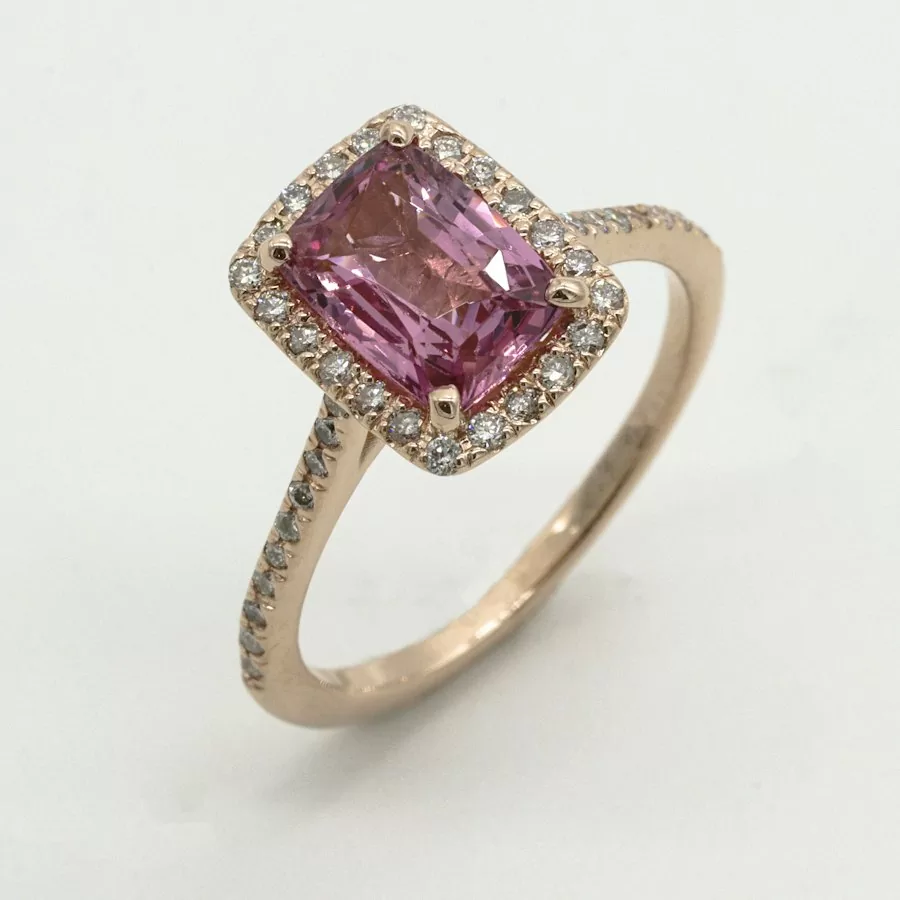
Few designs have survived as long as the solitaire, and fewer deserve to. A single stone held above a clean band strips an engagement ring down to its emotional core: one gem, one promise, no decoration arguing for attention. At a bespoke atelier, that apparent simplicity is exactly what makes the design interesting. There is nowhere to hide a weak proportion, a clumsy prong, or a band that does not sit right on the finger.
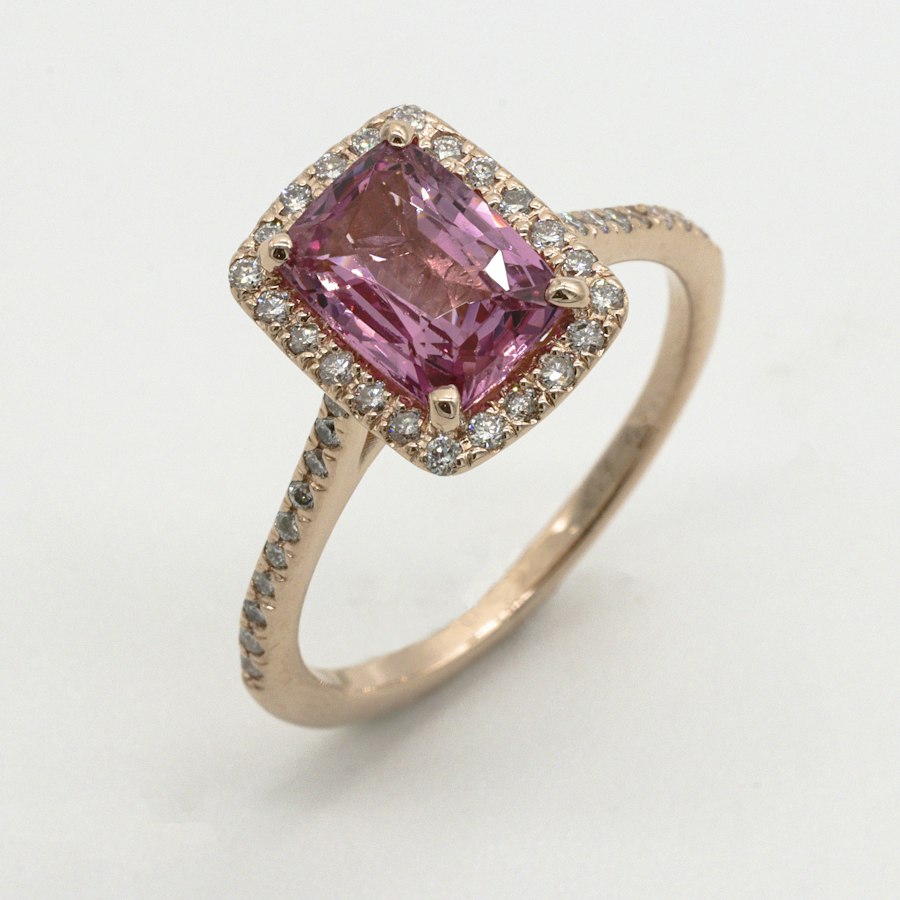 A six-prong platinum solitaire, built so the stone reads as if it is floating above the band.
The solitaire works because the eye is drawn straight to the center. That is also why every supporting decision matters. A slightly too-thick band competes with the stone. A prong head that sits too high catches everything. A basket that is too open lets light escape from below. When you commission a solitaire, you are not picking a style off a shelf; you are specifying how a particular stone, on a particular hand, should be framed.
IHow many prongs should a solitaire have?
Four prongs and six prongs are the two honest answers. Four prongs expose more of the crown and pavilion, which lets a well-cut stone breathe and flash. It also uses less metal, so the head feels lighter. The trade-off is that each prong carries more of the holding force, and a thin four-prong head on a taller stone can look spindly over time.
Six prongs spread the load. Each prong is smaller and does less work, which makes the head feel reassuringly grounded. Six prongs are often chosen for a higher setting or for a stone the wearer plans to keep on through an active day. The cost is a little more metal around the girdle and a touch less window into the stone. For most commissions, the atelier will recommend six prongs for stones above roughly a carat, and four for smaller, lower-set stones where openness matters more than security.
IIThe basket underneath
What you cannot see from the top is what keeps the ring comfortable. A basket is the open framework below the girdle that supports the stone and connects to the band. A well-built basket leaves enough room for your finger to breathe, especially if the stone sits high. A basket that is closed too tightly presses against the palm and becomes annoying within weeks.
For taller stones, we often add small shoulders that rise from the band and meet the head, so the setting reads as part of the ring rather than a component glued on top. These shoulders also give the band somewhere to push when the ring is resized later, which matters more than most buyers realize. See our notes on resizing a custom ring for why the shoulder design affects how smoothly a resize goes.
IIIBand proportions for a solitaire
The band should disappear. That sounds backwards, but a solitaire band that calls attention to itself is a solitaire that stops being a solitaire. A slim, slightly tapered shank—narrow at the top where it meets the head, a touch wider toward the base—gives the eye a path straight up to the stone. Heavy, flat bands make the head look small by comparison, even when the carat weight is substantial.
Finish matters here too. A high-polish band reflects light and adds life; a matte or brushed band reads quieter and more modern. We cover the trade-offs in finish choices, but the short version is that polish flatters a small stone, while a brushed finish gives a larger stone room to dominate without competition.
IVPicking the center stone
Because the solitaire has nothing else to look at, the center stone carries the whole ring. Cut quality does more work here than in any other setting. A stone that is slightly dark or poorly proportioned will read as dull under a bare band, because there are no side stones to draw the eye away. If you are still choosing, our guide to choosing a center stone for a custom ring walks through how cut, shape, and size interact with a solitaire head.
VWhen a solitaire is the right call
A solitaire suits someone who wants the ring to feel classic in twenty years, not just this season. It suits a center stone with a cut worth showing. It suits a hand that already wears other rings, because the clean silhouette stacks without arguing. It is less forgiving of a stone you are settling for, and less interesting if you are looking for a ring that reads as elaborate on its own.
Done properly, a solitaire is not a default. It is a deliberate choice to let one gem be the whole story. The atelier's job is to build the quietest possible stage for that story.
The history and conventions of engagement rings are outlined in the Wikipedia entry on engagement rings.
VIFrequently Asked Questions
What ring sizes can you supply in bulk?
US sizes 5–12 including half sizes. Send a size breakdown with your order and we cast to that curve; comfort-fit inner bands reduce resize requests.
Can I order a mixed size run instead of one size?
Yes. Mixed runs are standard for wholesale: specify quantity per size and we pack and label by size at no extra labor cost.
What is the MOQ for custom ring designs?
50 pieces per design for existing molds; 100–300 pieces when a new mold or CAD model is required.
How should I price rings for retail margin?
Most partners use a 3–4x markup on FOB cost for sterling and 2.5–3x for moissanite solos, which keeps landed cost under 30% of retail.


