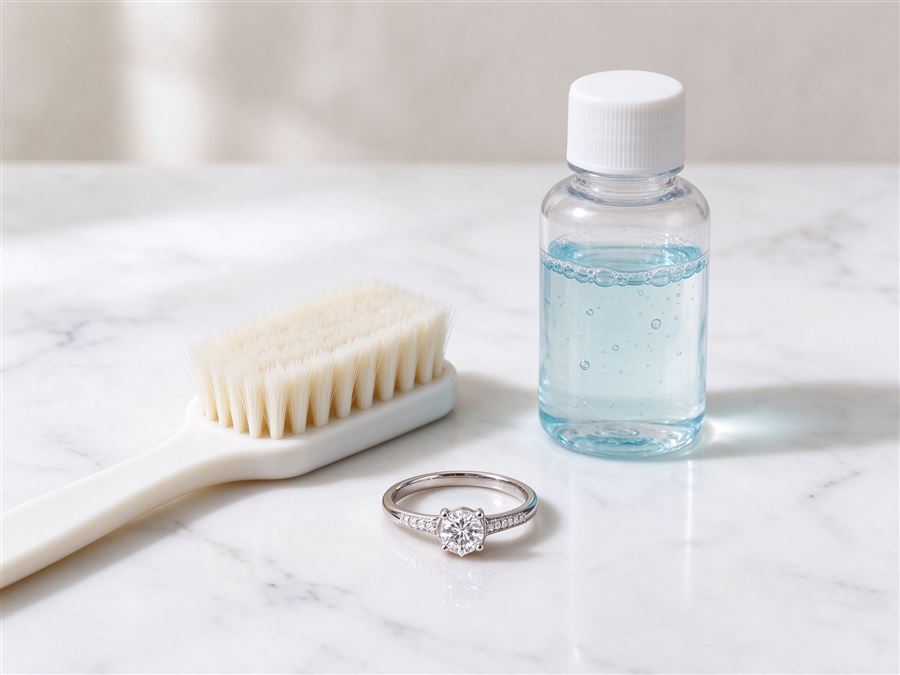
The ring came in with the center stone tipping to one side. The client assumed she needed a new ring. What she needed was a 45-minute reset. That conversation happens once a week: a woman panicking about a ring she has owned for 15 years, convinced the whole piece is ruined, when the actual problem is four worn prongs and a loose head. Restoring a ring is usually a reset, not a redesign, and the decision between the two is worth getting right before you spend the money.
The four warning signs
Wobbly stone. Tap the ring near your ear. A loose stone clicks. This is the urgent sign, because a stone that moves will eventually fall out. It is fixed by tightening the prongs, which takes 15 minutes and costs $40-80. It is not a redesign.
Worn prongs. Look at the tips under magnification. Healthy prongs are rounded and firm. Worn prongs are thin, flat, or polished to a knife edge. If one prong has worn to half its original thickness, the whole head needs rebuilding, which means lifting the stone, rebuilding the prongs, and resetting. That runs $180-350. We cover the broader repair-versus-redesign logic in repair versus redesign.
Bent or thin shank. A ring worn daily thins on the inside bottom, where it rubs against the finger and the desk. If the shank is under 1.2 mm thick, it needs a half-shank: a slice of new gold soldered inside the band. That costs $120-220 and adds years. If the shank is bent out of round, we true it on a mandrel first.
Chipped girdle or culet. Under 10x magnification, a chip on the edge of the stone is a structural risk. We may recut 5-10% off the stone to remove the chip, or move it to a setting that hides the damaged edge. This is the point where repair starts to look like redesign; we show both quotes. The difference between restoration and remake is covered in vintage restoration versus remake.
When a reset is the wrong answer
Three cases point away from a simple reset. First, the stone itself is heavily damaged or has recut to a smaller size than the setting, which means a new head. Second, the band is so thin or cracked that a half-shank will not hold; that is a rebuild. Third, the client wants a different look entirely, which is a redesign and not a repair. We tell clients this in the first inspection, because a reset quote that hides a rebuild is a bill shock three weeks later.
What a reset actually involves
We lift the stone with a prong tool, inspect the girdle and culet under magnification, photograph the damage, and quote the repair. The head is rebuilt or replaced, the stone is reset, and the ring is polished and cleaned. We check the seat under magnification before we tighten the prongs, because a stone that sits on a chip will crack later. We also re-check the seat after 48 hours, because the metal settles. The whole process is two to five working days, not weeks.
We document any treatment or repair consistent with the FTC Jewelry Guides, and we keep the before and after photos in the commission file. If the ring is a vintage piece with unknown marks, we cross-check against NGTC references and note any history we can confirm. The broader care routine is in caring for handmade jewellery.
Preventive maintenance that beats a reset
Most resets are avoidable. We recommend a prong check every 12 months, which takes five minutes and costs nothing for clients on our care plan. A ring that is checked annually never reaches the wobbly-stone stage. Ultrasonic cleaning is fine for diamonds, sapphires and rubies, but we tell clients to skip it for emeralds, pearls, opals and any fracture-filled stone; we cover that in cleaning custom jewellery at home.
FAQ
How do I know if my stone is loose?
Tap the ring gently near your ear with a small stick. A loose stone clicks. A tight stone is silent. If you hear a click, stop wearing the ring and bring it in; a loose stone falls out faster than you expect.
Does resetting damage the stone?
A skilled reset does not. We lift and reset under magnification, and we inspect the girdle before and after. Stones are chipped by dropped rings and by old settings that were filed too thin, not by a clean reset.
How much does a reset cost?
Prong tightening is $40-80. A head rebuild is $180-350. A half-shank is $120-220. A full reset into a new setting is $350-650 in labour. We quote all of it in writing before any work begins.
How often should I have my ring checked?
Once a year for a daily ring. A prong check takes five minutes and catches worn prongs before they become a lost stone. We include it free for clients on our care plan.
Heard a click, or seen a prong wearing thin? Bring the ring in for a free inspection. We will look at it under magnification in front of you, tell you whether it needs a tighten, a rebuild or a reset, and quote it in writing the same day. Trade retail partners: our repair decision tree one-pager gives your counter staff the same four warning signs we use, so you never quote a redesign where a $60 tighten will do.