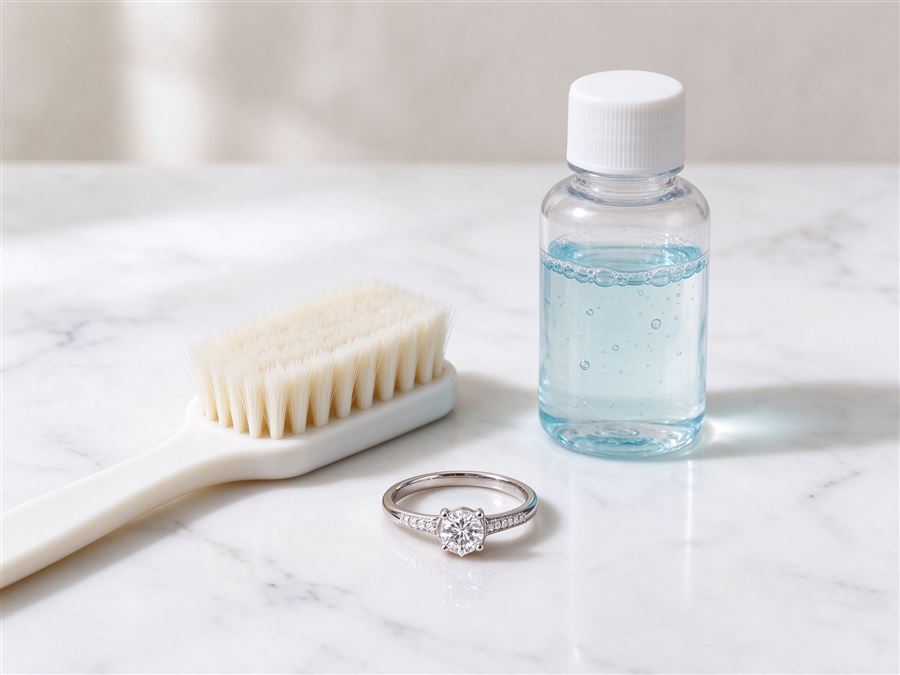
A client brought in her grandmother's engagement ring: a 1960s solitaire with a stone that rattled when she tapped the band. She assumed it needed a new setting. Under 10x magnification, the diagnosis was different: one prong was worn thin by 60 years of friction, the stone was intact, and the original basket was structurally sound. The fix was a re-tip of that one prong, not a reset. That distinction matters, because resetting a stone is a bigger intervention than most clients expect, and it is the wrong answer when a 20-minute re-tip solves the problem.
Diagnose before you reset
The first step in any restoration is a full inspection under magnification, before any tool touches the piece. We photograph the setting at 10x, note the condition of each prong, check for chips on the girdle and pavilion, and listen for movement when we tap the stone with a wooden stick. A stone that does not move, in a setting where the prongs are full, does not need a reset, even if the client thinks it does.
The conditions that genuinely call for a reset are specific. A prong broken off at the base (not re-tippable). A basket cracked through the shank. A stone that has chipped at a prong point and needs a different setting style to protect the new chip. A client who wants a different metal color or a different band width. In every other case, the repair is cheaper and the original setting survives. We walk through that decision in when to reset stones on a restoring ring and vintage jewelry restoration: repair versus remake.
Reset versus repair: when to move stones
A reset means the stone leaves the original setting entirely and is mounted in a new head. It is a bigger intervention than a re-tip, because the stone is exposed during the move and the original setting is cut away. We only recommend it when the original setting cannot be saved, or when the client explicitly wants a new design.
The most common reset commission is a client who loves her grandmother's stone but cannot wear the original ring because the style is wrong for her hand, or the band is sized for a finger three sizes off. In that case, the reset is the redesign: the stone moves into a new solitaire, a three-stone, or a pendant. We cover the ring-to-pendant path in redesigning a ring into a pendant, and the vintage setting side in restoring a vintage ring and resetting the setting.
Documentation before the work begins
Before a single tool touches an heirloom, we take three things. A clear graded photograph of the stone in the original setting, at 10x, from top and side. A weight of the original head, so we can account for the metal when we melt it or return it. And a written condition note: existing chips, worn prongs, repairs already made, and any engraving inside the band. If the stone has a GIA or IGI report, we keep it in the file; the report travels with the stone after the reset, because the stone itself is unchanged.
The reason for the documentation is that an heirloom is a legal and emotional object. If a prong was already worn before the work started, the client should know, in writing, before we are asked later whether we caused the wear. We also photograph the piece after the reset, so the client has the same record on both sides. For home care between restorations, see cleaning custom silver jewelry at home.
FAQ
How much does it cost to reset an heirloom stone?
A re-tip on one prong is $40-80. A full reset into a new solitaire head is $220-450 in labour, plus the cost of the new head. A reset into a three-stone or pendant runs $450-800, because the new setting has to be built from scratch.
Will resetting damage the stone?
Not if the stone is inspected first. The stone leaves the setting once, under magnification, and goes straight into the new basket. Existing chips are noted and protected. A stone that is already cracked is not reset; we suggest a bezel to contain it instead.
Should I keep the old setting?
Most clients choose to melt the old head into the new piece, so the new ring carries the original metal. About 20% keep the old head in a box. We return it either way, labeled, so the story stays attached to the piece.
How often should an heirloom ring be checked?
Every 12-18 months, for prong wear and stone tightness. A 60-year-old setting wears faster than a new one, because the metal has been work-hardened by decades of daily movement. We do the check free on pieces we have restored.
Have a family piece that rattles, wobbles, or just does not look like you? Book a 20-minute sitting with our restoration lead. We will inspect the piece under 10x magnification, photograph it in front of you, and give you a written diagnosis before we quote any work. We will show you the difference between a re-tip and a reset, and we will keep the documentation in your file. Trade retail partners: our white-label restoration one-pager gives your sales team the same diagnosis-first language we use with clients.