You have the date picked. The location is booked. The people who need to know, know. There is only one problem: the custom engagement ring you designed is still on the bench, and it will not be ready for another three or four weeks. This is the single most common scheduling problem couples bring to us, and the solution is neither to postpone the proposal nor to rush the design. The solution is a stand-in ring.

A stand-in ring, sometimes called a placeholder or decoy ring, is a temporary ring you use for the proposal moment itself. It is not meant to last forever. It is meant to look convincing in photographs, to feel real on her finger when you get down on one knee, and to buy you the time to design the actual ring together. Once you have proposed, you can bring her into the atelier, look at stones and settings side by side, and build a ring that reflects both of your tastes rather than a guess you made alone.
There are two ways clients usually handle this. The first is to propose with the stand-in, then design the real ring together in the following weeks. This is our favorite approach, because it turns the custom commission into a shared experience rather than a solo negotiation. The consultation, the CAD review, the first fitting, all of it becomes part of the story. If you go this route, our piece on designing rings as a couple walks through what that conversation feels like. The second approach is to design the real ring in secret, propose with the stand-in, and then reveal the finished piece a few weeks later. This works beautifully if you know her taste well and want the reveal to be a second surprise.
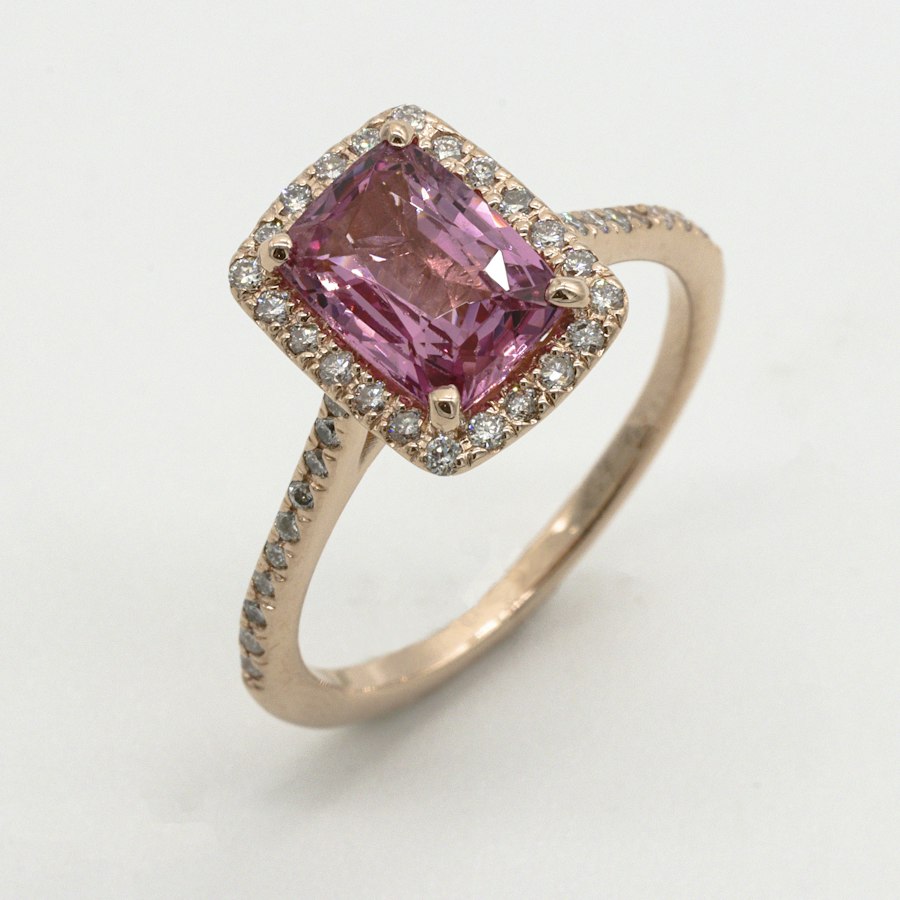
What should the stand-in ring look like? We keep this deliberately simple. A stand-in does not need to be expensive, and it should not be so ornate that the real ring has trouble living up to it. Most of our clients choose a small solitaire-style setting in a basic metal, sometimes with a small moissanite or CZ center stone that looks like a diamond in low light and in photos. The goal is plausibility, not permanence. We can make you a simple stand-in in a week or two, and it will cost a small fraction of a real commission. After the proposal it can be repurposed, kept as a memento, or melted down toward another piece later.
Size matters less than you think. A stand-in does not need to fit perfectly, because it is not going to be worn daily. If you have had to secretly estimate her ring size, a stand-in is actually the perfect pressure release valve. You have a ring to put on her finger for the question, but if the size is off by half a size, no harm is done. You will measure her properly at the first joint consultation anyway. This is one of the quiet advantages of the stand-in approach: it removes the riskiest part of a surprise proposal from the equation entirely.
Timing the handoff takes a little planning. If you are proposing in the morning, keep the stand-in on you until the moment is over and the photographs are taken. Once she says yes, you can explain that the ring on her finger is temporary and that the two of you will design the real one together. Most partners laugh when they hear this, because it tells them two things at once: that you planned a real proposal, and that you care enough about her opinion to build the ring with her rather than for her. We have seen this conversation go well dozens of times. It almost never goes poorly.
What about the budget? A stand-in is an extra line item, but a small one. Think of it as the cost of locking in a date you do not want to move. If you are working backward from a fixed proposal day, we will happily map out the timeline with you: how long the stand-in takes to make, how long the real commission takes, and what needs to be decided by when. Our article on the timeline for a custom engagement ring covers the full schedule from first sketch to finished ring, which is the document we usually hand to a nervous proposer at the end of a consultation.
The stand-in ring also solves a problem that does not get talked about enough: designing a ring for someone whose taste you cannot see. You can guess at a setting, a metal, a stone shape, and you might get it right. But if you have ever watched a partner's face light up when she sees a sapphire in person versus a photograph, you know that taste is tactile. The stand-in buys you the chance to make that decision together, in person, under the right light. That is worth more than any guess.
If your proposal date is fixed and the ring is not, give us a call. We will make you something clean and convincing, map out the real commission around it, and make sure the day feels exactly as planned.