A stone is only as secure as the metal holding it. At a bespoke atelier, setting is the moment the ring stops being a metal shape and becomes a piece of jewelry. It is also the step where cheap work and expensive work diverge most visibly. A prong set in ten minutes by a machine will look fine on day one. A prong set by hand, with the bail trimmed, the tip rounded, and the seat cut to the exact girdle thickness, will still look right in twenty years.
The choice of setting is not just aesthetic. It changes how the ring wears, how often it needs servicing, and how the light plays across the stone. We explain the broad families in ring setting types; here we want to go one level deeper into what each technique actually requires from the bench.
Prong setting
Prong setting is the most common because it exposes the most stone. The setter cuts a seat—a small groove in the metal sized to the stone's girdle—then bends each prong over the crown with a burnisher and a pusher. The prong is then trimmed to a clean tip and rounded so it does not catch fabric.
The skill is in the seat. A seat that is too deep sits the stone too low and darkens it. A seat that is too shallow leaves the stone wobbly. The best setters cut the seat slightly undersized, test the stone, and recut until it drops in with a soft click and no play. That click is what clients feel when they pick up a well-made ring.
Bezel setting
A bezel wraps a strip of metal around the stone's girdle and folds it over the crown. It is the most protective setting, because there are no prongs to catch on sweaters, hair, or gloves. It is also the most demanding. The bezel wall must be a uniform height all the way around, or the stone will sit tilted. Folding it over requires a burnisher, steady pressure, and a feel for when the metal has met the stone rather than overrunning it.
Bezels age beautifully. Over years, the metal softens where the finger rubs it, and the bezel develops a warm, worn edge that looks intentional. It is our default recommendation for clients who work with their hands, for a stone that sits on a daily ring, and for anyone who has lost a stone before.
Pavé setting
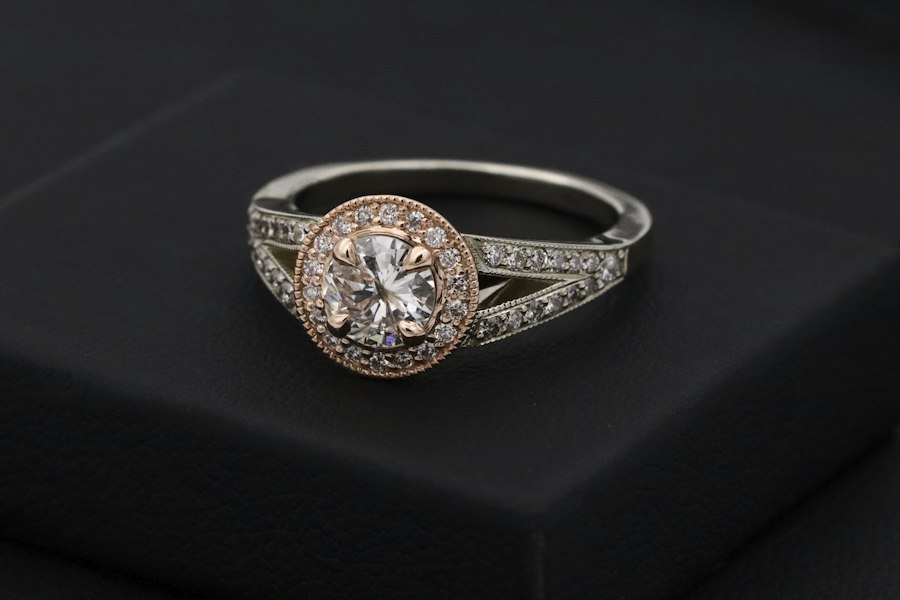
Pavé covers a surface with tiny stones held by minuscule beads of metal. The word means paved, and that is the visual: a road of small diamonds across the band. It is the most time-consuming of the three. Each small stone needs its own seat, and two tiny beads are raised and pushed over its edge. A row of ten pavé stones can take longer than setting a large center.
Pavé is delicate by nature. A pavé band needs an occasional check-up, because one loose bead can let a small stone go. We tell clients this honestly before they commission it. The look is worth it for many, but it is not the right choice for someone who wants a ring that never needs attention.
Flush and gypsy setting
A flush or gypsy setting sinks the stone into the band itself, so only the crown shows. It is the most low-profile setting there is, and it is a favorite for men's bands and for stacking rings. The cutter drills a seat into the metal, drops the stone in, and burnsishes the surrounding metal over the girdle. It is nearly impossible to catch, and it reads as part of the ring rather than something placed on top.
How often should a setting be checked?
Even the best setting loosens over years of wear, because metal flexes. We recommend a professional check every six months for a daily ring, and a full prong or bezel inspection once a year. The kind of routine we cover in when to see a jeweler is not optional maintenance. It is what keeps a hand-set stone where it belongs for decades.
Why hand-setting still matters
Machines can cut seats and bend prongs, but they cannot read how a particular stone sits in a particular head. Hand setting exists because every stone has a slightly different girdle, every metal has a slightly different feel, and every wearer wants the result to sit level and feel quiet. It is slow work. It is also the work that lasts.
After setting, the bench always does one more pass: a polish of the metal around the setting, and a careful inspection of every tip and edge under magnification. A sharp prong is not a quality problem that shows up immediately; it is the kind of thing that snags a sweater three months later. Hand finishing catches those edges before the ring leaves the studio. It is the last step of the setting process, and the one that most separates a commission from a catalog piece.