The halo ring deserves better than its reputation. When it is badly proportioned, a halo looks like a costume piece: a center stone drowning in a thick border of tiny diamonds, the whole cluster reading as one glittery blob. When it is done right, the halo reads as a soft light halo around the center stone, making it look larger and brighter without screaming "halo." The entire difference lives in three numbers - the gap, the halo stone size, and the outer head size - and all three are decided while the design is still on screen.
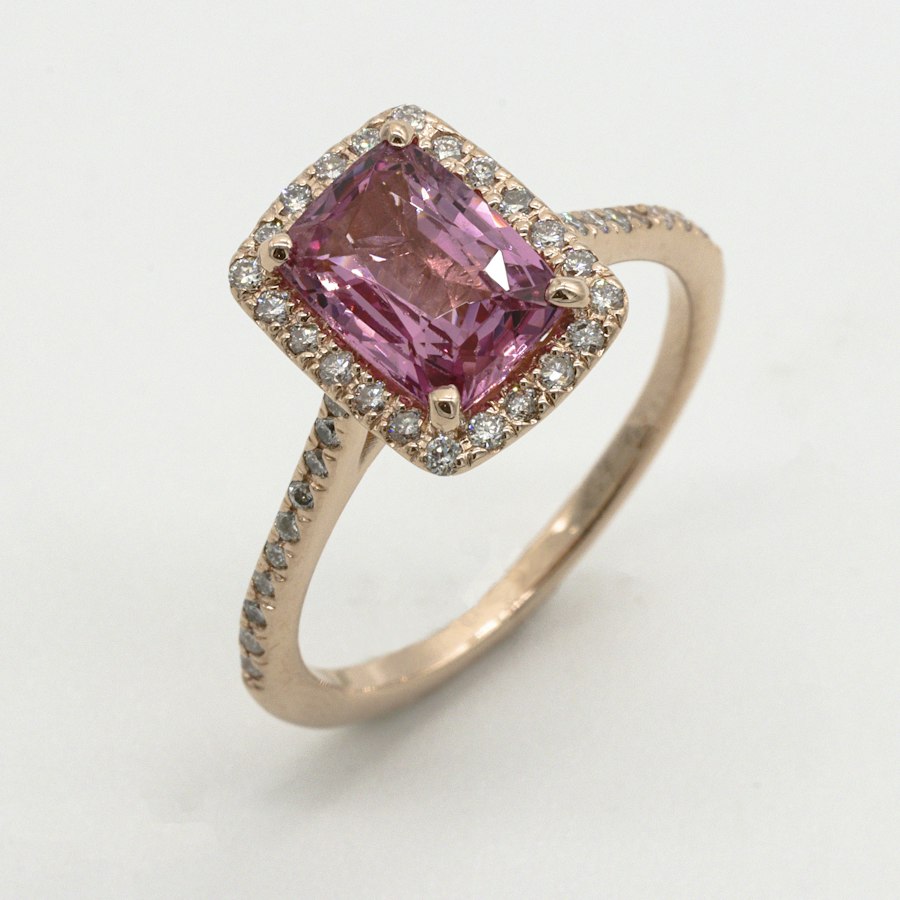
The gap is the single most important detail. It is the narrow channel of metal between the outer edge of the center stone and the inner edge of the halo stones. A halo with no gap - where the halo diamonds sit right up against the girdle of the center stone - looks crowded and fights the center for attention. A gap of roughly half a millimeter, sometimes slightly more, lets the center stone breathe. Your eye lands on the center first and only then notices the glow. On a CAD render, we draw this gap deliberately; on a mass-produced ring, it is whatever the tooling produced, which is usually too tight.
The halo stone size is the second lever. Tiny halos, built with stones under a point each, can look like a dusting of sparkle that disappears at arm's length. Halos built with stones that are too large - approaching a tenth of a carat each - start to compete with the center. The sweet spot for most engagement rings is a halo stone size that reads as a uniform glitter from across a room but does not resolve into individual diamonds when you hold the ring. That sizing is matched to the center stone: the smaller the center, the smaller the halo stones should be.
Outer head size is where the "does my stone look huge" question lives. A halo can make a one-carat center read like a carat and a half from across a room, which is usually the point. But it can also make the whole head so large that the ring no longer fits under a sleeve, no longer pairs cleanly with a wedding band, and dominates a finger. We aim for a finished head that reads as larger than the center stone but never larger than the width of the finger itself. Beyond that line, the halo stops flattering and starts performing.
Round halos are the most forgiving. They expand the visual size of a round or cushion center evenly and pair with almost any band style. Cushion halos - a square halo with rounded corners framing a cushion-cut center - are having a well-deserved moment because they echo the center stone's shape rather than fighting it. A halo that matches the outline of the center reads more elegant than a generic round halo on a square stone; the eye prefers shapes that agree. Our guide to three-stone designs deals with a related proportion problem - how accents relate to the center - and the same instinct applies: every surrounding stone should support the center, never shout over it.
Here is the practical part most buyers miss: the halo makes the head deeper. More stones means more metal underneath, which raises the center off the finger. A high halo catches on sweaters and is harder to wear at a keyboard. We keep the outer halo stones close to the center in height and build the setting low so the whole cluster sits flush. This is also why we discuss accent stone choice carefully - the halo stones need to match the center in white and brightness, or the whole cluster reads as two different materials stuck together.
A halo also changes the wedding-band conversation. A bulky halo head leaves no room for a flush-fit band, which is why we design a contoured or notched band at the same time. If you have already bought a halo ring off the shelf and now need a band that fits, that is a solvable redesign - but it is far cheaper to plan it in the first design. This is one reason our CAD revision process shows the wedding band on the hand before anything is cast. You see the stack, you approve the gap, and only then do we commit metal.
One more proportion worth knowing: the shank should narrow under the halo. A heavy, uniform band under a detailed head makes the ring look bottom-heavy. Taper the shank toward the head and the whole design lightens. These are the small drafting decisions that take a halo from "catalog" to "atelier." A halo is not a gimmick when it is drawn like this. It is a quiet way to make one stone do the work of two, and it has been for a century.