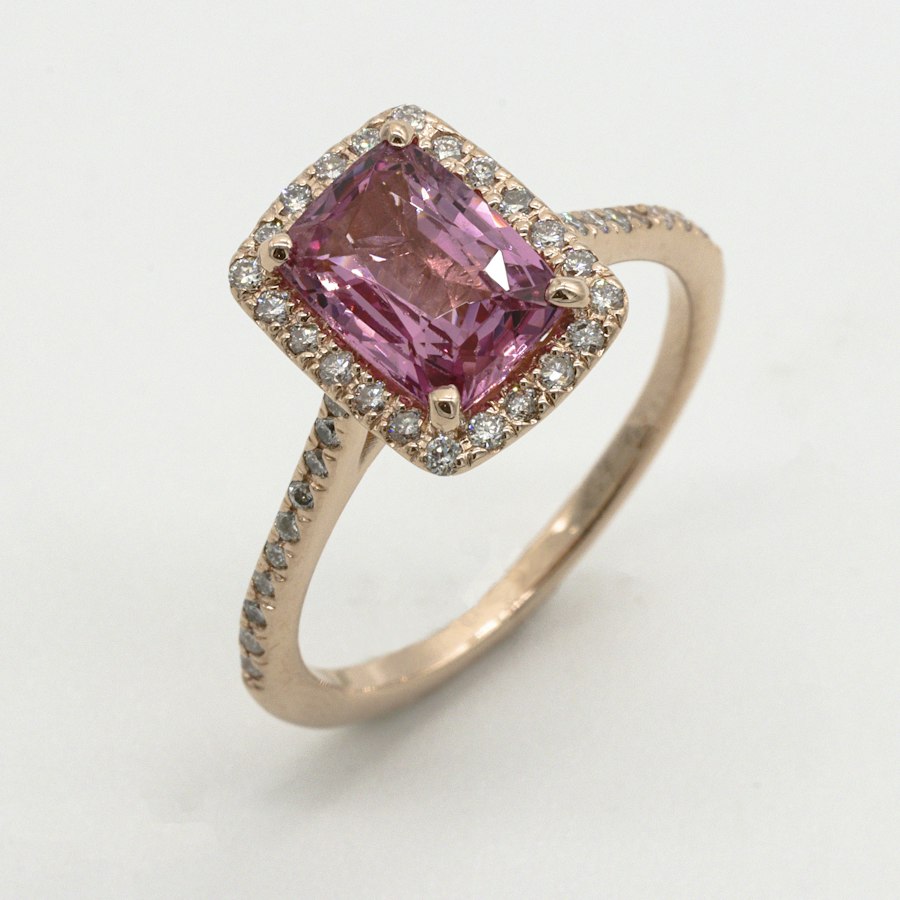
An east-west engagement ring takes the diamond you would normally set pointing up and down the finger and turns it ninety degrees, so the long axis of the stone sits across the finger instead of along it. The effect is quieter, wider, and more modern than a standard solitaire. It is the kind of ring that reads as expensive without reading as loud, and it has become one of the most requested silhouettes in our consultations over the last three years.
Why the orientation matters
Most engagement rings point the long dimension of the stone along the finger because that is how a marquise, oval, or pear is designed to sit. Pointing it east-west changes two things at once. It makes the ring sit lower and flatter against the hand, because the stone is not standing up. It also makes the finger look shorter and wider, because the stone now spans across it rather than drawing the eye up. That tradeoff is the whole decision, and it is worth being honest about.
Who it suits
East-west rings work beautifully on long, slender fingers, where the horizontal line balances the length. They are also popular with people who want a ring that does not catch on desks, steering wheels, and doorframes, because a low horizontal stone sits flush against the hand. They are a less obvious choice on shorter fingers, where the wide horizontal can make the hand feel broader, though a smaller stone and a slimmer band soften that. If you are trying to match a ring to your hand, our guide to choosing a cut for your hand shape works the same way for any stone.
Which cuts work
Not every shape turns well. Ovals, marquises, pears, and emerald cuts are the shapes that benefit from a horizontal orientation. Round stones have no long axis, so the distinction is meaningless. Cushion cuts work in a square orientation but not as well turned on their side, because the corners become awkward. The most dramatic east-west effect is on a marquise, which looks like a small beam of light across the finger. The most wearable is an oval, which is what most of our clients end up choosing. Our guide to choosing your cut shape covers the visual differences in detail.
Protecting a sideways stone
A stone set sideways is more exposed on the two points at the left and right. Those are the edges most likely to bump against things, and on a marquise or pear, they are sharp. The fix is to keep the prongs low and tight, and to choose a setting that wraps a little metal around the corners rather than relying on four thin claws. Bezel and semi-bezel settings are especially protective on east-west rings.
Pairing it with a wedding band
The flat, low profile of an east-west ring is one of its best features when it comes to stacking. Because the stone sits low, a straight wedding band can sit flush against it without a gap, which is the problem most people have with a tall solitaire. That makes east-west rings a great choice for anyone who cares about a clean wedding stack. Our guide to matching a band to your ring covers flush-fit bands in more detail.
The history behind the look
East-west settings are not as new as they feel. Art Deco jewelers in the 1920s turned emerald cuts horizontally for the same reason modern clients do: a horizontal stone sat lower on the hand and let a woman type, play piano, and work without the ring catching on anything. The silhouette fell out of favor in the 1980s, when tall, vertical solitaires were the default. It has come back because the way we use our hands has changed again. We are on laptops, steering wheels, and phone screens all day, and a low, flat ring simply gets in the way less.
How to commission one
If you are sold on the orientation, the commission itself is straightforward. You choose the stone and the cut, we design a setting that protects the left and right edges, and you approve a CAD render before any gold is cut. The render matters more on an east-west ring than on a standard one, because the way a stone sits horizontally on your finger is hard to picture from a drawing. Seeing it in 3D on a model of your hand removes the guesswork, and most clients leave the render step surprised by how much wider the finger reads than they expected.
An east-west ring is not for everyone, and that is the point. It is a choice you make because you want something that does not look like everyone else's. Set low, protected, and paired with a simple band, it is one of the most quietly contemporary pieces you can wear on your left hand.