A client once pointed at a 2.5 ct emerald in a showroom case and announced she would never take the ring off. She worked as a primary-school teacher. We gently walked her to a sapphire, because emeralds at 7.5 to 8 on the Mohs scale chip on desk edges, while sapphires at 9 survive nearly anything. The stone you fall for and the stone you wear are often two different objects. This is how we reconcile them.
Hardness decides whether the ring becomes jewellery or an ornament
The Mohs scale is the first filter, not the last. Stones below 8 (emerald, tanzanite, opal, pearl) belong on pieces that go on for evenings, not on a daily band. Stones at 9 (sapphire, ruby) and diamond at 10 are safe for hands that type, garden, and lift children. Moissanite at 9.25 sits above sapphire in hardness, and the Wikipedia entry on moissanite explains why it out-scratches most alternatives while weighing noticeably less than a diamond of the same size. If you are weighing centre stones specifically, our guide to choosing a centre stone walks through the same trade-offs.
Cut beats carat for small fingers
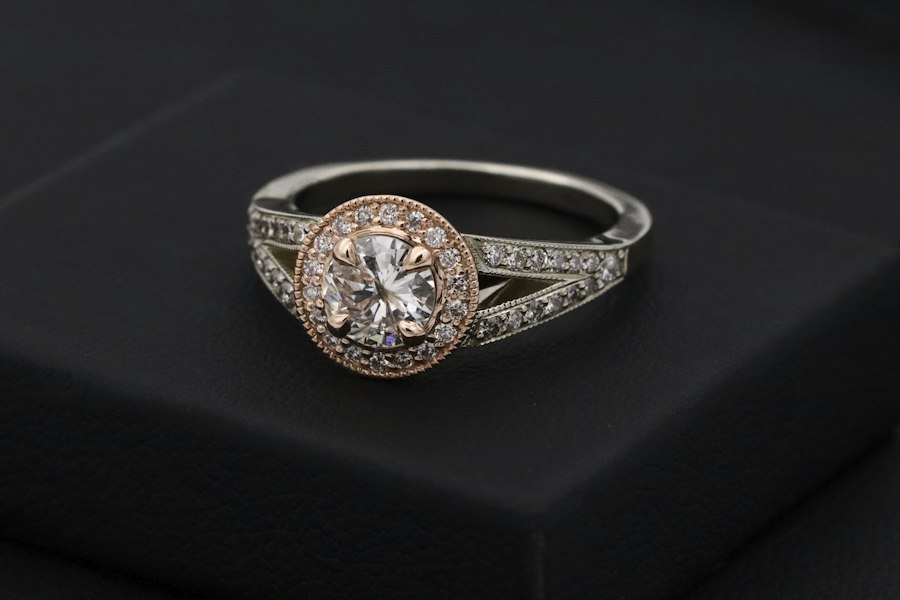
A 1 ct round on a size 6 finger looks balanced; the same carat in a long emerald cut can look like a door knocker. We match cut to finger width and setting style: ovals elongate short fingers, rounds flatter wide bands, and cushion cuts soften angular hands. The GIA explanation of the 4Cs is the reference we hand clients, but the practical filter for a bespoke commission is the ring design itself, not a certificate grade. Colour grade matters less when the band is rose gold, which warms up near-colourless stones for free.
Colour, and the wearer's wardrobe
A stone should look right next to the client's everyday watch and phone case. We pull three candidates (a white, a warm, and a coloured stone) and photograph them on the hand in natural light. The most common surprise is that the coloured stone the client thought she wanted disappears next to her yellow-gold wedding band. If you are deciding between metals alongside the stone, read our notes on rose gold versus yellow gold for custom pieces.
Treated, heated, and lab-grown disclosure
Most sapphires on the market are heat-treated; most emeralds are oiled; many diamonds sold today are lab-grown. The FTC Jewelry Guides (16 CFR Part 23) require accurate disclosure of treatments and origin, and we document every stone in the order file so the client can resell or insure honestly. Lab-grown diamonds can cut the centre-stone budget by 60 to 80 percent for the same visual size, which frees money for a more interesting setting.
Budget math for a custom ring
A realistic split for a bespoke ring is roughly 40 to 55 percent of budget on the stone, 30 percent on the metal and setting labour, and the rest on accents and finishing. A 1 ct lab-grown diamond in a 14k solitaire can land between 900 and 1,800; a natural equivalent starts around 3,000 and climbs fast. Our breakdown of how much bespoke jewelry actually costs shows where the other 60 percent goes. Wholesale clients: our loose-stone programme supplies calibrated sapphires, moissanite, and lab-grown melee in 1.3 mm to 3 mm sizes for private-label settings.
One practical check we run before finalising: the stone's culet. An open culet on an older cut leaves a tiny dark dot in the centre, which photographs as a flaw even when the eye cannot see it. Modern brilliant cuts have a closed culet and read cleaner on camera, which matters more now that clients share photos on social feeds. If you are weighing cut direction against setting style, our note on designing a one-of-a-kind engagement ring covers the same cut-to-hand logic.
FAQ
What is the most durable stone for a daily ring?
Sapphire, ruby, and moissanite all score 9 or higher on Mohs and take daily wear. Diamond at 10 is the hardest, but it can still chip if struck at the girdle.
Can I pick a stone after the ring is designed?
No. The setting is cut to the stone's exact diameter and depth. We design around the stone, not the other way around.
Are lab-grown diamonds a downgrade?
No, chemically or optically. They are a different supply route, and the FTC requires them to be labelled as lab-grown, not as natural. They are the value choice for clients who want visual size without the premium.
Do coloured stones come with certificates?
Many do, especially from Sri Lankan and Thai sources. We request a report for any stone over 1 ct, and we disclose treatments in writing regardless.
Not sure which stone suits the wearer? Book a consultation and bring the ring hand, the wardrobe, and the budget. We will photograph three candidates on the hand and quote a setting built around the chosen stone. Trade buyers: our calibrated loose-stone pack is shipped weekly with matching sizes for OEM settings.