Buying a one-of-a-kind engagement ring usually begins with a panic: the partner has tried on every solitaire in a mall store and disliked each one for a slightly different reason. The frustration is not about taste. It is that stock rings are designed for an average finger, an average knuckle, and an average lifestyle, and real hands are not average. Designing from scratch solves the fit problem, but only if you make the right decisions in the right order.
Start with the hand, not the stone
The first data point is the hand. Ring size is measured at the knuckle, because a ring that slides on over the knuckle but spins loose below it is a daily annoyance. Most re-sizing jobs after a proposal trace back to a guess taken on a cold morning or a loose fit at the wrong time of day. We measure three times, and we check whether the finger swells in summer or at altitude. Hand shape also drives setting proportion: a slim, tapered finger usually carries a lower, flatter setting without looking lost; a wider knuckle often needs a slightly raised basket so the ring does not vanish on the hand.
Lifestyle is the second filter. Hands that type, garden, or lift weights every day need a low profile and rounded prongs. A high cathedral setting that looks dramatic in a box catches on sweaters for the next ten years. If daily wear matters, keep the crown at or below 2.5 mm above the band.
Pick the center stone before the setting
The stone dictates the setting, not the other way around. A 1.5 carat round brilliant reads best in a solitaire or a slim halo; a 0.8 carat cushion cut often needs a halo or an east-west bezel to feel substantial on the hand. The GIA 4Cs establish that carat, cut, color, and clarity trade off against each other, and at custom budgets the smartest move is usually to spend on cut first. A well-cut 1.0 carat stone beats a poorly cut 1.3 carat stone in the box and on the hand.
You also choose the stone category now: mined, lab-grown, or a non-diamond such as moissanite. Lab-grown diamonds are physically and optically identical to mined stones at roughly 30 to 50 percent lower cost, which the lab-grown diamond overview on Wikipedia summarizes well. If you are weighing the options in depth, read choosing a center stone for a custom design.
Choose a setting that will not date
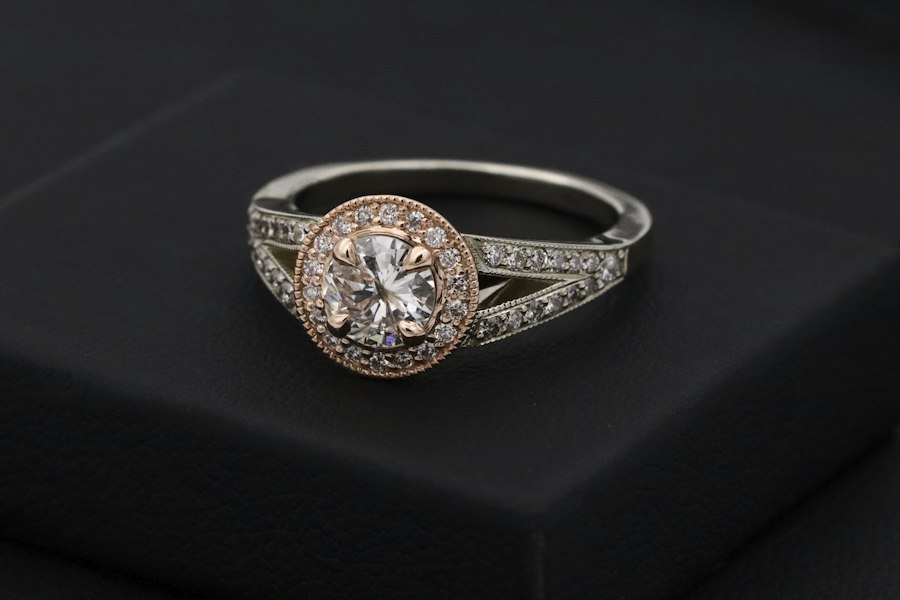
Trends age faster than marriages. A thick, 2020s-style tungsten-gray platinum shank with a floating halo may look right now and heavy later. The settings that survive decades are quiet: a six-prong solitaire, a slim bezel, a tapered pav band that is 2 mm wide, a hidden halo that adds sparkle without announcing itself. Budget-wise, setting labor on a custom solitaire runs $400 to $900 in bench time, separate from the stone.
Metal is decided here too, and it is worth comparing before committing. The visible difference between rose and yellow gold is larger than most expect; we break it down in rose gold vs yellow gold for custom pieces.
Plan ahead for the wedding band
The most overlooked custom step is the wedding band that will eventually sit next to the engagement ring. A high cathedral or a squared-off halo often leaves a gap that no straight band can close. Designing the engagement setting with a matching contour in mind, or commissioning both rings together, avoids that gap entirely. We cover this matching logic in custom wedding bands that match but do not match.
How much should a custom engagement ring cost?
Expect the stone to be 55 to 75 percent of the total. A full custom commission with a 1 carat equivalent center typically lands between $2,800 and $7,500 depending on stone type and setting complexity. See our realistic breakdown in how much does bespoke jewelry actually cost.
How far in advance should I start?
Start 6 to 8 weeks before the proposal date. If the center stone must be sourced or the band matched, add 2 weeks. A rush cast is possible but costs more and removes a revision round.
Can I keep the design a secret?
Yes. We never reference clients by name in photos, and we can hold the CAD files privately. Remote design by video is covered in working with an atelier remotely: design by video, which keeps the whole process discreet.
What if the ring does not fit after the proposal?
Most ateliers offer one complimentary first resize within 30 days. Resizing a custom solitaire is straightforward; resizing a fully pav band is not, which is another reason to measure carefully up front.
Propose with a ring that fits one hand, not a display case. Book a confidential design call and we will map your hand, budget, and story into a setting that will still look right in thirty years.