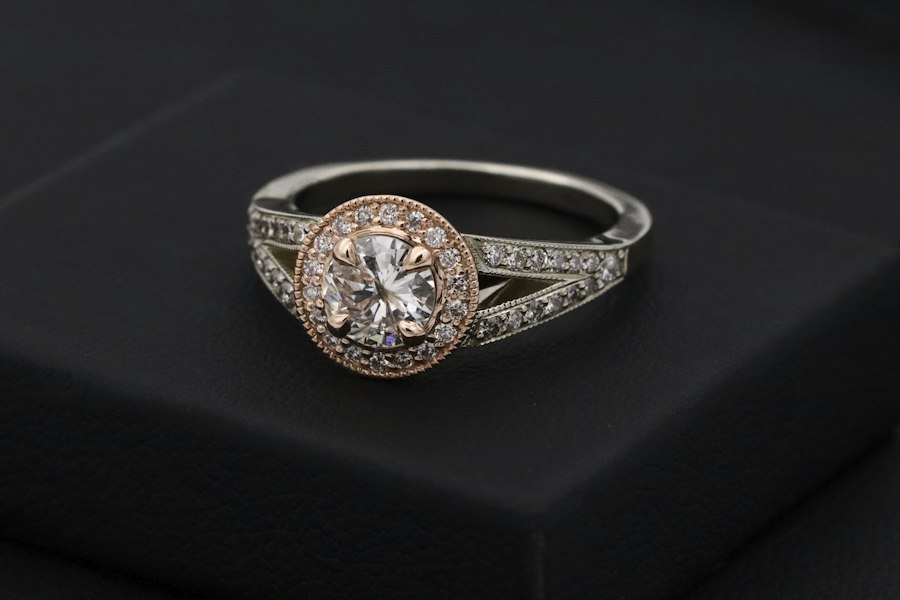
A client approved a CAD three weeks ago, then emailed us at 11 p.m. the night before casting: "Can we make the band thinner?" That request is the entire revision question in one sentence. It was a reasonable idea, it came from a real instinct, and if we had cast overnight it would have been the ring she never wanted. The bespoke process is built around these moments. The question is not whether revisions happen. The question is which ones are free, which ones bill, and how to brief them so the second version is the one you say yes to.
Where revisions are free and where they bill
Every atelier has its own policy, and ours is typical: two free CAD rounds after the first sketch, then a billed change order. The first CAD is the translation of the brief into geometry; the second CAD is where the client adjusts proportions. By the third round, we are no longer refining a design, we are restarting one, and the studio time that should have gone into casting is going into re-drawing.
The free rounds cover proportion changes: band width from 2.0 mm to 1.6 mm, stone size from 1.00 ct to 0.80 ct, head height from high to low. They do not cover direction changes that restart the project: moving from a solitaire to a halo, switching the stone shape from oval to emerald, or changing the alloy from yellow to white gold after the wax is cut. Those are new jobs, and we bill them as change orders at about $120-250 per round, depending on how much of the CAD has to be rebuilt.
The boundary between the two is the brief. A client who came in asking for an oval solitaire and decides to switch to an emerald three weeks later is not revising; she is re-commissioning. We explain this in what to expect on the bespoke timeline.
What clients actually change between CAD rounds
After ten years of commissions, the pattern is consistent. Round 1 produces the shape the client described. Round 2 is where she adjusts three things: the band width (almost always thinner), the head height (lower, so the ring sits flush with a wedding band), and the finish (polished to matte, or vice versa). About 60% of our commissions land on the second CAD. Another 25% need a small third adjustment that we usually absorb because it is a one-line change.
The remaining 15% are the real re-directions. The most common is "I want the stone bigger," which is a budget conversation, not a CAD conversation. The second most common is "I want it to look more like the first sketch," which is a reminder that the sketch and the CAD are two different languages: the sketch shows feeling, the CAD shows geometry. We walk through that translation in from hand sketch to CAD, and the casting step in CAD and wax in the commission process.
How to brief a revision so it sticks
A revision that says "make it thinner" will come back too thin. A revision that says "bring the shank from 2.0 mm to 1.6 mm, keep the head height the same, and do not change the prong count" will come back right. The difference is numbers.
We ask clients to send three things in a revision note: a measurement (width in mm, carat in ct, finish type), a reference image of what they mean, and one thing they do not want changed. The "do not change" line is the most important. It prevents the designer from re-balancing the whole ring when the client only meant to adjust one variable. The IGI grading report on the stone also stays in the file through every revision, so we do not accidentally source a different stone when the CAD changes.
For the lead-time impact, see realistic bespoke order lead times: each billed round adds about 5-7 working days, because the CAD has to be re-approved before the wax is cut.
FAQ
How many free CAD rounds do most ateliers include?
Two is the industry norm. Some include three; some include one. We build two into every commission because the second round is where the design actually lands, and cutting it saves money on paper but costs it in rework.
What happens if I want to change the stone after CAD?
If the stone has not been purchased, the change is free in the CAD but the new stone has to be sourced, which adds lead time. If the stone is already bought, the old stone goes back to the supplier on consignment and the new one is sourced; we charge a sourcing fee of about $80 plus the price difference.
Can I revise after the wax is cut?
Yes, but it is a billed change order, because the wax has to be remilled. A wax-stage revision costs about $150-300 and adds one week. We strongly recommend approving the CAD in writing before the wax, because the wax is the first physical object and the point of no cheap return.
What if I change my mind after casting?
That is a redesign, not a revision. The cast piece becomes the starting point for a new commission, and we credit the metal value toward the new piece. We discuss that decision in repair versus redesign.
Starting a commission and worried about getting the CAD right the first time? Book a 20-minute sitting with our design lead. We will walk through how to brief a revision in numbers, and we will send you our one-page revision checklist before you leave. Two CAD rounds are included in every commission; we will show you exactly where the boundary is on your project. Trade retail partners: our white-label revision-policy sheet gives your sales team the same free-versus-billed language we use with clients.