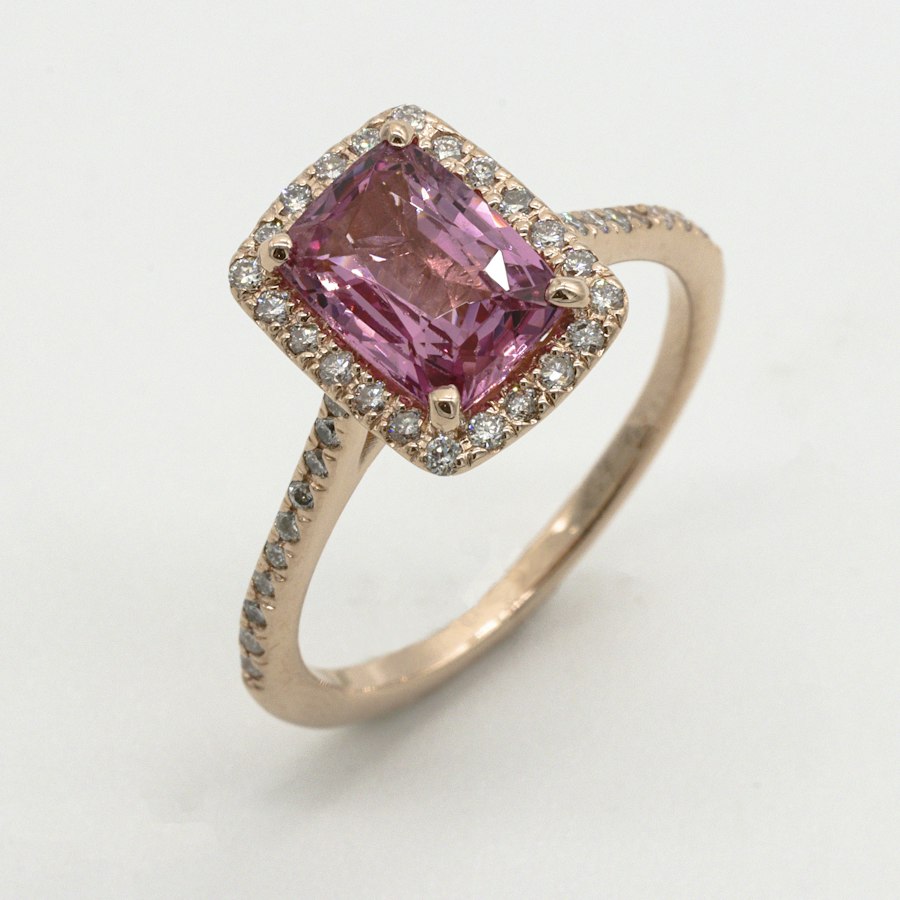
There is a reason 1920s and 1930s jewelry still photographs so well. Art Deco did not decorate; it organized. Lines fell into strict grids, stones were set in rhythmic pairs, and symmetry carried as much weight as sparkle. When clients come to us asking for something that feels "old, but not a costume," this is usually the direction they land in.
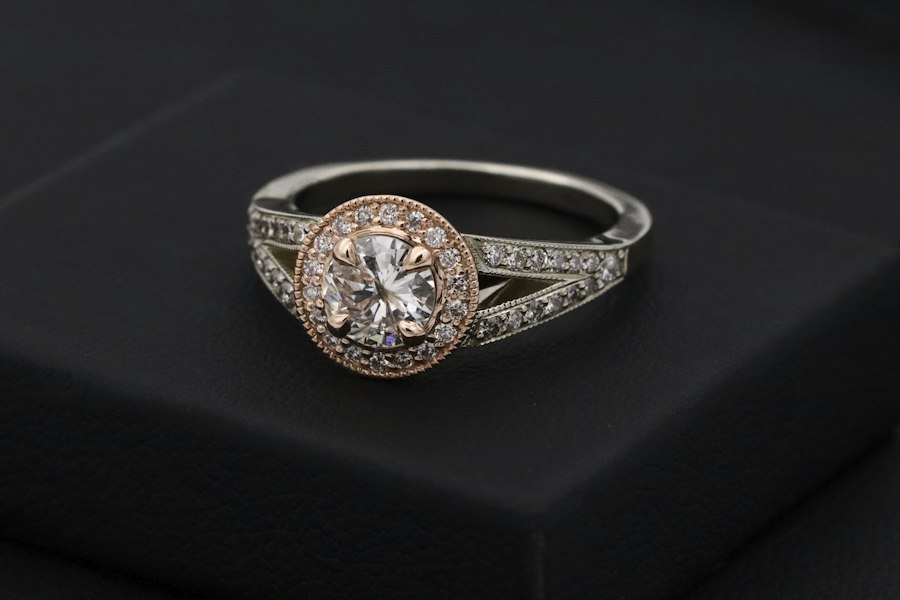
Working in a bespoke atelier gives you something a vintage dealer cannot: an original piece that borrows the grammar of the period without its wear. You get the proportion and the craft, but the metal is fresh, the stones are sourced to your standards, and the ring is built to your finger rather than the finger it was sold to in 1927.
What actually defines the look
Art Deco is easy to parody and harder to get right. The hallmarks are not "sparkly" or "ornate" in a vague sense. They are specific. Look for a strong central motif, often a step-cut stone such as an emerald or Asscher cut, set within a rectangular or octagonal frame. Side stones tend to be small calibré cuts—baguettes and tapered brilliants—lined up like soldiers rather than scattered. The shank is often slim, and the gallery underneath carries open geometric work: triangles, chevrons, sunbursts.
Milgrain, that beaded edge along the metal, is a Deco signature, but it should read as tiny beads, not a wavy line. Done by hand, it catches light along the railings of the setting and is one of the details that separates a convincing commission from a themed costume piece.
Why step cuts belong with the style
Around the turn of the last century, jewellers favored cuts that rewarded side-eye admiration rather than face-up fire. Emerald and Asscher cuts show off long, flat planes of light and a crisp outline. Set them in a square Deco frame and the geometry does half the work for you. If you prefer round brilliants, you can still build a Deco ring, but the surrounding detail—the baguette accents, the stepped shoulders, the open gallery—carries more of the historical load.
Many clients pair a colored center stone with this style. A sapphire or ruby in a Deco frame reads especially authentic, because colored stones were common in period jewelry and pair naturally with platinum's cool tone.
Modern twists that keep it wearable
Strict Deco rings were often fragile. Platinum was thin, filigree was delicate, and stones sat low and close to the hand. A modern bride who works at a keyboard, carries a toddler, or travels for work needs a setting that survives contact. Our approach keeps the silhouette faithful but builds the structure quietly: a slightly wider inner shank, prongs tucked under the stone line, and a low profile that does not catch on fabrics.
You can also soften the palette. A rose-gold shank under a white-gold Deco frame softens the austerity. Or keep it monochrome in platinum for the purest period feel. If you are still deciding between directions, our guide to engagement ring styles lays out the trade-offs before you commit.
Briefing the look the right way
Bring reference photographs—not just rings you like, but objects. A skyscraper frieze, a cigarette case, a tile pattern, a perfume bottle. Deco was a total design language, and a photo of a door handle often communicates the geometry better than ten screenshots of rings. Ask your jeweller to explain how each element will be built: is the milgrain hand-applied, cast, or etched? Are the baguettes channel-set or bead-set? Those answers tell you whether the piece will hold its detail over decades.
A note on authenticity
Platinum, the period-correct choice
The original Deco jewellers favored platinum for a reason. It is dense, strong enough to hold stones with very fine prongs, and it stays white without plating. That structural strength is what allowed the open, airy galleries that define the look—you cannot build a filigree bridge that fine in soft gold. If you want the most authentic Deco commission, platinum is the material that lets the detail survive. White gold works too, but remember that it will need periodic rhodium refreshing to keep that icy edge, whereas platinum ages into a soft satin finish on its own.
Where to spend the budget
Because Deco lives in the detail, a slightly smaller, well-cut center stone surrounded by beautifully executed baguettes often beats a larger stone in a plain setting. The craftsmanship in the gallery, the milgrain, and the matched side stones is what your eye will actually rest on over years of wear. Skimp there and the ring reads costume; invest there and it reads archival. When you plan the budget, set aside a clear line for the setting work itself, not just the center diamond.
A genuinely vintage ring carries history, but it also carries compromises: worn prongs, possibly a non-original center stone, resizing scars. A bespoke Deco commission gives you the visual vocabulary without the Archaeology. It is, in practice, the most honest way to wear the style—an homage built for the way you actually live.