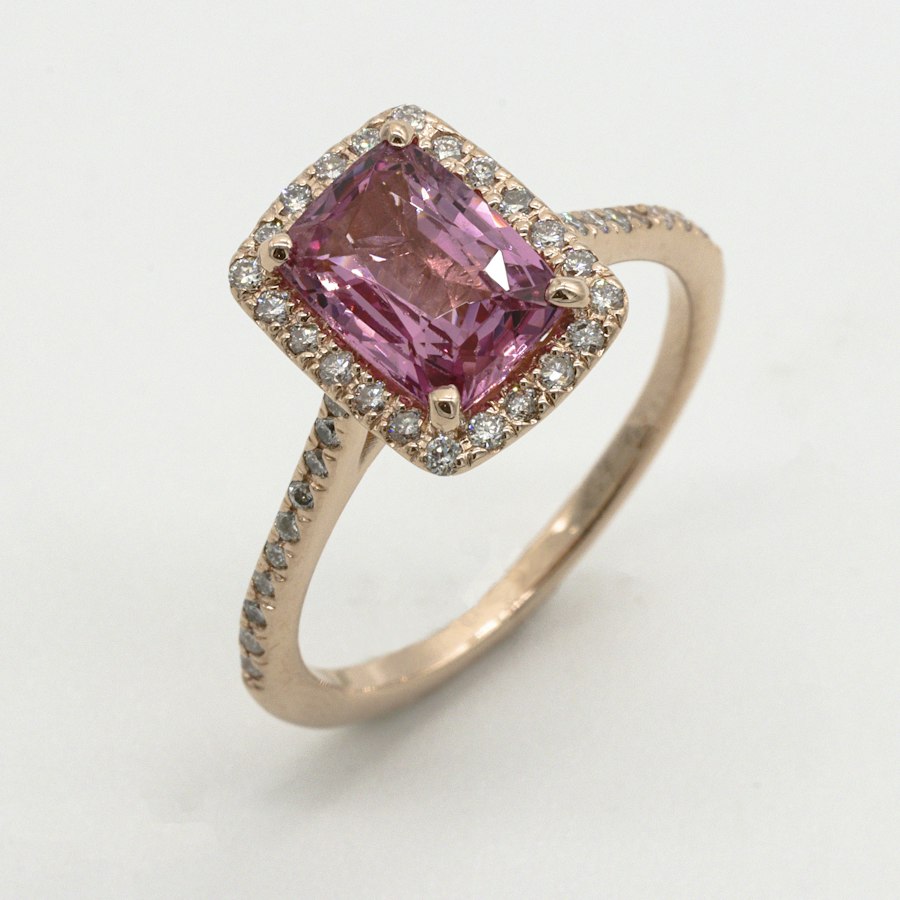
Art Deco engagement rings—inspired by the geometry of the 1920s and 1930s—have never really gone out of style. They read as architectural, graceful, and quietly glamorous: long elegant lines, open metalwork, diamond halos that sit like lace around the center stone, and bands thin enough to look almost fragile. A genuine Deco ring from the 1920s carries patina and handwork you cannot buy new, but a well-designed contemporary Deco-style ring captures the language of the period without the fragility and uncertainty of an antique. At our atelier, Deco is one of the most requested bespoke styles, and the difference between a convincing Deco ring and a costume-looking one lives in about six specific details.
The vocabulary of Art Deco jewelry
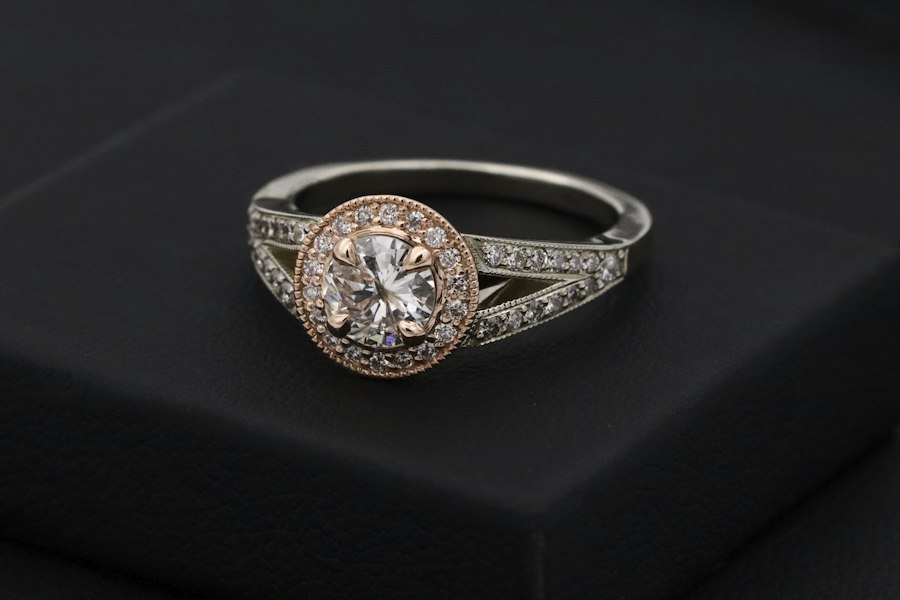
Deco design is built on symmetry and geometry. Expect step-cut stones (emerald cuts, baguettes) rather than soft ovals, because the period loved straight lines. Halos are common, but they are tight and rectangular or hexagonal, not round and fluffy. Side stones are often baguettes channel-set in straight bars, or calibre—custom-cut trapezoid and emerald-cut sapphires fitted like tiles around the center piece. The metalwork under the stone is open: you can see through the gallery to the finger beneath, which is what gives Deco rings their lightness.
Two details separate authentic-looking Deco from a cheap imitation. Milgrain—a beaded, rippled edge along the metal borders—is applied by hand with a roller and reads like a row of tiny pearls. Filigree under the gallery, where thin wires form scrolls and fans, adds the lace-like intricacy the period is known for. Without these, a Deco-style ring looks like a plain modern band with a halo; with them, it reads as the real thing.
Which center stone suits a Deco setting
Step-cut diamonds and colored step-cut stones are the natural partners. An emerald-cut center in a rectangular halo is the most classic Deco combination. Asscher cuts, with their deep stepped facets, are equally period-correct. We also love oval and pear centers in Deco settings, as long as the surrounding geometry stays angular rather than curvy. For colored stones, a deep blue sapphire in a white-gold or platinum setting with diamond baguettes on either side is the most Deco object we can think of. If you are still choosing a stone, our guide to choosing a center stone will help you weigh cut, color, and budget.
Platinum, white gold, and the metal choice
Original Deco rings were almost always platinum, because it could be drawn into the fine wires and prongs the style demands. Contemporary bespoke Deco rings can be made in platinum for that authenticity and durability, or in 18k white gold for a more accessible price. Rose and yellow gold Deco rings exist too, but they read more 1930s Hollywood than 1920s modernist. The metal choice shifts the mood; we will show you both on hand at the fitting. Read more in choosing the right metal for a custom ring.
Why bespoke beats buying an antique
Genuine Deco rings are fragile by modern standards: thin shanks, worn prongs, stones that have been reset several times. A bespoke Deco-style ring gives you the look with a shank built to modern durability, prongs that will not snag on sweaters, and a stone chosen to your own quality and budget. You also get the size and fit you actually need—resizing an antique Deco band can destroy its symmetry. If the antique route still appeals, our piece on vintage-inspired vs genuine antique rings lays out the trade-offs honestly.
Timing and budget
Because Deco settings involve hand-applied milgrain, filigree, and often custom-cut calibre side stones, they sit at the upper end of bespoke pricing and usually take eight to twelve weeks. The intricacy that makes them beautiful is also what takes time. We will show you a CAD and then a wax proof so you can see the geometry before the stone is set, and we will walk the design back and forth with you until the lines feel right.
One practical note: Deco settings can sit high off the finger because the open gallery needs room to show its filigree. That looks beautiful, but a tall setting catches on sweaters and hair, and it can feel delicate on a hand that works. We lower the center stone on bespoke Deco rings without losing the open-metalwork look, so the ring wears as comfortably as a modern solitaire while reading as period from across the room. Bring your everyday rings to the fitting; we will match the height to how you actually move, rather than to how the style looks in a photograph.
A well-made Deco ring is not "vintage-looking"—it is a contemporary ring built in a language the 1920s would recognize. Get the geometry, the milgrain, and the open gallery right, and the piece will carry the quiet glamour of that era for the next hundred years.