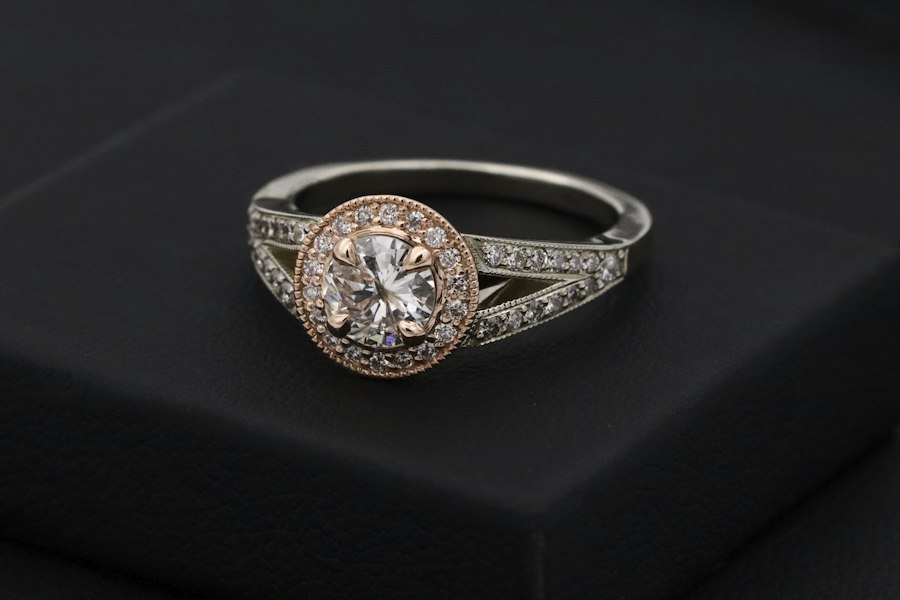
About a year after a client picks up a white gold engagement ring, we get an email. It is usually polite and slightly worried. The ring, they explain, seems to be turning yellow at the edges. Did something happen to it? Did the jeweler use the wrong metal? The answer is almost always no. What they are seeing is not a defect. It is the rhodium plating wearing off, and it is the expected lifecycle of white gold.
The first thing to understand is that white gold is not naturally white. Gold itself is yellow. To make a white alloy, jewelers mix gold with paler metals such as nickel, silver or palladium. The resulting alloy is technically pale, but in person it reads as a grayish, slightly warm tone rather than the bright silver-white people expect. To get that crisp, cool look seen in jewelry stores, the piece is electroplated with rhodium, a member of the platinum family that is extremely bright and extremely thin. The plating is measured in microns. It is closer to a coat of paint than to a layer of metal.
That is why it wears. Every time you wash your hands, type, carry groceries, shake someone's hand or rest your ring on a desk, the high points of the band rub against something. The inside of the shank, the top edge where the ring turns, and the edges of the prongs wear fastest. Over months, the rhodium there thins and the warmer underlying alloy starts to show through. It looks like the ring is changing color, but really the top layer is just moving.
The typical timeline is twelve to twenty-four months for a ring worn daily, and it varies a lot by person. People who work with their hands, garden, cook, or use heavy hand cream on a daily basis often see the first warm tones at six to nine months. People who wear the ring less often, or who take it off to wash dishes, can go two years or longer. Soap and lotion do not chemically attack rhodium, but they leave a film that makes the wear feel dull, which clients often confuse with the plating going bad. A professional clean solves that for a few weeks. A re-plating solves it for a year.
The refinishing process itself is straightforward and fast. The ring is cleaned, inspected for loose stones, lightly polished if needed, and then electroplated in a rhodium bath. Most ateliers can turn it around in a day or two. The cost is modest, especially compared with the original commission. We recommend clients combine it with their annual inspection, because the bench will check prongs, check the shank thickness and look for thinning at the same time. A re-plating alone does not fix a worn shank, and a worn shank should be repaired before it is replated so the new finish covers the repaired area cleanly.
There are a few things that shorten plating life, and most of them are avoidable. Chlorine in pools and hot tubs can pit the underlying nickel alloy in some white gold formulas, which creates rough spots that wear plating faster. Abrasive cleaners, toothpaste on a brush, and ultrasonic machines used at home can also speed wear. Perfume and hairspray are less of a problem than people think, but spraying them while wearing the ring is a habit worth dropping. Taking the ring off for heavy handwork is the single biggest thing that extends the plating life.
If the maintenance cycle is starting to sound tedious, there are alternatives. Platinum is the obvious one. It is naturally white, dense and does not need plating. It develops a soft patina over time rather than a yellow cast, and it wears more slowly because it is denser. The trade-off is cost at the outset, and a slightly heavier feel on the hand. Palladium-based white gold is another option; it is naturally a little whiter than nickel white gold, so the plating wears more gracefully and the warm undertone shows up less. Yellow gold and rose gold sidestep the issue entirely because their color is the metal itself, not a coating.
We are honest with clients at the consultation stage about which path they are choosing. A white gold ring is a commitment to a refresh every year or two, and that is fine. It is just a part of owning the piece, the same way a leather bag needs conditioning. A lot of clients prefer that to the higher upfront cost of platinum. Others, once they understand the plating cycle, switch to platinum for the wedding band and keep white gold for the engagement ring, which is a sensible middle ground.
The point worth remembering is that a ring showing its warm undertones is not damaged. It is telling you it is time for its annual refresh. That conversation, done at a trusted bench, is also the moment to catch a loose prong or a thin shank before it becomes a lost stone. The yellow edge is a reminder, not a warning.
For the bigger decision, read our breakdown of platinum versus 14k versus 18k gold, and book the refresh alongside our annual jewelry maintenance checklist so the plating and the inspection happen in one visit.