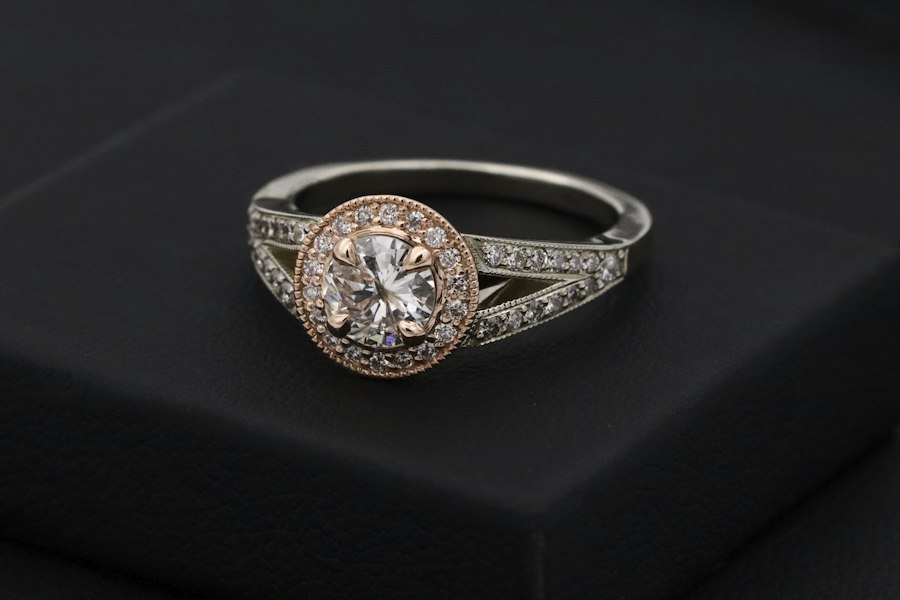
There is a specific kind of ring we see across the bench. It belonged to a grandmother. It sat in a box in a drawer. The owner brings it in wrapped in tissue and says some version of, I never wear it because I am afraid I will break it. We understand the fear. The ring has one living owner, and if it breaks, that is it. But there is a quieter cost that no one mentions: a ring that never leaves the drawer is a story that never gets told. The question is not really whether to wear it. It is whether you have done the work that makes wearing it safe.
The work starts with a structural audit. Before an heirloom ring goes back on a hand, it should be looked at under magnification by a jeweler who will be honest. What we are checking is the prong condition on every stone, the thickness of the shank, the security of any old soldered repairs, and the integrity of the setting itself. Antique rings are often held together by prongs that have softened over decades, by shanks worn thin from years of wear, and by repairs from the 1950s that are themselves old. A ring that looks fine from across the table can have a diamond held by two bent-over prongs rather than four. The audit is a small cost compared with the piece, and it is the reason people come home with their stone rather than without it.
Resizing is the riskiest step, and it is where well-meaning owners get themselves into trouble. An antique ring with a thin shank cannot be sized up by a half size the way a modern ring can, because stretching or adding metal to a fragile band can crack it. We often widen the shank, add a liner, or rebuild the base of the band before we resize, which adds cost but protects the piece. The rule we use is: if the ring needs to move more than a full size, talk to us about a redesign rather than a stretch. A ring that is too tight is also a safety issue, because taking it off in an emergency is harder than it should be.
The setting profile changes what daily wear looks like. A low-profile bezel-set ring from the 1920s is built to be worn every day. It was designed that way, and it will hold up beautifully. A tall, delicate prong-set piece from the same era is more vulnerable. It catches on sweaters, it taps desks, and the prongs take more of the impact. That does not mean you cannot wear it. It means you should know which hand you put it on. We usually suggest heirloom rings go on the less dominant hand, and come off for gym, gardening, heavy cooking and travel. A low-profile piece can live on the hand. A tall one can live on the hand at work, but not at the gym.
Insurance and documentation are non-negotiable. A family piece does not have a modern appraisal, and its sentimental value is not the same as its replacement value. We recommend a written appraisal from a gemologist, photographs from multiple angles, and a scheduled personal-property rider on a homeowner's or renter's policy. Heirlooms are often underinsured by a factor of ten, because no one updates the paperwork when the stone and the metal are worth more than they were in 1965. The cost of the rider is small. The cost of discovering you were underinsured after a loss is not.
Cleaning an older piece is different from cleaning a new one. Old prongs flex more. Old glue, where a past repair was done, may be present. Home ultrasonic machines, which are fine on a modern solitaire, can shake loose a stone that has been hanging on for decades. We recommend warm water, mild dish soap and a very soft brush for heirlooms, and a professional clean once a year at the bench where someone is looking at the prongs while they clean. That annual visit is the same visit where we will catch a thin shank before it splits.
There is a version of this conversation where the right answer is to save the ring. If it is a very rare museum-quality piece, if the stones are irreplaceable, or if the owner simply does not feel emotionally ready, keeping it in a safe is a legitimate choice. We respect that. But most of the heirloom rings we see are not museum pieces. They are well-loved rings made of durable gold and durable stones, and the people who inherit them are usually the first person in the family to actually wear them in a generation.
The inheritance math is worth saying out loud. A ring worn daily by its current owner for forty years then passed on to the next generation has two generations of wear and a hundred conversations attached to it. A ring kept in a box for eighty years has no one who remembers it on a hand. The next owner inherits a mystery. The choice between those two is, in the end, the point of the piece.
Before you start wearing it, book the audit our guide on heirloom ring repair and restoration describes, and read what we tell clients about resizing a ring before daily wear. The audit is the part that lets you wear it without the fear.