When clients come to us to reset a family center stone, they usually have one goal in mind: get the big diamond into a new setting. That makes sense. The center stone is the star. But the small stones flanking it, the ones tucked into the shoulders of the old ring, are often treated as an afterthought. They are small, a little chipped, sometimes cloudy. Most clients assume they are worthless and either leave them with the old mounting or throw the mounting away. That is almost always a mistake. The side stones are where a redesign gets interesting.
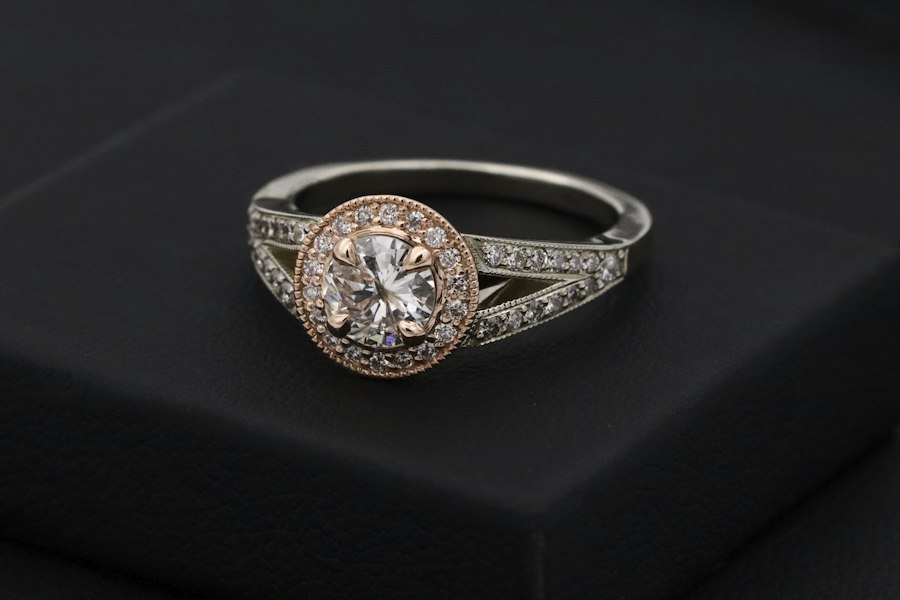
A typical three-stone or diamond-accented mounting contains two, four, six, or more small diamonds, usually between 0.05 and 0.20 carats each. Individually, they are not dramatic. Together, they are enough material to build an entirely separate piece of jewelry: a pair of studs, a petite pendant, a band of its own. Clients who reset only the center stone and discard the side stones are essentially throwing away half the redesign opportunity. We routinely encourage people to think of an old ring as a small mine rather than a single object.
What happens when the side stones come out
We remove each stone under magnification and inspect it for chips, abrasion, and durability. Some small diamonds are in good enough shape to reuse directly. Others have been worn on the culet or along the girdle and would benefit from a quick polish or a slight recut. A few are too damaged to reuse, and we say so honestly. We weigh whatever survives and calculate the total carat weight, which tells us what kind of new piece the material can support. Two well-matched stones become studs. Four stones become a narrow band or a pendant halo. Six or more become a full eternity or half-eternity band.
This is a different exercise from resetting the center stone into a new ring, and we usually plan both projects together. The center stone goes one direction; the side stones go another; the leftover gold gets melted or traded. The result is often two pieces where there was one, which is a remarkably efficient way to honor a family ring. We recently worked with a client whose grandmother's ring became an engagement ring for her hand and a small pair of stud earrings she wore to the wedding.
Design choices for the second piece
Because the side stones are small, the design has to be honest about that. Trying to make a dramatic halo ring out of 0.6 total carat will look thin. A pair of modest studs, by contrast, will look elegant and wearable. A slim band with stones every few millimeters will look intentional. We also think about who the second piece is for. Sometimes the client keeps both. Sometimes the studs become a gift for a daughter, a sister, or a bride. The redesign stops being about one ring and starts being about how a family's jewelry distributes itself across generations. Our note on recreating an heirloom from a photo is part of the same way of thinking: the goal is to keep the material alive, not to preserve the exact object.
Clients sometimes worry that reusing old, small stones means the new piece will look dated or old. It does not. A small diamond is a small diamond; the design of the setting determines whether it reads as vintage or modern. We set reused side stones in clean, contemporary mountings — plain bezel settings, simple prong clusters, slim channel bands — so the material feels current. The age of the stones adds a softness and depth to the light that brand-new small diamonds often lack, and clients frequently tell us the result looks richer than a piece built from new stones of the same total weight.
We also keep a small portion of the original mounting for sentimental reasons. A sliver of the old band, engraved with the original date, can be set inside the new piece as a secret detail. It is invisible when the jewelry is worn, but the owner knows it is there. This is the same instinct that drives hidden engravings and secret details, and it works particularly well on a redesign project where the original piece means more than the new one.
The economics
Reusing existing stones is one of the most cost-effective ways to commission custom jewelry. You are not paying for new diamond material; you are paying for design, setting, and metal. The side stones you might have thrown away are, in effect, free material for a second piece. Most clients are astonished at how much jewelry emerges from an old mounting they had written off. The next time you consider resetting a family ring, ask about the small stones. They are usually the best part.