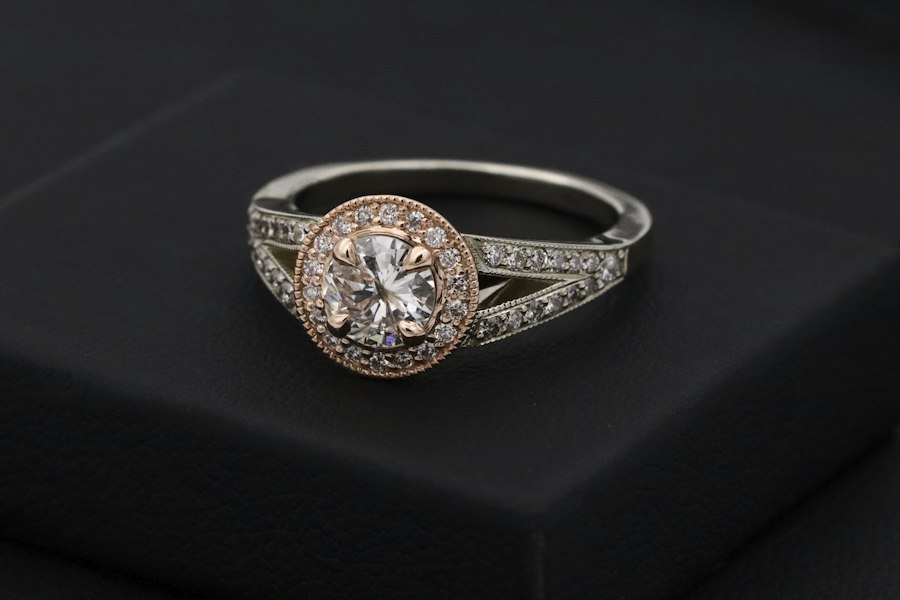
Most of the heirloom commissions we see involve diamonds. A grandmother's engagement diamond, a great-aunt's solitaire, a stone pulled from a broken chain. But a growing number of clients come in with something trickier: an old colored stone. A deep blue sapphire from 1962. A ruby from a 1970s cocktail ring. An emerald that has been sitting in a drawer since it came out of a brooch. Resetting these stones is not the same as resetting a family diamond, and treating it as if it were is how beautiful old stones get damaged. Here is what changes when the center stone is colored.
The first difference is condition. Colored stones in older jewelry were often cut differently than modern stones, and they may carry damage that diamonds do not. An emerald, for example, is commonly oiled to fill surface-reaching fractures, and that oil dries out over decades. A sapphire may have a chip along the girdle from decades of bumps. A ruby may have a loose pavilion because the old prongs have worn thin. Before we design anything, we examine the stone under magnification, check the edges, and look for signs of prior repairs. We have an entire article on heirloom ring repair and restoration, and that process almost always comes before the reset.
The second difference is setting geometry. Diamonds are the hardest natural material, so they can sit in relatively open prong settings and tolerate a low, open profile. Colored stones are softer and more brittle, even when they score high on the Mohs scale. A sapphire at 9 is hard, but it can still chip if struck sharply on the edge. The right setting for a colored heirloom is usually more protective: a bezel or half-bezel around the girdle, slightly heavier prongs, and a lower profile so the stone sits closer to the finger. This is one reason a bespoke reset is worth the investment: we tailor the metal to the stone, rather than dropping the stone into a generic mount. Our guide to setting types goes through the trade-offs of each.
The third difference is heat. Some colored stones, particularly emeralds and certain sapphires, should not be exposed to the heat of torch work near the stone. This means we cannot do repairs on the mounting with the stone in place. The stone has to be removed first, the setting repaired or rebuilt, and the stone re-set cold. This adds a step to the process, but it is the step that prevents thermal shock. We will tell you up front if your stone requires this, and we will document the condition before and after. If you have read our piece on resetting a family diamond, you will notice that this heat conversation is almost never part of a diamond reset, which is exactly the difference.
The fourth difference is cleaning. Colored heirlooms often should not go into an ultrasonic cleaner, especially emeralds, which can absorb the cleaning solution through their fractures. We clean old colored stones by hand, with a soft brush and mild soapy water, and we avoid steam unless we have confirmed the stone's treatment history. This is also why we ask about treatment: if a stone is unheated and untreated, we handle it with even more caution, because it may be more valuable in its original state than in a newly cut one. Our broader note on ethical sourcing touches on why treatment history matters for both value and care.
The design conversation itself is the same, and it is the best part. Once we know the stone's condition, we can build around it. Often the new setting is simpler than the old one, because the stone is doing the visual work. A 1960s sapphire cocktail ring, for example, often had a lot of surrounding detail that competes with the stone. Reset into a clean platinum solitaire, that sapphire finally reads as what it is: a beautiful, velvety blue with fifty years of family history inside it. We have done versions of this for clients who wanted an engagement ring with meaning, and for clients who simply wanted to wear a stone they had only ever seen in a jewelry box. Our article on redesigning a family heirloom into an engagement ring covers that specific path.
A note on value. Resetting an old colored stone does not change the stone, but it can change how the piece is insured. We will give you a written description of the stone and the new setting, which you can hand to your insurer. If you have not yet insured the piece, our guide to insuring a bespoke engagement ring walks through the process, and the same logic applies to an heirloom reset.
If you have a colored stone sitting in a drawer, bring it in. The worst that happens is we tell you it needs a small repair before it can be reset, and we show you what that would look like. The best that happens is a stone you have only ever seen in photographs becomes something you wear every day. Either way, you leave with a clear plan.