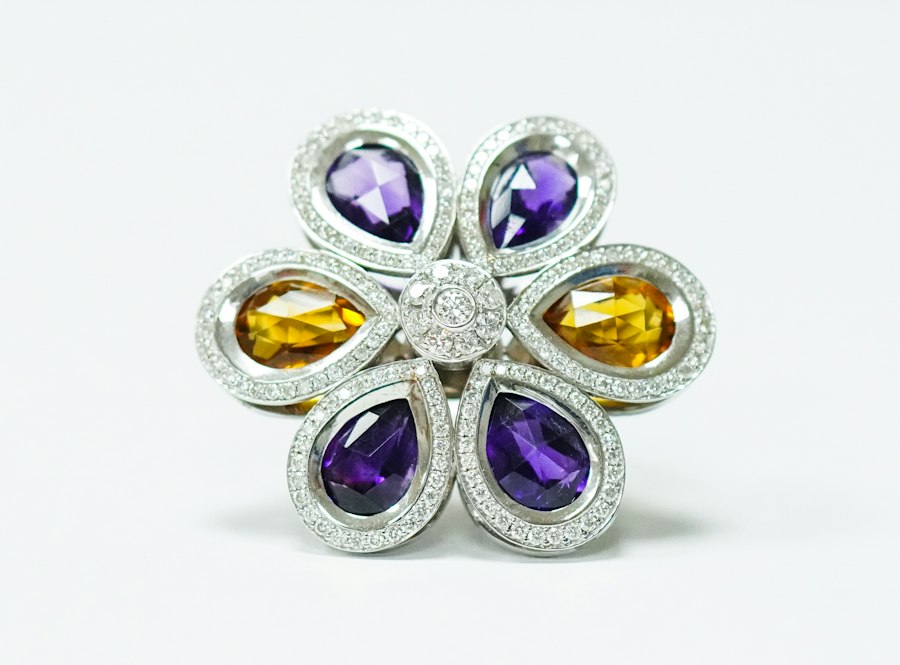
If you open a typical family jewelry box, you will find rings that no longer fit, earrings that lost their mate, and at least one brooch that no one has pinned to anything in forty years. Brooches are the most orphaned piece in American heirloom jewelry. Lapels narrowed, blouses lost their fabric, and the brooch ended up in a velvet compartment where it is slowly forgotten. Converting one into a pendant is the single most common brooch redesign we take on, and it is almost always the right call.

The first question is whether the brooch was built to hang. Most old brooches were designed to lie flat against fabric, which means the stones are set on a thin plate and the back is covered by the pin mechanism. When you hang that on a chain, two problems appear. The piece flips around so the decorated front is hidden against the chest, and the weight pulls on the thin plate, which can bend over time. The fix is not complicated, but it has to be done at the bench, not at the jeweler's counter.
Removing the pin back is the first step. The hinge and the catch are unsoldered or carefully cut away, and the back plate is cleaned up. We do not throw those parts away, because the gold and silver from them often goes back into building the new bail or the frame around the pendant, which lowers the additional metal cost. Once the pin mechanism is gone, we inspect every stone. Brooches that have sat in a box for decades frequently have loose prongs, because the pin mechanism used to cover the back and hide the condition. A stone that looks secure from the front can be hanging on two of four prongs.
The bail is the part that decides how the pendant wears. A fixed bail soldered to the top of the brooch keeps the piece upright and faces forward, which is what most clients want. A hinged bail lets the pendant swing flat against the chest, which works better for very heavy or irregularly shaped brooches. We almost always recommend a slightly larger bail than the client pictures, because a chain that is too thick will not pass through and a bail that is too small looks cramped on a detailed piece. The bail width should match the heaviness of the design.
Some brooches are asymmetrical or top-heavy, which means they will want to tip on the chain. The fix is to place the bail slightly off-center toward the heavier side, or to add a small counterweight at the bottom. This is the kind of adjustment that separates a clean conversion from one that looks homemade. We test the hang on a stand before we deliver, because you cannot tell from a drawing whether a piece wants to flip.
A choice clients face is whether to keep the brooch convertible. We can build a bail that screws or clips on, so the same piece can be pinned back on a lapel for a formal event. That is a lovely option if the brooch has sentimental value and the owner occasionally wears blazers or coats. It adds a little cost and a little width to the back, but it preserves both uses. Most clients, once they wear the pendant for a few months, tell us they never pin it again, but it is nice to have the option.
The frame around the brooch is the next decision. Many older brooches have exposed edges that were never meant to be seen in profile, because they were hidden against clothing. Hanging them on a chain puts that edge on display. We often add a thin bezel or a decorative wire rim to clean up the outline, especially on flower-shaped or circular brooches. This is a small change that makes the piece look intentional as a pendant rather than a brooch on a string.
Pairing it with a chain is the last step. A family gold brooch usually wants a chain in the same color and a thickness that matches. A dainty 1.0 mm chain against a heavy Victorian brooch looks fragile. A 2.0 mm chain against a delicate Edwardian pin looks overpowering. Eighteen inches is the default, but if the brooch has a focal point like a central stone, we often drop the chain to twenty inches so the stone lands at the sternum where it catches light. Layered looks work too, but a converted brooch is usually the heaviest piece in a stack and should sit lowest.
Cost varies with what the brooch needs. A clean pin removal, a new bail and a light polish often lands in a modest range. Resetting loose stones, adding a frame or rebuilding a bent back plate pushes it up. The timeline is usually two to four weeks, depending on how much stone work surfaces once the pin back comes off. We photograph the piece at every stage so clients can see what we found.
The emotional payoff is the part clients do not expect. A brooch in a drawer is a memory you cannot touch. A pendant at the collarbone is a memory you wear every day, and the people around you start asking about it. That is the point of a redesign: not to make the old piece new, but to put it back into circulation.
If a ring is next in the jewelry box, see how we approach turning an old ring into a pendant, and read what to expect when recreating an heirloom from a photograph instead of the piece itself.