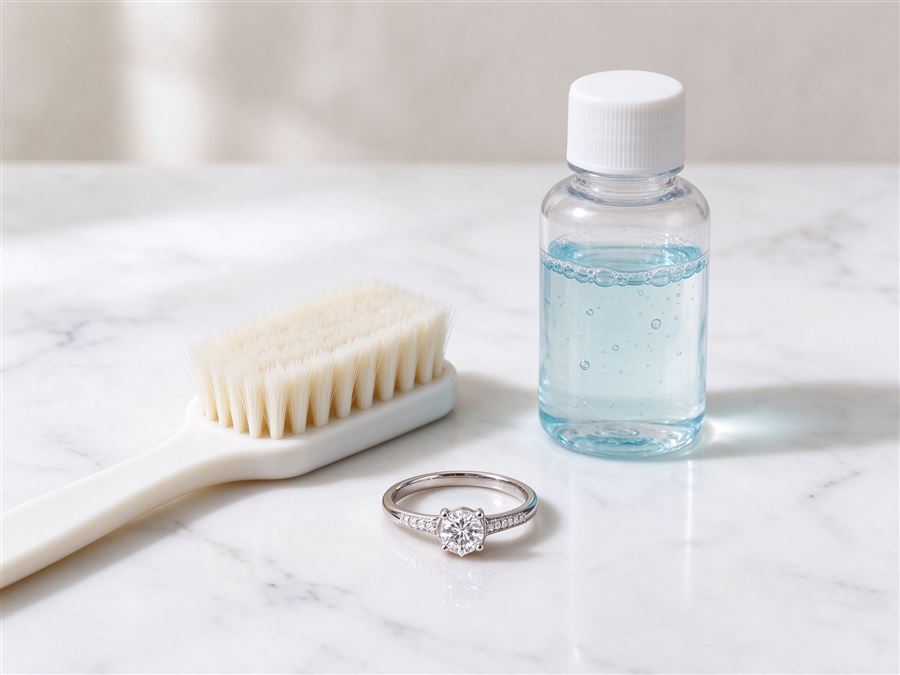
A customer brought in a solitaire last month and said, "I think one of the prongs looks a little low." Under a 10x loupe, all six were. The front-left prong was worn to a feather edge, thin enough to flex when touched. Another year of wear and the stone would have been on the floor of her car. This is the moment to re-tip. Most clients do not notice until the stone is loose, but the warning signs are visible much earlier. This piece is the diagnostic and the pricing.
What re-tipping actually is
Prongs are the small metal claws that hold a diamond in a solitaire or a three-stone setting. Over years of wear, the tips rub against desks, countertops and bedsheets. The metal thins. When the tip wears below the stone's girdle, the stone can slip out. Re-tipping is the bench process of adding a small ball of solder-matched gold onto the worn tip, then shaping it back into a claw that curls over the girdle. It is not a re-setting. The stone stays in the setting the entire time. We judge the stone's condition and security against the GIA prong and setting guidance before we touch the piece, because a stone with a chipped girdle needs a different fix than a clean one.
How to tell your ring needs it
Four signs. 1. The tip of the prong looks flattened rather than rounded. 2. You can feel the prong catch on knitwear every time you pull a sweater over your head. 3. The stone wiggles when you tap it with a toothpick. 4. One prong is visibly shorter than the others. Any one of these means the ring should come in within two weeks. Do not wait for the stone to go loose; by then the prong has already cut into the girdle.
Pricing and timing
A single re-tip runs $25 to $40 per prong. A full solitaire with six prongs re-tipped lands between $150 and $220. Bench time is 20 to 40 minutes. Most ateliers can do it while the customer waits. If the prong is so worn that the shoulder itself is thin, the fix is a full head rebuild, which runs $250 to $450 and adds 3 to 5 days because the old head has to be cut off and a new one soldered on. We recommend prong inspection once a year on a daily-wear solitaire; that catches the wear at the 2 mm-thin stage, which is the cheap moment to fix it. For context on the broader restoration path, see restoring a vintage ring, compare repair vs reset in when to reset vs repair, and check whether a polish or a re-plating is actually the issue in polishing vs replating. Daily care that slows prong wear is in caring for a handmade piece.
Wholesale buyers: we run prong re-tipping as a flat bench service for trade accounts. Send the ring in, get it back in 5 to 7 days, with a photo of the before and after. Minimum order for trade turnaround is 5 rings.
We see three prong-wear patterns at the bench. The front-left prong wears fastest on right-handed customers, because that corner of the ring rubs against every surface they write on. The back prongs wear slowest. And on rings worn to gym sessions, all six prongs wear down 30 percent faster than office-worn rings, because the metal is flexed daily. We tell gym-going customers to leave the ring in a locker during workouts; that single habit doubles the time between re-tips.
How often should prongs be checked?
Once a year on a daily-wear ring. Twice a year on a ring worn to an active job (gym, gardening, manual work). A 30-second loupe check catches the issue early.
Can re-tipping damage the diamond?
No, if the bench worker uses a heat shield and a low-temperature solder. We cover the stone with a wet quill during the solder step. Heat on a diamond is not the risk; heat on an included emerald or sapphire is, which is why colored-stone settings sometimes need a full reset instead.
How much does a full head rebuild cost?
$250 to $450 in 14k, depending on the head style. This includes removing the old head, soldering the new one, re-setting the stone and a re-polish.
Do prongs on platinum wear faster than gold?
Platinum actually wears slower than 14k gold because it is denser. But when platinum prongs do wear, they tend to splinter rather than thin, which is harder to see in casual inspection. Platinum rings benefit from the twice-yearly check.
Is re-tipping covered under warranty?
Most bespoke ateliers cover one re-tipping within the first year. After that it is a flat bench fee. We include a free prong inspection with every cleaning, so wear never reaches the lost-stone stage on our commissions.