Is Moissanite Scratch Resistant? The Honest Hardness Answer
Moissanite is often marketed as nearly as hard as diamond. That is true on a chart, but it is not the whole story. If you are buying a ring that will be worn every day for fifty years, you want to know what actually scratches the stone, what does not, and what happens when it does. The short answer is that moissanite is one of the most scratch-resistant gemstones you can buy, but it is not invincible, and the metal around it will show wear long before the stone does.
The Mohs Scale, In Plain Terms
The Mohs scale ranks minerals by whether they can scratch each other. Diamond is 10, the hardest. Moissanite is 9.25. Sapphire and ruby are 9. Quartz is 7. A gemstone scratches when it is rubbed against something harder than itself. On this scale, moissanite can scratch almost everything in daily life, and almost nothing in daily life can scratch it.
The things that can scratch moissanite are diamond, corundum (sapphire and ruby), and silicon carbide itself. None of those are in your kitchen, your handbag, or your desk drawer. Sand, which is mostly quartz, sits at 7 and will not scratch moissanite. Steel sits at 5.5 and will not. Glass sits at 5.5 and will not.
What Actually Happens in Daily Wear
Worn on the hand, a moissanite ring brushes against tables, keyboards, steering wheels, and phone screens. None of those surfaces are hard enough to scratch the stone. What they do is scuff the metal band, which is why a gold ring picks up micro-scratches over years. The moissanite on top stays bright.
The one realistic risk is sandpaper, concrete, and rough stone surfaces. If you are renovating, gardening with bare hands, or handling rough rock, the grit can scratch the facet edges. Even then, the scratches are usually shallow and polish out.
Scratches vs Inclusions
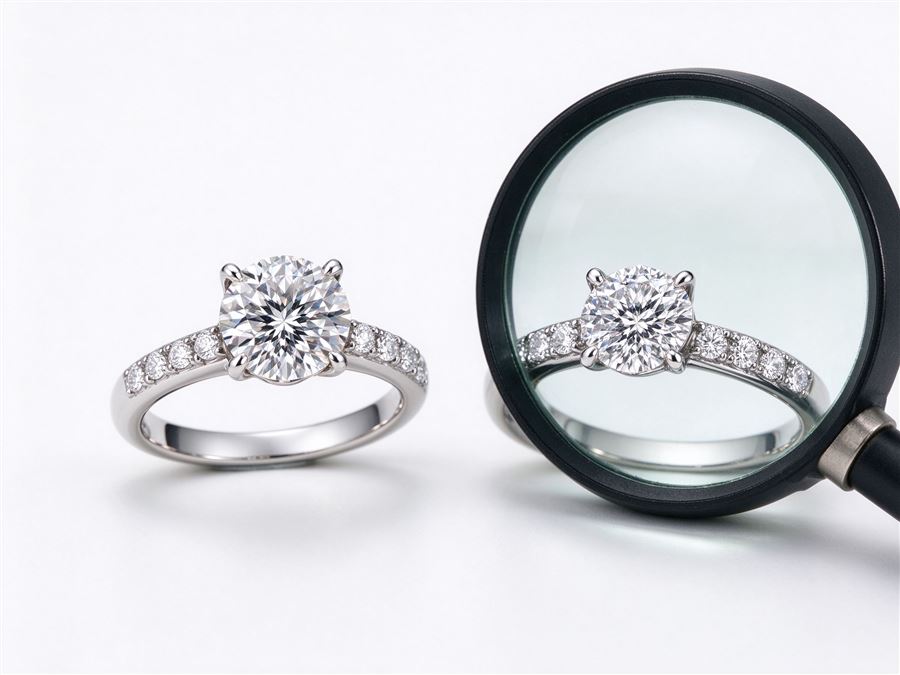
When people look closely at a moissanite and see a line, they assume it is a scratch. Most of the time it is not. Moissanite has internal needle-like inclusions that are part of the material, and under a loupe they look like fine lines. They are inside the stone, not on the surface. You cannot polish them out, and you cannot cause them by wearing the ring. They were there when the stone was cut.
A real scratch is on the surface, catches the light from every angle, and is usually a single straight line. An internal inclusion is only visible under magnification and does not change when you rotate the stone.
Can You Polish Out a Scratch?
If a scratch does appear, a jeweller can repolish the facet. Moissanite is hard but it can be re-polished by a lapidary with the right tools. The cost is modest, and the stone comes back looking new. This is a rare event for a daily-worn ring, but it is good to know the option exists.
The Prongs Wear Before the Stone
The real wear point on a moissanite ring is not the stone, it is the prongs. Gold prongs are soft. Over years of brushing against surfaces, a prong can thin, bend, or lift. Once a prong lifts, the stone is at risk of falling out. That is why we recommend a prong check every year, not because the stone is fragile, but because the metal holding it is not.
Moissanite vs Diamond on Hardness
Diamond is harder than moissanite, but in daily wear the difference is almost invisible. Both stones survive decades of handwashing, typing, and cooking. The places where diamond wins are extreme industrial settings and very rough manual work. For an engagement ring, the hardness gap is not a reason to choose diamond over moissanite.
Where moissanite actually outperforms diamond is toughness. Moissanite is less brittle than diamond, which means it is less likely to chip if it receives a sharp blow. Diamond can chip along a cleavage plane. Moissanite does not have that cleavage, so it is more forgiving of an accidental knock.
What About Sand, Chlorine, and Perfume?
Sand will not scratch moissanite, but it can scratch the gold band. Chlorine does not damage moissanite, but it can pit gold over long exposure. Perfume does not scratch either, but it leaves a film that dulls the look. None of these are stone-damaging, but they are band-dulling, which is why we recommend the home clean routine.
What Moissanite Is Actually Made Of
Moissanite is silicon carbide, a crystal that exists in nature but is too rare to mine commercially. Every commercial moissanite is grown in a laboratory furnace. The crystal is then cut and polished like a diamond. Because it is a single-crystal material with no cleavage plane, it does not chip along a natural line the way diamond can. That toughness is why moissanite survives a drop that would chip a diamond.
The Prong Check Every Year
Run a fingernail across each prong once a month. If one catches, make an appointment. The annual professional checkup catches the rest. Prongs thin slowly, and the ring does not tell you when it is about to fail. A five-minute tightening costs nothing. A lost stone costs a new stone.
Sand, Concrete, and the Real Risk
Everyday surfaces do not scratch moissanite. The realistic risks are sandpaper, rough concrete, and rubbing against another diamond. If you are renovating, gardening with bare hands, or working on stone, take the ring off. The grit in concrete is quartz, which at 7 on the Mohs scale will not scratch moissanite at 9.25, but it will scratch the gold. Take the ring off to protect the band, not the stone.
Repolishing the Facets
If a scratch does appear, a lapidary can repolish the facet. Moissanite is hard but not unpolishable. The cost is modest, and the stone comes back looking new. This is a rare event. Most moissanite owners never need it.
Moissanite vs Diamond on Toughness
Diamond is harder but more brittle. It can chip along a cleavage plane if it receives a sharp blow at the right angle. Moissanite has no cleavage, so it absorbs a knock without splitting. For an active hand, that toughness matters more than the theoretical hardness advantage of diamond.
What Moissanite Is Made Of
Moissanite is silicon carbide, a crystal that exists in nature but is too rare to mine commercially. Every commercial moissanite is grown in a laboratory furnace. Because it is a single-crystal material with no cleavage plane, it does not chip along a natural line the way diamond can. That toughness is why moissanite survives a drop that would chip a diamond.
The Prong Check Every Year
Run a fingernail across each prong once a month. If one catches, make an appointment. The annual professional checkup catches the rest. Prongs thin slowly, and the ring does not tell you when it is about to fail. A five-minute tightening costs nothing. A lost stone costs a new stone.
Sand, Concrete, and the Real Risk
Everyday surfaces do not scratch moissanite. The realistic risks are sandpaper, rough concrete, and rubbing against another diamond. If you are renovating, gardening with bare hands, or working on stone, take the ring off. The grit in concrete is quartz, which at 7 on the Mohs scale will not scratch moissanite at 9.25, but it will scratch the gold. Take the ring off to protect the band, not the stone.
Repolishing and Toughness
If a scratch does appear, a lapidary can repolish the facet. Moissanite is hard but not unpolishable. This is a rare event. Diamond is harder but more brittle: it can chip along a cleavage plane if it receives a sharp blow at the right angle. Moissanite has no cleavage, so it absorbs a knock without splitting.
The Bottom Line
Moissanite is scratch-resistant enough for a lifetime of daily wear. It will not scratch from normal contact. The things that can scratch it are rare and avoidable. The real maintenance is the prongs and the band, not the stone. Get the prongs checked once a year, clean the ring every two weeks, and the moissanite will outlast the setting.