GRA Certificate Explained: What Your Moissanite Document Actually Means
When a moissanite ring arrives in a little box with a folded paper certificate tucked beside it, most buyers flip past the numbers and go straight for the sparkle. That certificate is doing more work than it looks. The GRA report tells you what stone you actually received, how it was graded, and whether the piece on your finger matches what you paid for. At HOLYCOME we ship every loose moissanite and every finished ring with its matching GRA dossier, and we want customers to read it before they admire the ring.
What Is GRA, Anyway?
GRA stands for Gemological Research Academy, an independent gem-testing laboratory that grades loose moissanite on the same visual criteria the public already understands from diamonds. Because moissanite is a lab-grown material, it is not mined, and it does not carry a GIA diamond report. The industry built its own grading system around moissanite, and GRA is the certificate most international buyers recognise and resellers accept.
A GRA dossier is not a guarantee of origin in the mining sense, because there is no mine. What it does guarantee is that a trained gemologist examined the finished stone under standardised light, measured its proportions, checked its clarity, and recorded its colour grade on a printed sheet tied to a serial number laser-inscribed on the stone's girdle.
How a Moissanite Stone Gets Graded
Before any certificate exists, the moissanite rough is cut, polished, and examined under magnification. The grader looks at four things, adapted from the diamond 4Cs but interpreted for moissanite's softer refractive properties.
Cut
Cut is the single biggest driver of a moissanite's fire. A poorly cut stone looks heavy and dark even if the material is flawless. GRA grades the angles, the table percentage, the crown height, and the pavilion depth, and assigns an Ideal, Very Good, or Good rating. Round brilliant moissanite sold as HOLYCOME stock is cut to Ideal proportions so the stone returns light evenly across the table.
Colour
Moissanite is graded on a D-to-Z colour scale borrowed from diamonds, but the comparison is not exact. Nearly all commercial moissanite sits in the near-colourless range because the material itself has a faint warm undertone. Colourless (D-F) moissanite is rare and carries a price premium, while G-I stones look white to the naked eye in a white gold or platinum setting and are the most common engagement-ring choice.
Clarity
Because moissanite is grown in controlled furnaces, included stones are unusual. Most commercial stock lands in VS or VVS territory, and the certificate records the clarity grade alongside a plot of any visible inclusions. At HOLYCOME our stock is VVS1 to VVS2, which means inclusions are barely visible under ten-power magnification.
Carat Weight
Carat is a weight measurement, not a size measurement, and on a GRA report it is recorded to two decimal places. Remember that moissanite is less dense than diamond, so a one-carat moissanite measures slightly wider across the table than a one-carat diamond. The certificate lists the weight, and your finger sees the millimetres.
Reading the Numbers on Your Report
Open the certificate and you will see a table with fields for shape, measurements, carat weight, colour grade, clarity grade, cut grade, polish, symmetry, and fluorescence. The measurements look like 6.50 - 6.53 x 4.02 mm, which tells you the stone is a round of roughly 6.5 mm. The serial number on the report should match the laser engraving on the girdle, visible under a loupe. That match is what stops a swapped-stone scenario.
Fluorescence on a GRA moissanite report is usually recorded as None or Faint. Unlike diamond fluorescence, which can matter in larger stones, moissanite fluorescence is rarely a buying decision because the material is already optically active.
What the Certificate Does Not Tell You
A GRA report grades the loose stone, not the finished ring. It does not tell you the karat of the gold, the quality of the setting, or whether the prongs are finished cleanly. Those questions belong to the manufacturer. HOLYCOME builds the setting after the stone is graded, and we photograph the finished piece so the customer can see both the certificate and the mounted ring together.
The certificate also does not tell you whether the stone is ethically grown. Moissanite is always lab-grown, so ethical sourcing is built into the material itself, but it is worth confirming with the seller that the rough came from a reputable cultivator rather than an unbranded reseller.
Why the Serial Number Matters
Every GRA stone carries a microscopic laser inscription on the girdle matching the certificate number. If you ever take your ring to an independent jeweler for a cleaning or resizing, that jeweler can read the number and confirm the stone matches the dossier. If a reseller quotes you a price based on the stone, the serial number is what they check. Keep the certificate in a safe place, not in the jewelry box, because the paper is easier to replace than the match between paper and stone.
Common Certificate Red Flags
- No serial number on the girdle. If a loupe shows no engraving, the certificate may be printed for a different stone.
- Numbers that do not add up. A 6.5 mm round should weigh close to one carat. A report claiming two carats on a 6.5 mm stone is wrong.
- Photocopied certificates. Original GRA dossiers have a security watermark and a hologram. A black-and-white scan is not a substitute.
- Vague grading. A certificate that says good colour without a letter grade is not a GRA report.
Pairing the Certificate With Your Receipt
When you buy from HOLYCOME, the package includes the GRA dossier, a printed invoice, and photos of the mounted ring. Keep all three together. If you ever sell, insure, or redesign the ring, the combination of certificate, invoice, and photographs proves what the piece is and what you paid. Insurance companies ask for exactly this paperwork.
How GRA Grading Differs From Diamond Grading
Because GRA borrows the diamond scale, buyers sometimes compare the two reports directly and come away confused. A GRA VVS1 moissanite is not the same as a GIA VVS1 diamond. The grading language is shared, but the materials are not. Moissanite is grown in a controlled furnace, so inclusions are rare and usually tiny needle-like growth features. Diamond is mined, so inclusions range from feathery fractures to crystals. When you read VVS1 on a GRA report, it means the moissanite is clean to the eye, not that it has been compared side by side with a diamond of the same grade.
Colour is another area where the comparison breaks. Moissanite has a natural body colour that leans slightly warm, even in its top grades. A GRA D-F moissanite looks white next to a GHI stone, but it will not look ice-cold the way a D-flawless diamond does. Buyers who expect that icy diamond look should ask us for a photo of the actual stone in white gold, not rely on the letter grade alone.
The Serial Number Under the Loupe
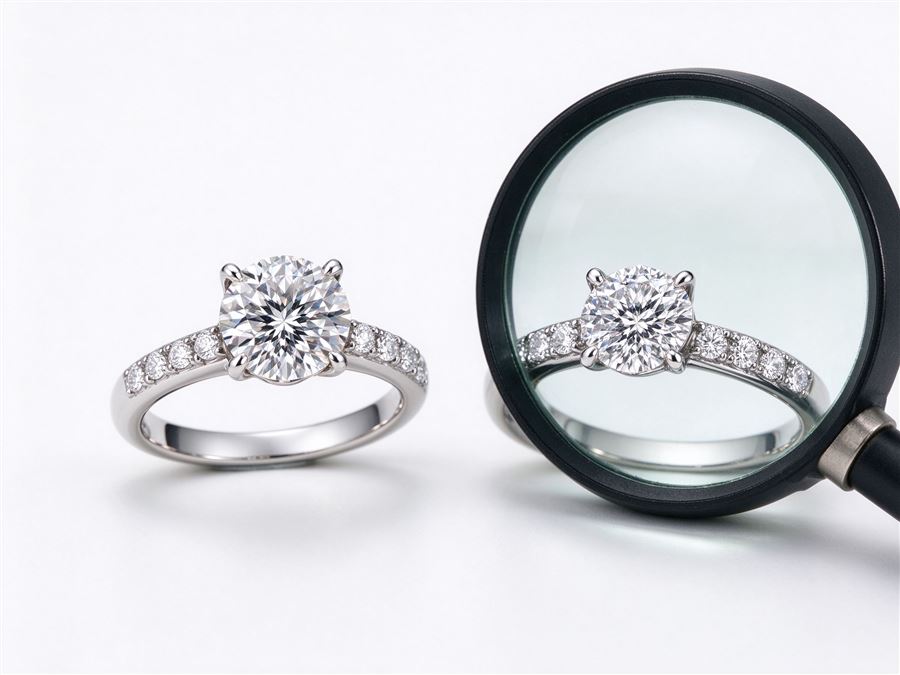
The laser inscription on the girdle is microscopic. You will not read it with your naked eye. You need a ten-power loupe, which is the same jeweller's loupe you can buy for a few dollars online. Hold the loupe close to your eye, bring the stone up to it, and rotate the ring until the girdle edge comes into focus. The serial number is usually on the wider part of the girdle, not on the thin edge. It will match the number printed on the GRA dossier.
If you cannot read it yourself, any jeweller can show it to you in thirty seconds. Do not buy a stone sight-unseen where the seller will not confirm the girdle number before shipping. That confirmation takes one photo.
Why We Photograph the Certificate With the Ring
When HOLYCOME ships a finished ring, we photograph the GRA dossier next to the mounted ring. This is not marketing. It is provenance. The photo shows that the stone in the ring matches the stone on the certificate. If you ever need to make an insurance claim, resell the ring, or have it inspected by an independent jeweller, that photograph is the link between paper and piece. Keep those photos with the receipt.
We also photograph the serial number side-on so you can see the engraving. If a jeweller ever questions the stone, that photo is your answer.
Common Questions About the GRA Report
Is GRA a Recognised Lab?
GRA is the laboratory most international moissanite buyers use. It is not GIA, and it does not grade diamonds. It is the accepted standard for lab-grown moissanite. If a seller offers a GIA report on moissanite, be suspicious, because GIA does not issue reports for commercial moissanite in the way it does for diamonds.
Does the Certificate Cover the Setting?
No. The certificate grades the loose stone only. The setting is covered by our workmanship guarantee, not by GRA. If you want the setting appraised for insurance, a local jeweller will write a separate appraisal.
What If I Lose the Certificate?
Contact us. We keep records of every stone we ship, including the GRA number. We can send you a copy of the report. The original paper can be reordered through GRA, but the record stays with us regardless.
Can I Upgrade the Stone Later?
Yes. The GRA system works by serial number. If you want to trade up to a larger or better-coloured stone later, the old stone and its certificate come back to us, and we apply the value against the new one. The certificate follows the stone, not the setting.
Reading the Measurements Like a Jeweller
The measurements on the certificate, for example 6.48 - 6.52 x 3.98 mm, are more informative than the carat weight. The first two numbers are the diameter across the table, measured at two points because a round stone is never perfectly circular. The third number is the depth, from the table to the culet. The ratio of depth to diameter tells you whether the stone is cut shallow, deep, or ideal. A well-cut round sits around 60 to 62 percent depth. A stone cut too deep looks dark. A stone cut too shallow looks light and glassy.
When we select stones for HOLYCOME rings, we read those ratios before we read the price. The numbers are what tell us the stone will throw fire, not just that it is certified.
What HOLYCOME Customers Ask Us Before Ordering
In a typical week, the questions we answer before a sale are remarkably consistent. Customers ask whether the GRA number will match the girdle engraving. It will. They ask whether the certificate ships in the box. It does. They ask whether we send photos of the exact stone before setting. We do. They ask what happens if the stone is not what they expected. We resend or refund within the return window. None of these are tricky questions, and the answers are always the same, because the process is designed to be transparent.
The question we like most is whether the stone will look like a diamond. The honest answer is that it will look like a brilliant, colourless, well-cut stone, but if someone inspects it under magnification they will see moissanite's double refraction, which looks like doubled facet edges. That is not a flaw, it is a material signature. On the finger, at conversational distance, no one can tell the difference. We tell customers this up front, because the ring should be bought with open eyes.
The After-Sale Paperwork
When the ring ships, the package contains the GRA dossier, the printed invoice, and the photographs of the mounted ring. Keep all three together in a single envelope. If you ever insure the ring, resell it, or have it redesigned, those three documents are what the next person asks for. The certificate without the invoice is hard to value. The invoice without the certificate is hard to grade. Together they prove what the piece is and what you paid.
We keep digital records on our side as well. If you lose the paper, contact us with the order number and we will resend the electronic copy. The paper is the copy you show to an insurance agent. The digital copy is the backup.
How the GRA Report Reads in Practice
When you open the dossier, you will see a small table. The shape field says Round Brilliant. The measurements field says something like 6.50 - 6.53 x 3.98. The carat field says the actual weight. The colour and clarity fields say the grades. The cut field says Ideal. The serial number appears at the bottom and is repeated on a security hologram. If any of those fields is blank, or if the serial number does not match the girdle, the certificate is not legitimate. We photograph the certificate before we ship so you can compare it side by side with what arrives.
The Bottom Line
The GRA certificate is the bridge between a pretty picture online and a verifiable stone on your finger. It is not glamourous, and most people will never show it off at a dinner party, but it is the document that protects the value of the ring for decades. Read it before you wear the ring, keep it with your important papers, and buy from a seller who treats the certificate as part of the product rather than an afterthought.