Two identical moissanite rings can sit on two shelves for two very different prices. One is in a mall boutique with a polished counter and a commission salesperson. The other ships from a workshop that cuts the stones and casts the settings in the same building. The stone, the metal, and the finish may be indistinguishable. The price gap is not magic, and it is not a sign that one of them is fake. It is a markup structure, and once you see how it works, you stop paying retail by accident.
IHow a Ring Normally Reaches Your Finger
A conventional retail ring passes through several hands before you buy it. The moissanite rough is grown by a cultivator, cut by a lapidary, sold to a jewelry wholesaler, sold again to a regional distributor, sold to a boutique, and finally sold to you. Each step adds a margin to cover overhead, profit, and risk. By the time the ring reaches the boutique, the price has been marked up three or four times, and the boutique still has to cover rent, staff salaries, insurance, and display lighting.
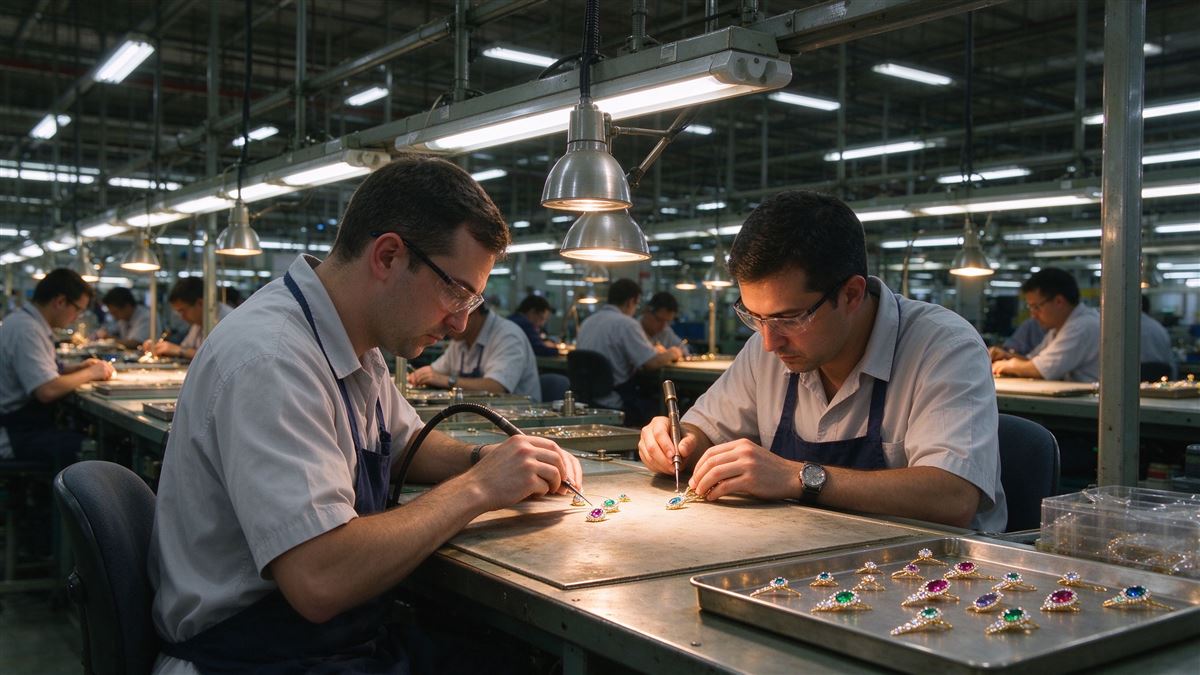
The direct-to-factory model collapses those steps. The workshop buys the cut moissanite, designs the setting, casts it, sets the stone, and ships it to you. There is no regional distributor and no boutique. The price you see is the workshop's price, not a series of stacked markups.
IIWhat You Actually Save
On a comparable one-carat equivalent moissanite solitaire, a retail boutique typically prices the ring between two and four times what a direct factory charges. The stone itself may be the same GRA-graded VVS1, the metal the same 14k white gold, and the finish the same hand-polished high polish. The difference is entirely in the distribution chain.
That saving is not a corner cut. It is a margin cut. The workshop still pays its bench jewelers, still polishes the rings by hand, still QC's every setting under a loupe. It simply does not pay for a storefront you will walk through once.
IIIWho Is Wholesale Pricing For?
Wholesale and direct pricing serve two different buyers.
The Individual Couple
A couple buying one engagement ring does not need a wholesale account. They benefit from direct factory retail pricing, which is already below boutique retail because the factory has skipped the middlemen. They get a certificate, a return window, and a finished product, and they pay the price the factory charges rather than the price a boutique adds on top.
The Small Jewelry Business
A boutique owner, a stylist, or a reseller buying ten or fifty rings at a time can open a wholesale account. Wholesale pricing is lower still, but it comes with minimum order quantities, longer production runs, and usually no individual return window. At HOLYCOME we support wholesale partners with bulk production, private labeling, and consistent stone grading across runs.
IVWhat Wholesale Does Not Mean
Wholesale does not mean ungraded stones, seconds, or clearance stock. A legitimate wholesale partner buys the same quality stone a retail customer buys, in larger volume, at a lower per-unit cost. The GRA certificate still ships with every loose stone. The QC process still applies. The only difference is the quantity on the order.
What wholesale usually does mean is less hand-holding. A wholesale order is not customized ring by ring. It is a production run of a style, in a range of sizes, shipped on a pallet. If you are a couple reading this, you want the retail-direct experience, not the wholesale contract.
VComparing Apples to Apples
When you compare a boutique price to a factory price, make sure the comparison is honest. Check these points side by side:
- Is the stone the same carat equivalent and the same measurement across the table?
- Is the color grade comparable? G-H and D-F are not the same price.
- Is the setting the same metal karat? 10k, 14k, 18k, and platinum are very different costs.
- Does the boutique price include the certificate, or is that an upcharge?
- Does the factory price include insured shipping and resizing, or are those added later?
Once you line those up, the price gap usually narrows a little but never closes. The boutique will still be meaningfully more expensive, because its costs are meaningfully higher.
VIThe Trade-Offs of Buying Direct
Direct factory buying is not perfect. You give up the in-store experience. You cannot try the ring on before it ships. You depend on photographs and videos rather than a salesperson holding the piece under a display light. For some buyers, that trade is uncomfortable. If you are someone who needs to touch and try, a boutique may still be worth the premium, and that is a fair choice.
What you gain is price transparency, factory visibility, and direct communication with the people who actually made the ring. If something needs adjusting, you are talking to the bench, not a clerk who will email the bench on your behalf.
VIIPrivate Label and Bulk Custom
For business buyers, direct factory pricing is where private label becomes viable. A boutique can carry a line of moissanite engagement rings under its own brand, manufactured by HOLYCOME, with consistent grading and repeatable quality. Bulk orders run on predictable lead times, and the factory can engrave a boutique logo inside the band rather than the manufacturer's mark. That is how small brands compete with large retailers without building a workshop of their own.
VIIIThe Math Behind the Markup
To understand the price gap, follow the money. A cut moissanite stone costs the workshop a known amount. The setting metal is priced by weight. Labor is priced by the hour. Add those three together and you have the factory cost. A boutique then adds its overhead, which includes rent, sales commissions, display cases, insurance, and marketing. On top of that, the boutique adds its profit margin. The result is typically two to four times the factory cost.
When you buy direct from HOLYCOME, you pay the factory cost plus a smaller margin. The workshop still pays its bench jewellers, still polishes by hand, still QC's every ring. It simply does not pay for the storefront you will walk through once.
IXWho Is the Middleman, Exactly?
The distribution chain looks like this. The moissanite rough is grown by a cultivator. It is sold to a cutting workshop. The cut stone is sold to a jewelry wholesaler. The wholesaler sells to a distributor. The distributor sells to a boutique. The boutique sells to you. Each of those steps adds a margin. By the time the ring reaches the boutique, the price has been marked up three or four times.
Direct-to-factory collapses those steps. The workshop buys the cut stone, casts the setting, sets the stone, and ships to you. One margin instead of four. The stone, the metal, and the finish are the same. The price is not.
XDoes Direct Mean Lower Quality?
This is the question people ask, and the answer is no. The workshop that sells direct is the same workshop that supplies boutiques. The bench jeweller does not make a worse ring because it is shipping to a customer rather than a boutique. The QC process is the same. The GRA certificate is the same. The difference is the price, not the product.
In fact, direct-to-factory buyers often get better quality, because the workshop has a direct relationship with the customer. If something needs adjusting, the customer talks to the bench. A boutique customer talks to a clerk, who emails the bench, who emails the clerk, who emails the customer. The round trip is longer and the feedback is fuzzier.
XIThe Wholesale Buyer Checklist
If you are a small business considering a wholesale account, ask these questions before you commit to a run. What is the minimum order? What is the lead time on reorders? Do you provide private labeling? Can you match grading across runs? What is the sample cost? Do you provide product photography? What are the payment terms?
A reputable factory will answer all of these in a single email. If the answers are vague, the wholesale relationship will be vague too. HOLYCOME works with boutiques and stylists who need consistent stock, and we answer these questions on the first call.
XIIWhen Retail Is Still the Right Choice
Retail is not a scam. It is a service. If you want to try the ring on, walk out with it that day, and have a salesperson walk you through the options, retail is worth the premium. If you live somewhere with no direct shipping, or you need the ring this weekend, retail is the answer. The premium buys immediacy and the in-store experience.
What is not a good idea is paying boutique prices for a product you could have bought direct for half the price, without realising the difference. The smarter shopper knows which one they are paying for.
XIIIThe Resale Value Question
Here is a point that surprises people. A ring bought direct from a factory holds the same resale value as the same ring bought at retail, because the resale value is based on the materials and the craft, not on what the original buyer paid. A two-thousand-dollar factory ring and a four-thousand-dollar boutique ring with the same stone and the same metal are worth the same on the resale market. The boutique markup never comes back.
This is why direct buying is the smarter financial choice. You spend less on day one, and you do not lose the premium when the ring is resold.
XIVThe Hidden Costs of Boutique Buying
The price tag at a boutique is not the whole cost. Boutiques often add on the certificate, the insurance appraisal, and the cleaning plan. They offer a free ring cleaning, but only if you come back to them. They engrave the ring, but they charge for the second line. By the time the boutique adds everything, the gap to direct factory pricing widens further. When you compare prices, add up the extras on both sides. The boutique price grows. The direct price does not.
XVWhy Some Buyers Still Prefer Retail
Retail is a service, not a markup. If you want to try the ring on, walk out with it that day, and have a salesperson walk you through the options, retail is worth the premium. If you live somewhere with no direct shipping, or you need the ring this weekend, retail is the answer. What is not a good idea is paying boutique prices for a product you could have bought direct for half the price, without realising the difference. The smarter shopper knows which one they are paying for.
XVIThe Resale Math
A ring bought direct from a factory holds the same resale value as the same ring bought at retail, because resale value is based on materials and craft, not on what the original buyer paid. A two-thousand-dollar factory ring and a four-thousand-dollar boutique ring with the same stone and metal are worth the same on the resale market. The boutique markup never comes back. This is why direct buying is the smarter financial choice.
XVIIThe Bottom Line
Retail exists for buyers who want service, atmosphere, and immediacy. Direct factory pricing exists for buyers who want the same physical product at the price it actually costs to make. Neither is a scam, and neither is a secret. The smarter shopper knows which one they are paying for before they hand over the card. When the ring is a moissanite engagement ring that will be worn every day for decades, choosing the direct factory route usually leaves enough budget to upgrade the stone size, the metal, or both.
XVIIIRelated Articles
- Moissanite Clarity: What Actually Looks Eye-Clean
- Moissanite for Your Hand: Matching Stone Shape to Finger Length and Width
Gemstone grading terminology used here follows the Gemological Institute of America’s gem encyclopedia.
XIXFrequently Asked Questions
Is moissanite a good diamond alternative for retail buyers?
Yes for price-sensitive customers who want brilliance and hardness. Moissanite ranks 9.25 on the Mohs scale, holds up to daily wear and costs a fraction of a natural diamond of the same size, so it resells fast in bridal and fashion lines.
What is the minimum order for wholesale moissanite?
Our minimum order quantity depends on the design and is confirmed in your written quote. Custom cuts and private-label settings usually start at 100–300 pieces depending on the mold.
Do you provide certificates with moissanite stones?
Yes. Stone documentation is prepared according to your order sheet and confirmed on the quote. We recommend passing the certificate to your end customer for trust.
How long does sample and bulk production take?
Lead times for samples and bulk orders are stated on your quote and reconfirmed on the PO. We confirm sampling and production schedules per order rather than quoting a generic timeframe.
Related reading: Moissanite Rings Vendor China Factory Direct, Moissanite Earrings Vendor China Factory Direct, Moissanite Earrings Wholesale Pricing Tiers EXW.