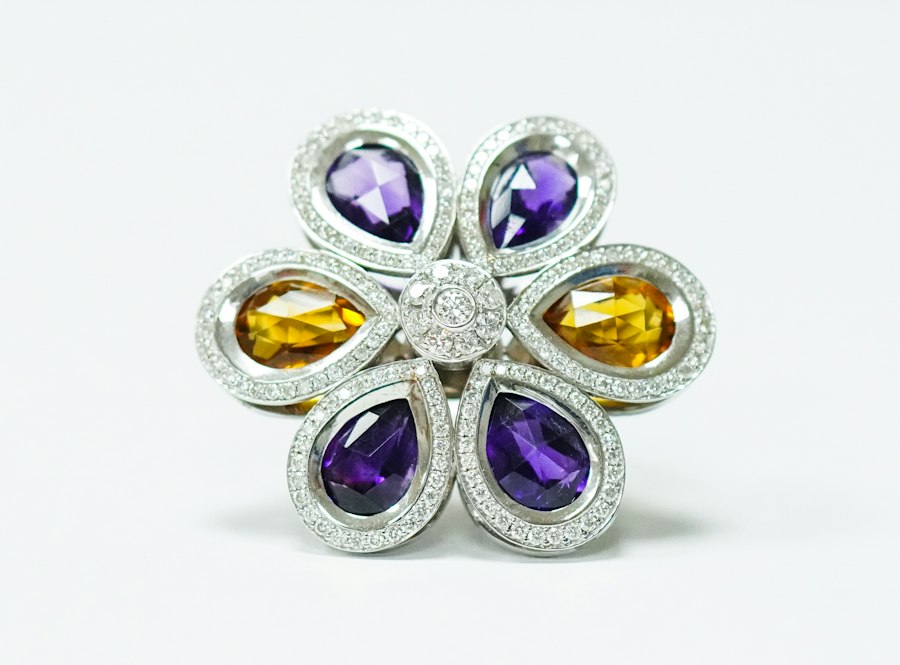
Every family has a jewelry box that no one opens. Inside it: a ring that belonged to a grandmother, a brooch from a great aunt, a pair of earrings from a parent, each piece meaningful on its own, none of them actually worn. No one wants to throw any of it away. No one quite knows what to do with all of it. The solution we build most often is one new ring, designed to hold several of those stones at once.
Inventory the pieces first
Before any design, we lay everything out. We identify each stone, note its cut, its color, its condition, and which family member it came from. We also check which pieces are worth keeping whole. Sometimes a brooch is beautiful enough that it should stay a brooch. Sometimes one ring is worn exactly as-is by a cousin. We are not here to melt everything down. We are here to find the pieces that are sitting unworn, and to design around them.
This conversation usually reveals that the family has three or four stones that really matter: a diamond, a sapphire, a small pearl, a garnet. The rest is scrap gold that can be recycled into the new band. We work the old gold into the new piece whenever the client wants that continuity, and we tell them honestly when the old alloy is too worn or too mixed to be worth using.
Designing for the stones, not the other way around
This is the part that separates a multi-stone family ring from a random cluster. We do not pick a setting and force the stones into it. We lay the stones on the bench and arrange them until the composition feels right. The largest stone anchors the piece. The others orbit it by color, not by size. A warm diamond next to a cool sapphire reads well. A pink pearl next to a red garnet can fight. We try the arrangement on a short model so the client can see it on the finger before we commit.
We also think about who will wear the ring. If it is going to be worn daily by one person, the setting needs to be protective and low. If it is a family piece that passes between siblings on holidays, it can be more dramatic, because it is not going to a keyboard or a gym bag. The same stones, designed for two different lives, become two very different rings.
What to do with stones that do not fit
Not every inherited stone belongs in the ring. A cracked emerald, a chipped pearl, a stone with sentimental weight but poor color, these are better kept as keepsakes or set into separate smaller pieces. We have built the ring, and then designed a matching small pendant or a pair of studs for the stones that did not make the cut. The client ends up with two pieces instead of one, both honest, both worn.
If a stone is too fragile to reset at all, we keep it in its original setting as a small memento. There is no rule that says everything must be worn. Some heirlooms are meant to be kept, and we say so rather than forcing a redesign that damages a piece of family history.
The result
A well-combined family ring is one of the most powerful pieces we make. It is not a single heirloom reset. It is a piece that visibly holds several generations at once. The grandmother's diamond sits at the top. The aunt's sapphire on one shoulder. The mother's small pearl on the other. Inside, we engrave the names and the years, so the wearer knows, without explaining to anyone else, exactly what they are wearing.
When these rings come back to us ten years later for a polish, the client usually tells us a story. The ring was on their hand at a funeral, at a wedding, at a graduation. That is the point of combining the stones instead of keeping them in separate boxes. The family becomes one piece, worn against the body, instead of a drawer of good intentions. If you have a box like that at home, it is worth laying it out and seeing what it wants to become. We have redesigned enough of them to tell you that almost always, the answer is better than anyone expects.
A question we get often is whether the family gets a vote. We recommend one designated client on the commission, with the rest of the family consulted on which stones matter and which pieces can be broken down. A design by committee ends up pleasing no one and including stones no one actually likes. The wearer should make the final call on the shape, the metal, and the setting. The family gets to be heard on the meaning, and that is usually where the emotion actually lives.