When clients describe their dream wedding band, they talk about metal color, finish, and maybe a small stone. They almost never talk about width. Yet width is the single proportion that most changes how a band feels on the hand. A 2mm slim band and an 8mm wide band are not different versions of the same object. They are different objects. Choosing between them is a decision about comfort, style, and how the ring will wear over decades.
Most off-the-shelf bands sit in a narrow middle range, around 4mm to 6mm, because that is what sells. Bespoke work lets you step outside that range. Some hands want a band that nearly disappears. Others want a band that reads as a deliberate piece of jewelry. The right width depends on the hand, the other rings the wearer owns, and the life they lead.
Slim bands, roughly 1.5mm to 3mm
A slim band feels like a thread on the finger. It is the traditional choice for a wedding band meant to sit next to an engagement ring, because it tucks under the head without gaping. It is also the choice for someone who rarely wears rings and does not want to notice one on their hand. Slim bands stack beautifully with other stackers and read as delicate, modern, or timeless depending on the finish.
The trade-off is durability. A 2mm band in soft gold will thin over decades of wear and may need rebuilding. It also bends more easily if it catches. For a daily ring worn through years of hands-on work, a slim band is a commitment to servicing it. For someone who wears it gently, it ages gracefully and develops a lovely worn-in feel.
Middle bands, roughly 4mm to 5mm
The middle range is where most commissioned bands land, and for good reason. A 4mm band reads as a proper ring without dominating the hand. It holds detail—engraving, a small stone, a textured finish—without crowding. It sits comfortably next to a solitaire and on its own. It is the safest choice if you are unsure, and it is the width we default to when a client has no strong opinion.
It is also the width that pairs most cleanly with an engagement ring, because it matches the visual weight of most solitaire shanks. Our guide to choosing a complementary band works through how to match width to an existing head.
Wide bands, roughly 6mm to 10mm
Wide bands make a statement. They are architectural, they read as jewelry rather than band, and they suit a hand with longer fingers or a wearer who likes to see their ring. They are the traditional choice for many men's commissions, and they are increasingly chosen by women who want a ring that does the work on its own without an engagement ring beside it.
The trade-off is fit. Wide bands need a comfort-fit inside—a rounded inner edge—because a flat inner band across 8mm of finger feels stiff. They also fit a half-size larger than a slim band, because more metal presses against the finger. This is the same sizing nuance we cover in measuring ring size, and it matters more for wide bands than slim ones.
How width changes the look of metal
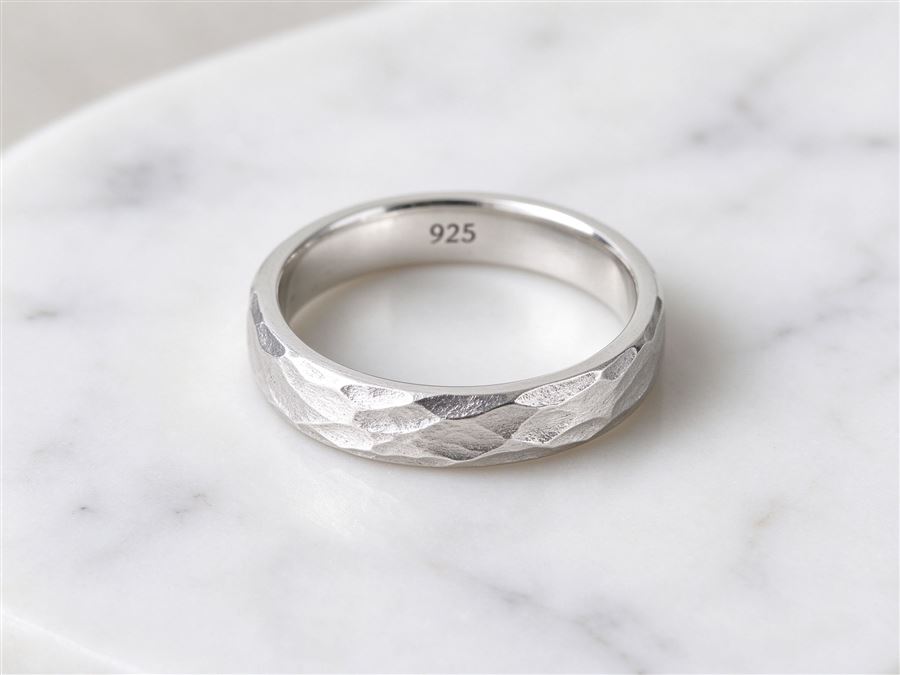
A wide band shows more finish. A brushed texture, a hammered surface, or a hand-engraved pattern reads fully on a 6mm band and gets lost on a 2mm band. Conversely, a high polish reads cleaner on a slim band, where the light travels in a single line. If you have your heart set on a detailed finish, build the band wide enough to show it.
Width also changes how metal color reads. Rose gold looks richer on a wide band, because there is more of it. Platinum looks its coolest and most modern on a slim band, where the white tone reads as crisp rather than heavy.
Stacking and future rings
If you plan to stack a wedding band with an engagement ring and future stackers, a slim or middle band is more forgiving. A wide band takes up finger space that you may want later. If you plan to wear one ring only, a wide band gives you more to look at on its own.
The right width for your hand
Try widths before you commit. Most ateliers can bring samples in 2mm, 4mm, 6mm, and 8mm in a similar metal, and the difference on your own finger will surprise you. The width that looks right on a screen often feels wrong on a hand, and the width that felt too wide in the photo often feels perfect in person. It is the one proportion we never trust without trying on.
One more consideration: weight. A wide band in platinum is noticeably heavier than a slim band in the same metal. Some wearers love the solid feel; others find it tiring by the end of a long day. If you are choosing a wide band, try one on for a full afternoon before you commission, especially if you have never worn a ring heavier than a slim band. The right width is the one you stop noticing, and weight is part of that.