Moissanite is graded on the same four Cs as diamond: cut, color, clarity (per GIA's diamond grading standards) and carat. But the meaning of each grade is different, because the stone is manufactured rather than mined. Here is how we read a GRA card on the bench.
ICut: the grade that actually matters
For a manufactured stone, cut is the only grade that can be bad. Color and clarity start near the top because lab growth is controlled; a poorly cut moissanite, however, will look dull, dark or lopsided no matter how clean the stone is. We only buy stones cut to ideal or excellent, because a good color grade on a bad cut is a waste.
On a round, look for a well-centered table, even girdle and symmetrical facets. On a fancy shape (oval, pear, heart), look for even shoulders and a centered culet. If a stone looks slightly lopsided in the product photo, it is lopsided in real life.
IIColor: D-F, G-I, and what you actually see
Moissanite is graded D-F (colorless), G-I (near colorless) and J and below (faint tint). On a white-metal setting, D-F and G-I look nearly identical to the untrained eye. The tint only becomes visible next to a true colorless stone, or in indirect light on a yellow-gold setting.
Our honest take: D-F is worth paying for if you are setting in white rhodium. G-I is the better value if you are setting in rose or yellow gold, because the warm metal will warm the stone anyway. Below G-I, the tint starts to read as gray rather than warm, and we stop recommending it.
IIIClarity: VVS, VS and what an inclusion looks like
VVS means very, very slightly included; VS means very slightly included. On a moissanite, inclusions are almost never eye-clean problems at VVS or VS. They are tiny growth needles that only show under 10x loupe. For a ring you wear on your hand, VVS and VS are indistinguishable.
We drop to SI only on stones smaller than 3mm, where no one will ever see the inclusion at all. For center stones, VVS is our default.
IVCarat: a misleading number
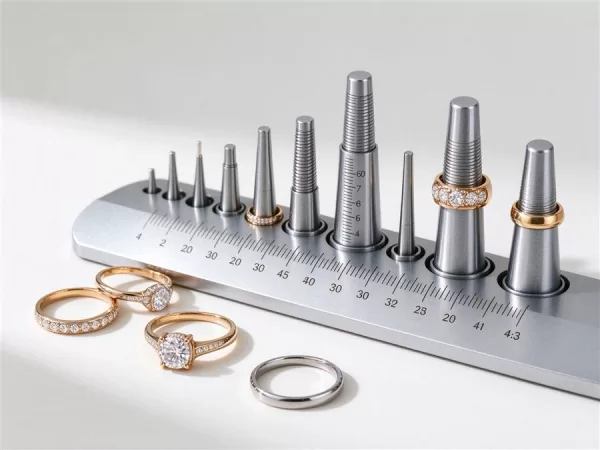
Moissanite is less dense than diamond, so a 1-carat moissanite measures larger than a 1-carat diamond. In our shop we quote by diameter (6.5mm, 8x6mm, 7x5mm) rather than by carat, because diameter is what your eye sees. When a listing says 1 ct, ask what the physical size is. A 6.5mm round is about 1.0 ct equivalent. An 8x6mm oval is about 1.2-1.4 ct equivalent.
The grade to pay for is cut. The grade to compare by is diameter. The grades to stop worrying about after VVS are clarity below that.
Every GRA card we ship lists cut, color, clarity and dimensions. Ask us for the card of the exact stone in your ring before it ships, not a sample card from another batch.
VRelated Articles
VIFrequently Asked Questions
Is moissanite a good diamond alternative for retail buyers?
Yes for price-sensitive customers who want brilliance and hardness. Moissanite ranks 9.25 on the Mohs scale, holds up to daily wear and costs a fraction of a natural diamond of the same size, so it resells fast in bridal and fashion lines.
What is the minimum order for wholesale moissanite?
Minimums are agreed per design; your quote states the exact starting quantity. Custom cuts and private-label settings usually start at 100–300 pieces depending on the mold.
Do you provide certificates with moissanite stones?
Yes. Grading reports are available on request and specified on your order confirmation. We recommend passing the certificate to your end customer for trust.
How long does sample and bulk production take?
Sampling and bulk lead times are confirmed in writing with your quotation. Production timelines depend on the design and order size and are agreed before we start.
Related reading: Moissanite Carat Size: What 1, 2, and 3 Carats Actually Look Like on a, Round, Oval, Cushion, or Pear: Choosing Your Moissanite Cut Shape, Moissanite Color Grades Explained.