Round, Oval, Cushion, or Pear: Choosing Your Moissanite Cut Shape
The cut shape is the first decision most shoppers make, and the one they second-guess the most. Round feels safe. Oval feels modern. Cushion feels vintage. Pear feels romantic. All four are excellent on a moissanite, because moissanite's high refractive index throws fire in any shape. The right shape is the one that matches her style, her hand, and the setting she will wear for the next fifty years. Here is how the four big shapes compare.
Round Brilliant
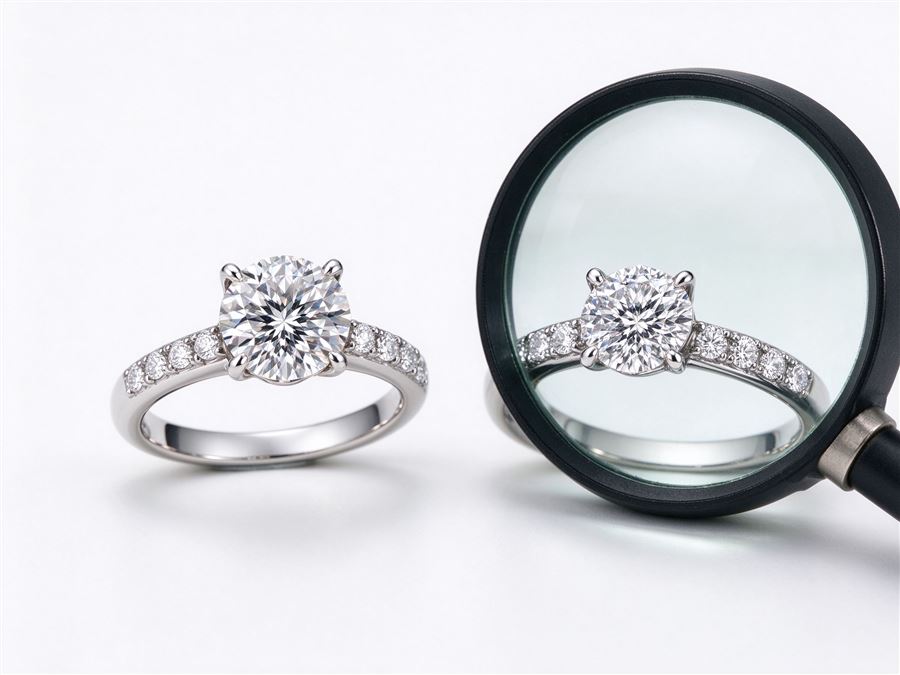
The round brilliant is the classic, and it is the best-proportioned cut ever developed. The 58 facets are arranged to return light evenly, which is why a well-cut round moissanite looks bright from every angle. Round is the most expensive shape to cut, because more rough is wasted, but it is also the most recognizable and the safest choice. If you are proposing and you do not know her taste, a round solitaire is the ring least likely to disappoint.
Round works on every finger. It is symmetrical, it pairs with every band style, and it photographs as a perfect circle. The trade-off is that it does not elongate the finger, so on short or wide hands it can look a touch stocky at larger sizes. Pair it with a slim band and it stays elegant.
Oval
The oval brilliant is the modern favourite. It has the same facet pattern as the round but stretched into an ellipse, which makes the stone look larger for the same carat weight and lengthens the finger. Oval moissanite throws a lot of fire, and the elongated shape suits an engagement ring because it reads as diamond-adjacent without being generic.
Watch for the bow-tie effect. On some oval cuts, a dark shadow appears across the center of the stone, shaped like a bow tie. It is more visible on cheaper ovals. HOLYCOME cuts ovals to avoid a strong bow tie, and we photograph the stone face-up under direct light so you can see it before you buy. Oval pairs beautifully with vintage settings, thin bands, and halo mounts.
Cushion Cut
The cushion cut is a square or squarish-rectangle with rounded corners and large facets. It reads as vintage, romantic, and a little softer than a round or an oval. Cushion moissanite has a plush, pillowy look that many people find more intimate than the sharp geometry of a round. It is also more forgiving of colour, because the larger facets hide slight warm undertones better than a round.
Cushion pairs with yellow gold and rose gold particularly well, because the warm metal complements the soft corners. It is a great choice for vintage-inspired rings, Art Deco settings, and halo mounts. On wider fingers, a cushion sits more balanced than a narrow oval.
Pear Cut
The pear cut is a teardrop, pointed at one end and rounded at the other. It is romantic, feminine, and elongates the finger dramatically. Pears look beautiful on longer fingers, worn with the point toward the knuckle. They are less common than rounds and ovals, which means the ring feels unique without being avant-garde.
The risk with a pear is symmetry. A badly cut pear looks lopsided, with one shoulder heavier than the other. Ask to see the stone held upright, and check that the two sides mirror each other. Pears also catch the light differently depending on which way the point faces, so wear them consistently in one direction.
Shapes We Did Not Cover
Emerald, asscher, marquise, and heart are all available in moissanite. Emerald and asscher are step cuts, which show clarity more than fire, and on moissanite they look clean and architectural. Marquise is the most elongated shape and maximizes finger length, but it can look pointy if the proportions are off. Heart is romantic but is a niche choice. If you are considering any of these, ask the factory for a stone-in-hand photo, because step cuts and marquise shapes photograph very differently in a studio than on a finger.
Matching the Shape to the Setting
The shape and the setting talk to each other. A round stone is safest in a solitaire, a halo, or a pavé band. An oval loves a vintage setting with milgrain edges. A cushion looks right in a bezel or a four-prong mount that shows the corners. A pear needs a setting that supports the point, usually with a V-prong to protect the tip.
If you already have a setting in mind, it narrows the shape quickly. If you already have a stone shape in mind, it narrows the setting. Most people start with one and let the other follow.
Shape and Lifestyle
Pointed shapes wear less well than rounded ones. Pear and marquise tips chip if they catch on surfaces, so they need sturdy prongs. Round and cushion are more forgiving for everyday wear. If the ring will never come off, round or cushion is the practical choice. If the ring comes off for gardening, typing, and cleaning, a pear or marquise is fine.
The Facet Pattern Difference
Each cut shape has a different facet arrangement, which changes how the stone returns light. A round brilliant has 58 facets arranged for maximum return. An oval uses the same pattern stretched. A cushion uses larger, fewer facets that create a softer, more plush look. A pear mixes the round brilliant pattern with a tapered point. These differences are subtle in photos but visible on the finger.
Moissanite throws more fire than diamond because of its higher refractive index. That fire looks best in a cut designed to show it off. A well-cut oval or round will throw rainbows. A step-cut emerald will look clean and architectural rather than fiery. Choose the facet style that matches the look she wants.
Bow-Tie and Windowing
Two optical effects to watch for on fancy shapes. Bow-tie is a dark shadow across the center of an oval or pear, shaped like a bow tie. It is more visible on cheaper cuts. Windowing is a dark, flat area on a step-cut stone. HOLYCOME cuts ovals and pears to minimize bow-tie, and we photograph each stone face-up under direct light so you can see it before you commit.
If a seller cannot show you a face-up photo of the exact stone you are buying, do not buy that shape sight-unseen. Round and cushion are safer blind. Oval and pear need the photo.
Matching the Cut to the Metal
Round looks right in every metal. Oval pairs beautifully with yellow and rose gold. Cushion loves warm metals. Pear is classic in white gold or platinum. The combination of cut shape and metal colour is what makes the ring feel cohesive. A cushion in rose gold reads vintage. An oval in platinum reads modern. A round in yellow gold reads timeless.
What Happens When You Change Your Mind
The cut shape is the one decision that is hard to change later. You can resize a ring, re-plate it, even re-tip prongs, but you cannot turn an oval into a round without buying a new stone. Choose the shape carefully. If you are genuinely torn between two shapes, ask us to show you both in CAD on the same hand. The visual comparison settles it.
The Facet Pattern Difference
Each cut shape has a different facet arrangement, which changes how the stone returns light. A round brilliant has 58 facets arranged for maximum return. An oval uses the same pattern stretched. A cushion uses larger, fewer facets that create a softer, more plush look. A pear mixes the round brilliant pattern with a tapered point. These differences are subtle in photos but visible on the finger.
Bow-Tie and Windowing
Two optical effects to watch for on fancy shapes. Bow-tie is a dark shadow across the center of an oval or pear, shaped like a bow tie. It is more visible on cheaper cuts. Windowing is a dark flat area on a step-cut stone. HOLYCOME cuts ovals and pears to minimize bow-tie, and we photograph each stone face-up under direct light so you can see it before you commit. If a seller cannot show you a face-up photo of the exact stone, do not buy that shape sight-unseen.
Matching the Cut to the Metal
Round looks right in every metal. Oval pairs beautifully with yellow and rose gold. Cushion loves warm metals. Pear is classic in white gold or platinum. The combination of cut shape and metal colour is what makes the ring feel cohesive. A cushion in rose gold reads vintage. An oval in platinum reads modern. A round in yellow gold reads timeless.
What Happens If You Change Your Mind
The cut shape is the one decision that is hard to change later. You can resize a ring, re-plate it, even re-tip prongs, but you cannot turn an oval into a round without buying a new stone. Choose the shape carefully. If you are genuinely torn between two shapes, ask us to show you both in CAD on the same hand. The visual comparison settles it.
The Bottom Line
Round is the safe, brilliant classic. Oval is the modern, finger-lengthening favourite. Cushion is the soft, vintage romantic. Pear is the unique, teardrop statement. All four look stunning in moissanite, because the material's fire carries the cut. Choose the shape that matches her wardrobe, her hand, and the setting you have imagined. At HOLYCOME we cut all four shapes in VVS1 clarity, and we can show you the exact stone on a hand before the ring is set.