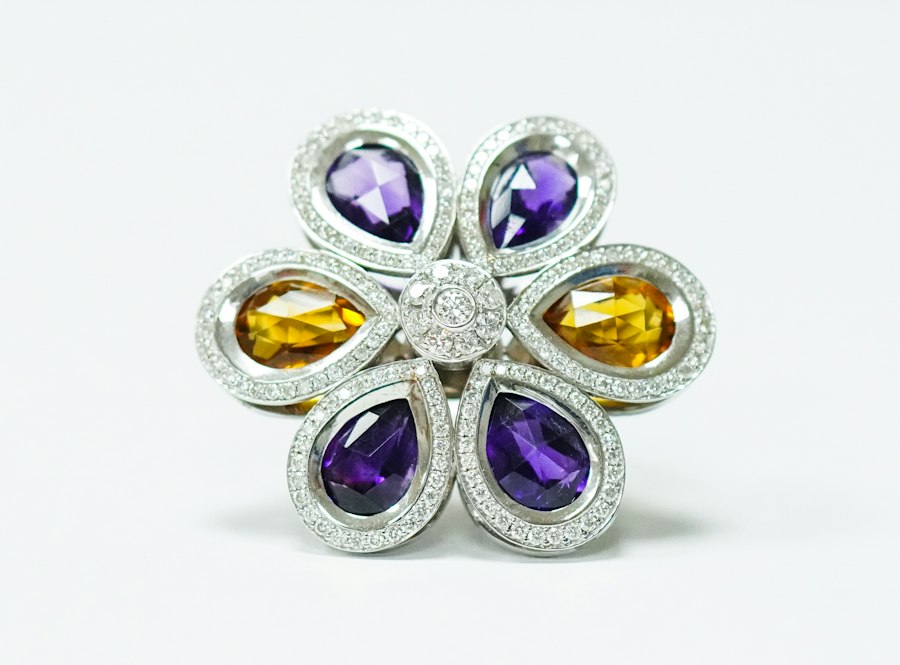
A few years ago, a client brought us a sketch she had drawn herself: a thin white gold band with a single rose gold prong gripping her grandmother's diamond. She thought she was being unconventional. We thought she was describing one of the oldest ideas in jewelry — mixing metals to create contrast that a single color of gold simply cannot achieve. That commission became one of our most-imitated designs, and it is why we want to talk honestly about two-tone rings.
What two-tone actually means at the bench
There are two ways to make a two-tone ring, and the difference is everything. The cheap method is electroplating: a white gold ring is flashed with rhodium, then painted with rose gold lacquer on a section. It chips. The lacquer wears off in months, usually on the part your thumb touches. The atelier method is soldering separate metal pieces together — yellow gold soldered to white gold, rose gold fused to a platinum shoulder. Each color is solid metal, and the line between them is a deliberate joint, not a coating.
If you commission a two-tone ring, insist on the second method. It costs more and takes longer, but it will not wear away.
Why mix metals at all?
Clients come to two-tone design for three reasons, and once you name them, the design almost writes itself.
- Meaning: one metal for each side of the family, or yellow gold for the engagement and white for the wedding band, or rose gold to honor a mother's ring.
- Flattery: yellow gold warms a cool skin tone; white gold brightens a warm one. Mixing lets a ring flatter both hands in a couple, or flatter a hand that sits between undertones.
- Depth: a prong in rose gold against a white gold halo makes the center stone read warmer and brighter. The contrast draws the eye exactly where you want it.
Rules we follow so it does not look busy
Mixing metals goes wrong in predictable ways. We protect against them with a few quiet rules:
- Pick a dominant metal. Aim for roughly 70–80% of one color, 20–30% of the other. Equal splits tend to look like two rings welded together.
- Keep the transition deliberate. A sharp line, a milgrain edge, or a hand-cut curve — never a fuzzy gradient. Fuzzy gradients age badly.
- Match the alloys where they touch. We choose karats that solder cleanly together. Mismatched alloys crack at the joint over years of wear.
- Think about what sits on top. If you will add a wedding band later, decide now whether that band is yellow or white, because the two-tone split should be designed around it.
Cleaning and care across two metals
Mixed-metal rings need a slightly different cleaning routine, because the rhodium on the white portions wears at its own pace. We clean these rings in warm, soapy water with a soft brush — never an ultrasonic bath, which can stress a soldered joint over years of use. The white gold sections will need their rhodium refreshed every year or two, while the yellow and rose gold portions simply need a polish. When we design a two-tone ring, we position the white-gold sections on the parts of the band that face outward, where the rhodium will be touched least and the finish lasts longest. It is a small decision, but it means the ring stays balanced in color for years rather than months.
Who a two-tone ring is not for
A two-tone ring is not the right choice for everyone, and we say so at the consultation. If you wear only one metal — strictly all gold or strictly all silver — a two-tone ring can feel like a compromise rather than a conversation. If you plan to stack several bands on the same finger, mixed metals can start to look busy rather than layered. And if your heart is set on a single, unbroken expanse of one metal, we will gently steer you back to it. Two-tone is a deliberate choice, not a default. When it fits, it fits beautifully. When it does not, a single metal always wins.
It is the small contrast that people notice
The best two-tone rings are not the ones that announce themselves. They are the ones a friend leans in and says, "Is that rose gold on the inside?" A hidden band, a single colored prong, a whisper of yellow gold beneath a white gold halo. Those details cost almost nothing extra in design time, but they give a ring a second layer to discover. That is the whole point of mixing metals: not a louder ring, but a deeper one.