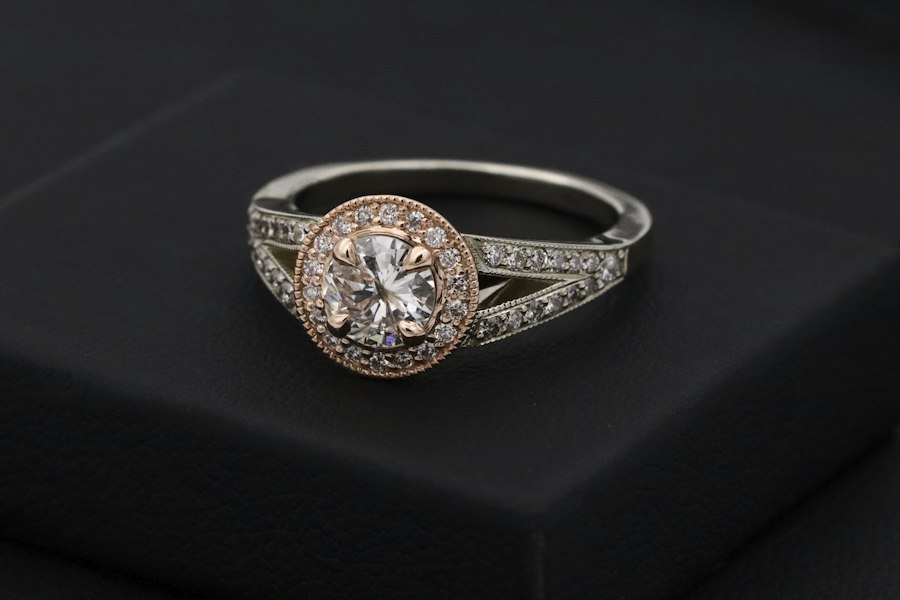
Turn your ring over and look inside the band. Somewhere on the inner surface, usually near the shoulder, you will see tiny stamped marks: "14k," "585," "PT950," "750," sometimes a small symbol or letters that look like a maker's cipher. These are hallmarks, and they are the jewelry world's way of telling you, without an argument, what the metal actually is and who stood behind it. Reading them takes about ten minutes and saves you a lifetime of wondering. At our atelier, every piece we make carries our own registered maker's mark alongside the metal stamps, so the provenance of the ring is documented the day it leaves the bench.
The karat marks
Gold purity is stamped either in karats or in parts per thousand. You will see both. 10k means 10 parts gold out of 24, roughly 41.7% pure gold—stamped "417" in parts-per-thousand form. 14k is 14/24, about 58.3%, and appears as "14k," "585," or "583." 18k is 18/24, 75%, and appears as "18k" or "750." 22k and 24k appear as "22k" or "916," "24k" or "999." The higher the number, the more pure gold in the alloy and the softer the metal. A "14k" stamp is not a brand; it is a guarantee by the maker that the metal meets that standard. If you are choosing between them, our guide on 14k vs 18k gold vs platinum explains the wear and color trade-offs.
Platinum and silver marks
Platinum is marked with its own system. You may see PT950 (95% pure platinum), PT900, or simply "PLAT" or "PT." The higher the number, the denser and more valuable the alloy. Sterling silver is usually stamped 925, meaning 92.5% pure silver—the standard alloy for durable silver jewelry. If you see "S925" or "STER," that is the same thing. A piece that claims to be platinum or silver but has no stamp at all should raise an eyebrow; in most countries, stamping is a legal requirement for fine jewelry sold as such.
The maker's mark
Alongside the metal stamp you may see a small set of initials, a symbol, or a tiny design. This is the maker's mark—a registered stamp identifying the workshop or individual who made the piece. In historic jewelry, hallmarks include town marks, date letters, and duty marks, which is how collectors date antique pieces to within a year. In modern bespoke jewelry, the maker's mark is less about legal assay and more about authorship: it is the bench jeweler's signature. If your ring ever needs repair, resizing, or restoration, the maker's mark helps a new jeweler understand how the piece was constructed and who to call with questions. We discuss this further in our note on heirloom ring repair and restoration.
Why some marks are faint
Hallmarks are stamped into soft gold by hand or with a press, and over decades of wear they can rub down and become difficult to read. Resizing the band can also move or erase the mark. A faint or missing stamp does not automatically mean the piece is fake; it often just means the ring has been loved and worn. A jeweler can test the metal with acids or X-ray fluorescence (XRF) to confirm the purity without damaging the piece. If you inherit a ring and the stamps are illegible, this is the way to find out what you have before you decide to redesign or insure it.
What the stamps are not telling you
Hallmarks tell you the metal. They do not tell you the quality of the diamond, the color grade of the gold alloy, or the skill of the making. A 14k stamp on a poorly cast ring is still a 14k stamp, but the ring may be thin, rough, and badly set. This is why buying bespoke is about more than reading the inside of the band: the stamp is the baseline, not the whole story. For the rest of the picture, you look at the portfolio, the workmanship, and the documentation. Our guide on choosing a bespoke jeweller by portfolio walks through what to inspect.
You may also encounter GP, GF, or RGP on less expensive pieces. Those mean gold-plated, gold-filled, and rolled gold plate—layers of gold over a base metal, not solid gold. Gold-plated jewelry wears off in months to years; gold-filled can last decades. Neither is a flaw, but both mean the ring is not the solid karat gold it might look like, and the stamp is telling you so honestly. If you see no stamp at all on a piece sold as fine gold, treat the claim with caution and ask for an XRF test before you buy. This is also why our own pieces are always stamped: the mark costs us almost nothing, and it saves the next owner from guessing.
The next time you take your ring off, squint inside the band. Those tiny marks are a small act of honesty—a promise, pressed into the metal, about what you are actually wearing. Hold onto that. It is worth more than it looks.