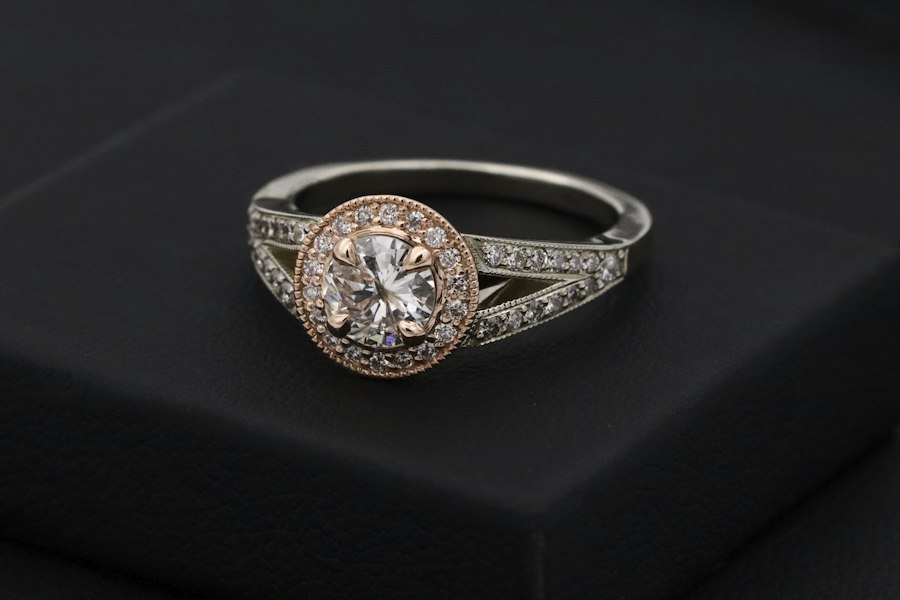
When you collect a bespoke ring, the excitement is real, and it is easy to slip it on, gasp, and walk out the door. That is what the bench expects. But the ten minutes you spend inspecting the piece in the studio, under the right light, are the ten minutes that decide whether a small problem gets fixed now or annoys you for the next decade. We give every client the same checklist at collection. Here it is, so you know what you are looking at.
Light is everything
Do not inspect a ring under the store spotlight. It is flattering light and it hides everything. Ask for a daylight window, or a neutral white inspection lamp. Tilt the ring slowly. Good work reveals itself in consistent reflections. Bad work shows up as a dull patch, a wavy line, or a reflection that jumps unexpectedly.
If you are picking up the piece in person, take it outside. Natural light is the honest judge. If you are having it shipped, photograph it under a window on arrival, not under indoor lighting, before you sign for it. We walk clients through this on a video call when distance makes an in-person inspection impossible.
The finish
Run a fingernail along every edge. It should catch nothing. A polished ring should reflect the same way on both sides of a shank. A brushed ring should have lines that run consistently in one direction, with no swirls or patches where the brushes crossed over. A matte ring should read as even gray, not blotchy. If the finish changes direction halfway around the band, that is a hand-finishing shortcut, and it will show within months as the worn area starts to shine.
Look at the inside of the band. This is where beginners hide work. The interior should be smooth and comfortable, with a polished or comfort-fit curve that does not dig. The hallmark, serial number, and maker's mark should be cleanly stamped, not crooked or doubled. If the inside is rough, the outside was rushed too.
The settings
Every prong should be the same height, the same shape, and the same tightness against the stone. Run a needle or a piece of floss around the base of each prong. It should not catch. A prong that is too loose will let the stone shift; a prong that is too tight has been pushed too hard and may chip the girdle. Look straight down at the stone from above. It should sit level, not tilted in its seat.
For a bezel or rub-over setting, the metal edge should hug the stone continuously with no gap visible at the girdle. Run a fingernail around the bezel wall. It should be smooth and even, with no spot where the metal lifts away from the stone. That gap is where soap, dirt, and eventually corrosion will collect.
The soldering and structure
Look at every joint where two pieces of metal meet. Shoulders, basket joins, gallery rails, attachment points for a setting. The solder line should be invisible or at least neat. A dark, crumbly, or lumpy joint is a weak joint. It will flex, it will tarnish faster, and in the worst cases it will eventually fail under normal wear. You do not need to be an expert to see this; you just need to tilt the piece so light rakes across the surface.
For a ring that will have a wedding band added later, check that the two rings actually touch when you hold them together. A gap at the join is a common bench fit error, and it is fixable now. It is much harder to fix after you have been wearing the ring for a year.
Comfort and wear
Put the ring on and turn it around your finger. It should spin smoothly without a high spot catching. Put it beside your other jewelry. The shank should not have a sharp inside edge. If you are left-handed and wear the ring on your dominant hand, think about how it will feel holding a phone, a steering wheel, a pen. A ring that looks perfect in the case but digs when you grip is not finished, and the bench can usually round the inside in a few minutes.
What to do if you find a problem
Say so. A good atelier expects this and wants to fix it before you leave. Most finishing issues take ten minutes on the bench. Structural issues like a loose stone or a weak joint take longer, but they are far better discovered in the studio than in a year. We would rather you take the piece back to the bench than walk out unhappy. This inspection is not a formality. It is part of how good jewelry stays good, and it is the moment where a commissioned piece becomes a piece you trust for the next fifty years. We also recommend a short maintenance rhythm after delivery, so small issues are caught early rather than at resizing time.