An engagement ring is a very public object. People look at it. They ask about it. They remember it. But the most meaningful decisions in a bespoke commission are often the ones no stranger will ever notice. Hidden details—the kind only the wearer knows are there—are why people come to an atelier instead of a store.
These details work like a private language. You catch them when you twist the ring on your finger at a meeting, or when you turn it under a lamp at dinner. They are not for an audience. They are for you.
The inside of the band is a secret wall
The inner surface of a ring is the obvious place to start, and people still underuse it. Beyond a name and a date, you can fit a remarkable amount of text with hand engraving: coordinates, a GPS point where a proposal happened, a line from a song, a short promise. A skilled engraver can fit 40 to 60 characters inside a comfort-fit band in clean script. Two short phrases, one on each side, is a favorite of ours.
A fingerprint or a lip print is more intimate still. We scan the impression at high resolution, scale it to fit, and engrave it into the inner wall. It is invisible in daily wear but unmistakable when you run a thumb across it. For related ideas, our guide to hand-engraving ideas covers the range.
A stone no one can see
One of the loveliest hidden details is a tiny gemset into the underside of the basket or the inside of the band. It could be a birthstone, a stone from a family piece, or a simply colored dot that means something only to you. It catches a flash of light at certain angles and is otherwise invisible. Couples often choose matching secret stones in their two rings—a private handshake between pieces.
Shape and structure as symbolism
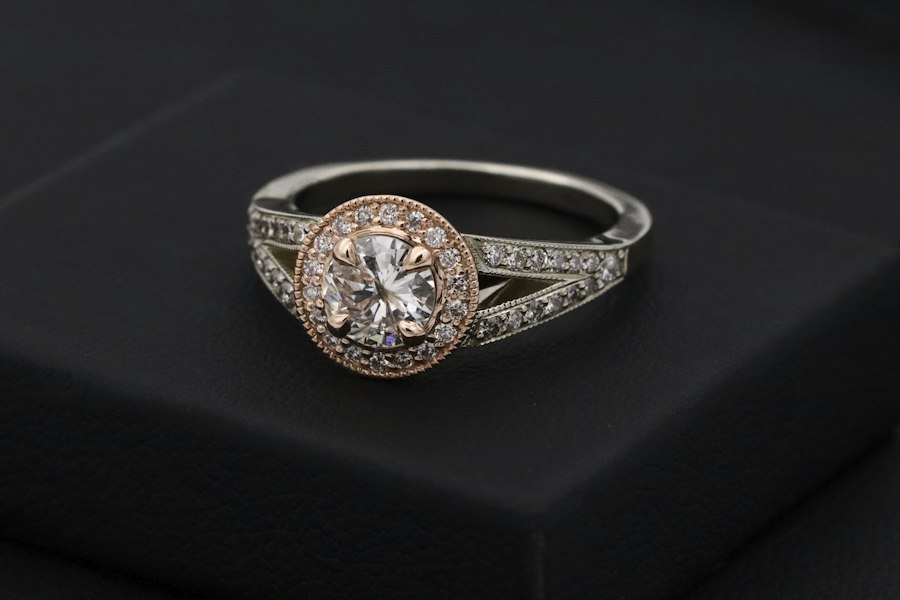
Hidden meaning does not need to be engraved. It can be built in. A band split into two halves that rejoin beneath the stone can represent two lives merging. A tiny gap in the setting can reference a word. A contour on the inside of the shank can be shaped around a specific date in Roman numerals. These choices cost almost nothing extra at the design stage and read as elegant geometry to anyone looking from the outside.
The underside of a halo
Halo and pavé settings offer a canvas that sits against the palm of the hand. We have set a small word, a row of tiny stones spelling a date, or a single accent diamond on the underside of a halo where the wearer sees it with every gesture. It is the kind of detail that makes a ring feel like it was made for a specific person, because it was.
Keeping it legible, not fussy
The risk with hidden details is piling on too many. A ring with an inside engraving, a secret stone, a micro-symbol, and a shaped shank becomes a busy object. The strongest commissions choose one or two secrets and leave the rest of the design clean. Less reads more personal; more reads costume.
Remember that the inside engraving may eventually be altered by a resize. If an inscription is precious, size the ring carefully the first time, or position it where the bench can preserve it. We talk through placement before any stone is set.
Why this is the whole point of bespoke
Budgeting for the invisible
The thing that surprises clients is how little most hidden details cost. An extra line of engraving is minutes on the bench. A secret accent stone is a small addition to the stone sheet. The shaped shank and structural symbolism cost essentially nothing at the design stage, because they are decisions rather than extra materials. What costs money is doing these things badly at the last minute, after the stone is already set. Bring the secrets to the first consultation, not the fitting, and they slot into the design for almost no premium. If you want to see where the bench conversation sits in the wider flow, our piece on what to bring to your first consultation maps it out.
A ready-to-wear ring can be beautiful. It cannot hold your secrets. When you commission a piece, you are buying the right to put yourself into it—not by grand statements, but by quiet details that only one or two people in the world will understand. Years from now, when the ring is handed on, those secrets become the stories that make the piece worth keeping. Sometimes they are decoded by a child who finds the engraving on a quiet afternoon. That conversation is the whole point of doing this by hand rather than off a shelf.