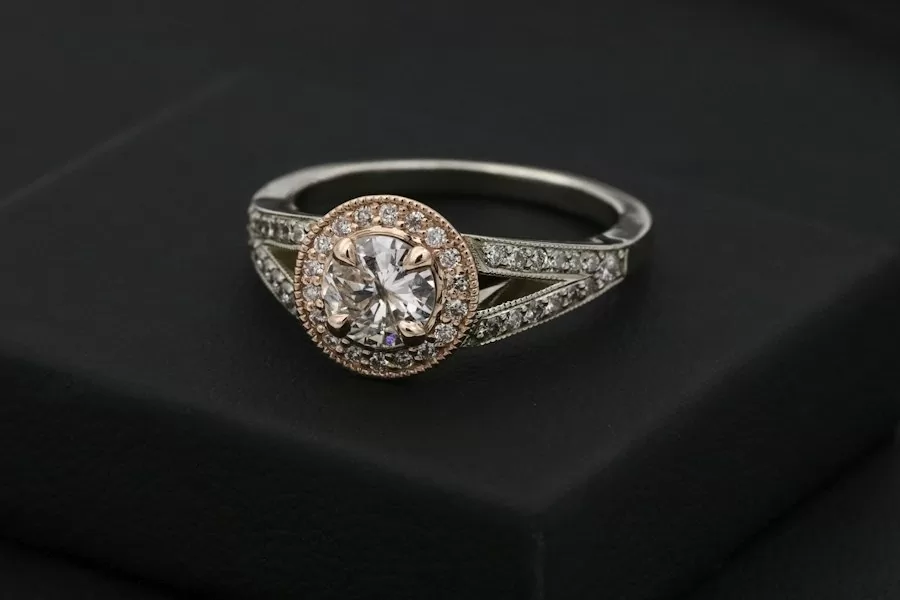
When people first pick up a handmade ring and compare it side by side with a factory piece, they sometimes frown. The factory ring is flawless—perfectly uniform prongs, a mirror edge, no visible mark anywhere. The handmade ring has a faint tool line, a prong that is a fraction taller than its neighbor, a surface that is almost flat but not quite. Customers wonder if something went wrong at the bench.
Usually, the opposite is true.
IWhat "perfect" costs
Mass-produced jewelry achieves its uniformity through repeated stamping, casting, and polishing that strips away every human trace. That is a legitimate way to make jewelry, but it is also a process that can hide shortcuts. A casting made from a cheap mold, over-polished to uniform brightness, can look identical to a hand-built piece in a product photograph. The hand-worked piece, by contrast, shows its construction: the file marks where a shoulder was shaped, the slight variation in bead settings, the way a wire was soldered into place.
Those marks are not defects. They are the fossil record of how the ring was made. When we explain when hand fabrication beats digital design, this is what we mean—the visible logic of a ring that was built, not poured.
IIWhat a handmade piece should actually look like
There is a line between character and carelessness. A well-made hand-built ring should be honest, not rough. The joins should be clean, the prongs should be seated firmly against the stone, the edges should be deliberate. The small irregularities that remain are the ones that cannot be removed without destroying the craft: a slight variation in milgrain beads, a gentle curve in a hand-drawn line, a surface that catches light at imperceptibly different angles across its width.
If you hold a loupe to it, you should see intent everywhere you look. What you should not see are jagged solder seams, loose stones, rough interior surfaces that would scratch the finger, or asymmetry that looks like a mistake rather than a style.
IIIWhy we do not polish the life out of it
Some customers ask us to bring a handmade ring to a perfect mirror finish, and we can—but we advise against it. Over-polishing removes metal. It rounds sharp corners, thins prongs, and burns away the fine detail that made the piece distinctive. A small amount of honest tooling, left in the finish, means the ring will take longer to wear through its life and will retain its character for decades. It also ages better: a hand-finished surface develops a soft, even patina that tells the story of your wear, rather than a network of micro-scratches that looks tired.
IVHow to inspect your commission
When you collect a bespoke piece, look for three things. First, is it finished where it touches you—inside the band, under the gallery, where the prongs meet the stone? A good maker finishes the places you cannot see. Second, is the setting method consistent—every bead seated, every prong closed? Third, does the piece feel like an object a person could have made, or like something assembled from a mold? The former is what you paid for.
VWhat to actually reject
Character is one thing; carelessness is another. Reject a piece—politely, and without apology—if you feel a rough spot inside the band that would scratch you, if a stone shifts under a light nudge, if a solder seam is visibly lumpy, or if a prong is sharp enough to catch on fabric. A good bench jeweller expects this conversation and will fix it on the spot. The difference between an honest hand mark and a sloppy finish is that the hand mark is consistent, deliberate, and never touches you. If you want to know more about how a piece is built, our look at a commission on the bench shows the steps that produce clean, finished work.
VIWhat digital design leaves behind
Modern CAD and casting are extraordinary tools, and we use them when they serve the piece. But a CAD-printed and cast ring carries the uniform geometry of a machine: perfectly round galleries, identical beads, surfaces that read as "designed" rather than "made." Hand-built work carries the opposite signature—slight corrections made by eye, a wire soldered slightly off and then filed to intent, a surface that responds to how the jeweller's hand actually moved. Neither is superior in the abstract. The point is that when you pay for handmade, you should be able to see, under magnification, that a person held tools against your ring. If you cannot, you may have paid for handmade and received manufactured.
The best handmade jewelry does not look like it was printed. It looks like it was loved into existence, one file stroke at a time. When you collect your piece, give it a quiet moment under good light before you put it on. Those small marks are not flaws to be fixed. They are the proof that the ring you are holding is genuinely, irreplaceably yours.
For third-party reference, the Wikipedia article on moissanite details moissanite’s discovery, optical properties and use in jewelry.
VIIFrequently Asked Questions
How do I verify a factory before placing a bulk order?
Request a production video, business license, export records and a paid sample run. A factory that accepts a 50-piece test order is usually a real manufacturer.
What payment terms do you offer?
Payment terms, including the deposit and balance schedule, are set out in the order agreement. This protects both sides on first orders and can move to net terms after a track record.
What is your normal reject rate?
3–5% under 10x loupe inspection for cast and set pieces. Defective units are replaced free in the next shipment.
Where is the factory located?
Wuzhou, Guangxi, China—the core lab-grown and moissanite manufacturing cluster. Shipments go via Guangzhou or Shenzhen ports.