Fifteen years ago, a wedding set meant two identical bands, one scaled down. Today most couples ask for the opposite: bands that clearly belong together but do not look like a matched set from a catalog. The goal is a shared fingerprint, not a twin. Designing that pair is about choosing which three or four details to align and which details to deliberately leave alone.
What "matching" should actually share
A coherent pair almost always shares three things: the metal family, a design motif, and a finishing language. That means both bands in 18k yellow gold, both carrying the same small engraving or the same hammered texture, and both finished with the same satin or high polish. Those shared cues are enough to read as a set. A 4 mm men's band and a 2.5 mm women's band can share a hammered finish and instantly look related, even though the widths are different.
Metal is the most important shared cue because a rose gold band next to a platinum band reads as a mismatch no matter the design. If the two partners genuinely want different metals, the custom move is two-tone: each band carries a sliver of the other metal along one edge. We explain the alloy logic in rose gold vs yellow gold for custom pieces.
What you should deliberately keep different
Width, profile, and stone count are the details that should differ. A 5 mm flat men's band and a 2 mm comfort-fit women's band can share the same satin finish and still fit two very different hands. Comfort fit, meaning a slightly rounded inner wall, is worth specifying for daily wear; it adds about $40 per band but removes the "breaking in" period of a flat inner shank.
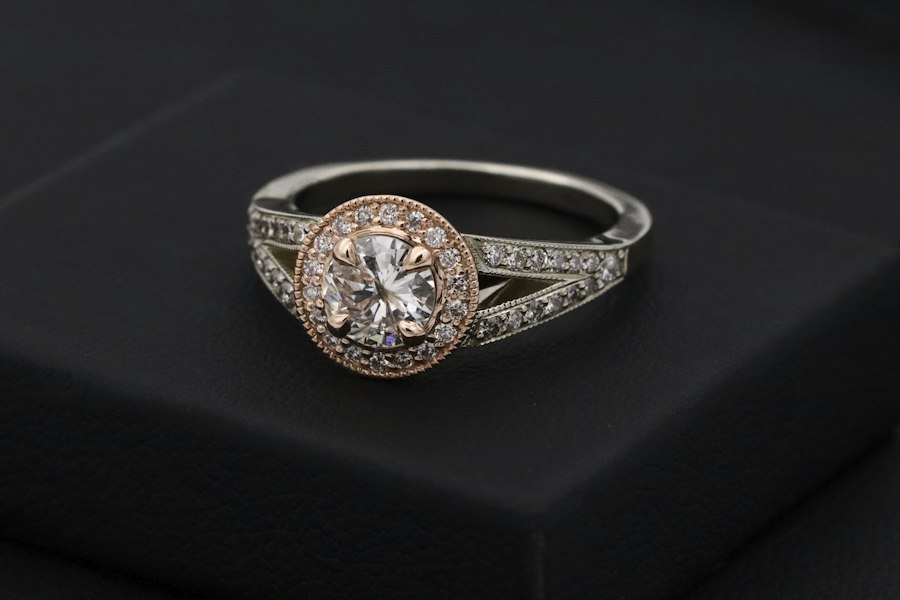
If one partner already wears an engagement ring, the wedding band must be designed to sit against it. A flat band next to a high cathedral engagement ring leaves a visible gap. The custom fix is a contour or notched band, shaped to follow the exact base of the setting. This is far easier to get right if both rings are designed together from CAD. The process behind that alignment is in the bespoke process from sketch to setting.
Engraving as the quiet shared detail
The cheapest and most personal matching cue is a shared engraving on the inner shank: a date in the same hand-engraved style on both bands, or a short coordinate, or a phrase split between the two rings. Hand engraving runs $40 to $90 per band and does not wear off the way machine engraving can. It also gives the pair a private connection that is invisible on the outside, which suits couples who want a subtle set rather than a loud one.
Because both bands sit against skin permanently, material safety matters. The EU Nickel Directive 2004/98/EC sets a release limit of 0.5 micrograms per square centimeter per week for items worn directly on the skin, which is the standard we build to for any band meant to be worn 24 hours a day.
Timing and cost for a pair
A matched pair of custom bands costs roughly $900 to $2,400 in bench work, depending on width, finish, and any stones. Designing them together rather than separately saves 15 to 25 percent, because the CAD and casting setup is shared. If the bands commemorate a specific date or story, that narrative layer is part of the brief; see bespoke anniversary gifts that commemorate a story.
Do wedding bands have to match the engagement ring metal?
No, but they should read as related. Most clients match the wedding band to the engagement ring metal, and let the partner's band echo the finish rather than the metal.
Can we design our bands if we live in different cities?
Yes. Remote commissions by video call are standard, and ring sizes are taken at a local jeweler before the call. See working with an atelier remotely.
How long does a matched pair take?
About 4 to 6 weeks. Contour bands that must match an existing engagement ring take a week longer because the ring has to be measured or scanned.
What is the most underrated matching detail?
A shared inner-shank engraving. It is cheap, permanent, and private, and it makes two visually different bands feel like one set.
A final cost note: engraving and a contour cut are usually quoted as add-ons, not included. Ask for them in writing at the same time as the band price, so the pair does not arrive 15 percent higher than agreed. Also decide early whether you want comfort fit, because changing it after casting means re-casting the shank and starting the bench clock again.
Design a pair that belongs together without looking bought together. Book a two-band design call; we will align the metal and finish, and leave the widths to fit two real hands.