When most people shop for a ring, they look at the outside. They choose the width, the finish, the stone. Almost no one asks about the inside of the band—and yet that curve is what the finger feels, hour after hour. The inside profile is the difference between a ring you forget you are wearing and one you twist off by lunchtime. At an atelier, we shape the interior on purpose.
What "comfort fit" actually means
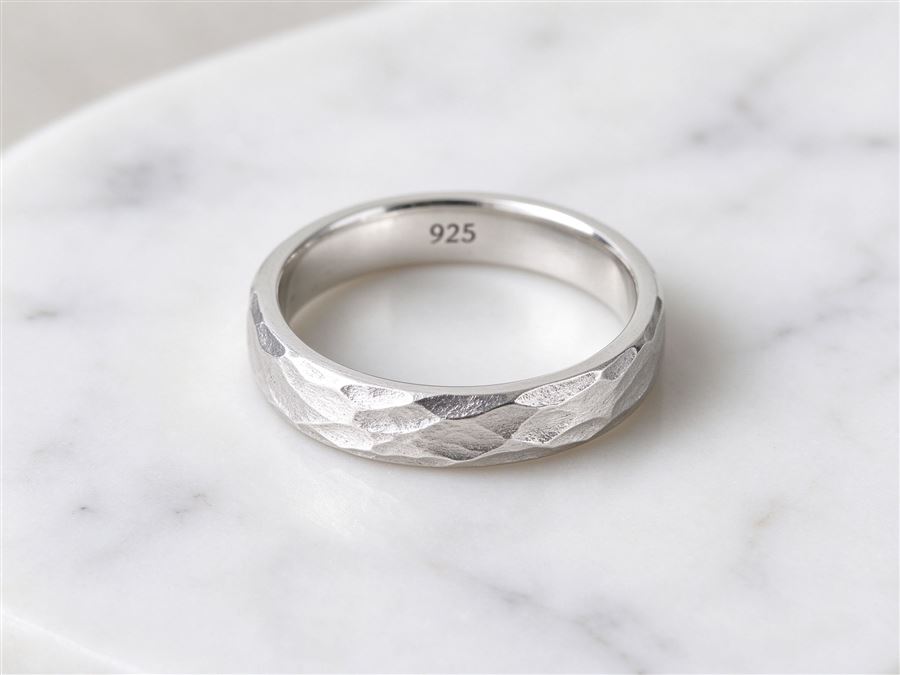
A comfort fit band is rounded on the inside. The inner wall curves gently, so the band slides over the knuckle with less friction and sits against the finger like a cushion. A standard (or "pipe") fit band is flat on the inside—a squared inner wall that meets the finger more directly. Neither is better. They are tools for different hands and widths.
The rounding comes from removing metal from the inner edges during finishing. Because a comfort fit band has slightly less material at the wall for the same visible width, it is usually built a touch heavier or wider to keep its weight. That is why a true comfort band costs a little more than a flat one of the same size.
How it changes your ring size
This is the detail jewelers wish more customers knew: the interior shape changes the size that fits you. Because a rounded band slides more easily over the knuckle, people often size a comfort fit slightly smaller than a standard fit in the same width—often by half a size. Size a comfort band as if it were flat, and it will likely spin around on your finger once the swelling of the day settles.
If you are measuring at home, our guide to measuring your ring size at home is the place to start, but always tell your jeweler whether you are ordering comfort fit or standard—it matters.
Who should choose comfort fit
Comfort fit earns its keep in a few clear situations. Wide bands—anything over about 5 millimeters—feel dramatically better with a rounded inside, because a flat wide band acts like a cuff digging into the skin. People who wear their ring 24/7, who work with their hands, or who have slightly larger knuckles than their base finger all prefer the ease of a rounded interior. It is also the standard choice for men's wedding bands, which tend to be wider.
When standard fit is the right call
A slim band—under 3 millimeters—barely feels either way, so the extra cost of comfort fit is wasted. Standard flat bands are also easier to resize cleanly and leave more room inside for hand engraving, since a flat inner wall is a stable surface. If you want a thin, engraved, heirloom-style band, standard fit is usually the cleaner choice.
Weight, width, and the feel you want
"Comfort" is also about heft. A band that is too light for its width flops and annoys you; one that is too heavy feels like a reminder on your finger. We match the wall thickness to the width and to the metal—platinum is denser than gold, so a platinum band at the same width already feels substantial. We talk through how you want the ring to feel: nearly invisible, present but easy, or a deliberate weight you can feel. That conversation decides the profile.
Many clients are surprised to learn that a comfort fit band also slides on and off more easily when their hands are cold—which matters if you ever take the ring off to wash dishes or apply lotion. The rounded edge catches on skin less than a sharp inner corner, so the ring comes off without that tugging sensation. It is a small thing to describe and a noticeable thing to feel, and once you have worn a comfort band for a week, going back to a flat one on a wide band feels like wearing cardboard.
Try before you commit
The best way to choose is to wear both. If you visit a workshop, ask to feel a comfort band and a flat band in the same width on your own finger. The difference is immediate once you feel it. Remote clients can describe their preference in the brief—we will shape the interior to match, and the CAD lets us show you the profile before anything is cast.
One more practical note: the wider the band, the more it acts like a tight sleeve across the whole finger. A wide band that feels right on a cool morning can feel constricting by evening, when fingers swell. We account for that by sizing wide comfort bands a touch generously and by keeping the inner curve smooth, so the ring moves with the day rather than fighting it. It is a small calibration that makes the difference between a ring you reach to remove and one you barely notice.
The small detail that changes daily wear
No one buys a ring because of its inner curve. But the people who live with a well-profiled band will tell you it is the reason the ring disappears into their day. It is a quiet piece of engineering—invisible from the street, felt on the finger for decades.