Walk into five jewelers and ask for a custom ring, and you will get five different products. One will sketch from scratch. Another will hand you a tray of settings and let you pick a stone. A third will quote a price that sounds like a catalog piece but calls it bespoke. The word is doing a lot of work, and the gap between the cheapest quote and the most expensive one is usually not markup. It is a completely different service.
Fully bespoke
Fully bespoke means the piece does not exist in any catalog and will not be repeated. The design begins with you: your story, your hand, your existing jewelry, the way you actually live. The atelier sketches the silhouette, builds a wax or CAD model you approve, casts the metal, sets the stones by hand, and finishes the piece. No two commissions are identical, even when two clients ask for a solitaire. The process usually takes six to twelve weeks and involves at least one approval stage where you can change your mind. This is what a true bespoke commission looks like end to end.
Semi-custom
Semi-custom starts from an existing setting the jeweler already makes. You choose from a menu: this solitaire head or that one, platinum or 14k gold, a slightly wider shank, a different stone. The proportions are fixed by the maker, the mold already exists, and the variations are limited to what that setting comfortably accepts. The result feels personal because the stone and the metal are your choices, but the underlying design is not new. Semi-custom is faster, cheaper, and lower risk, and it is a perfectly good way to get something you love. It is just not the same as designing from a blank page.
Made-to-order
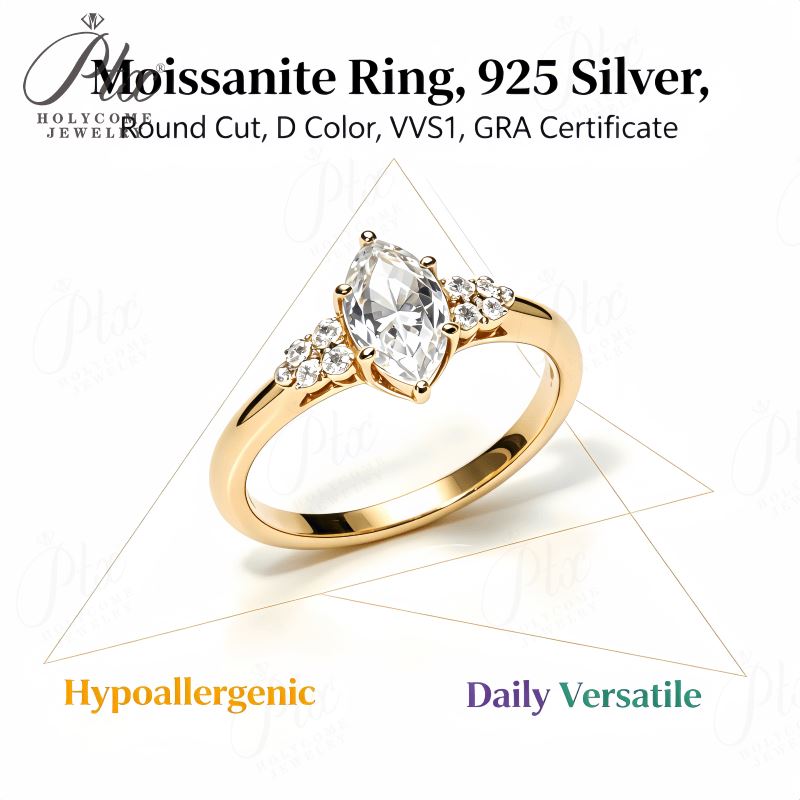
Made-to-order sounds like it should mean the same thing, but it usually means something narrower. A design you see online is manufactured after you place the order, in your size, rather than pulled from a shelf. It is made for you, but it is not designed for you. Thousands of other people own the same ring. The advantage is consistency and price. The disadvantage is that nothing about it is tuned to your hand, your story, or the jewelry you already wear.
How to tell which one you are getting
Ask three questions. First, will this setting exist in any other client's order? If the answer is yes, you are in semi-custom or made-to-order territory. Second, can we change the silhouette, or only the metal and stone? If the silhouette is fixed, the design is not being invented for you. Third, do I approve a model before it is cast? A bespoke process always shows you a tangible wax or CAD approval. A catalog pipeline often skips that step because there is nothing to approve.
Which one is right for you?
If the ring is for an engagement, an heirloom reset, or a gift that must carry a specific story, bespoke is worth the extra time. If you know exactly what style you want and mainly care about the stone and the metal, semi-custom gets you there faster and for less. If you simply want the ring you saw online in your size, made-to-order is the honest name for what you are buying.
The trap is paying bespoke prices for a semi-custom product. A clear conversation up front prevents that. We would rather tell you that a catalog setting will do the job than sell you a sketch you do not actually need.
How price maps to each tier
It helps to understand where the money goes in each tier. Fully bespoke spends a large part of the price on design time, model-making, and one-off handwork. You are paying a craftsperson to solve a problem that has never been solved before. Semi-custom spends most of the price on the materials, because the design cost was amortized over many sales. Made-to-order is largely materials plus manufacturing, with almost no design overhead. That is why a fully bespoke ring in the same metal and stone can cost noticeably more, and why that difference is not always about profit. Asking where the price sits on that spectrum prevents a lot of confusion when two quotes look worlds apart.
Questions that expose the gap
If a quote is ambiguous, press on the process rather than the price. Ask whether the piece will be hand-fabricated or cast from a shared mold. Ask whether you will see a physical model before casting. Ask whether the design can be modified after you approve it. The answers reveal the tier far more reliably than the words on the brochure. A jeweler who is genuinely making something for you will walk you through the bench, the wax, and the approval steps without hesitation. One who is selling a catalog item will politely redirect you back to the stone and the price.