Bespoke Earrings Design | Custom Studs, Hoops & Dangles — HOLYCOME
Designing custom earrings that sit straight on the ear, match perfectly as pairs, and hold up through thousands of earring changes is a different engineering challenge from rings or necklaces. Every bespoke earrings design needs to account for post straightness, finding mechanics, pair matching by weight and dimension, and weight distribution for dangles — details that only become visible after the piece is worn for a day. At HOLYCOME, we have been producing bespoke earring commissions and private-label earring collections for over 12 years, working with bridal brands, independent designers, and high-street retailers. This guide covers our bespoke earring design process, pair-matching standards, finding options, and the quality benchmarks we hold for every custom pair.
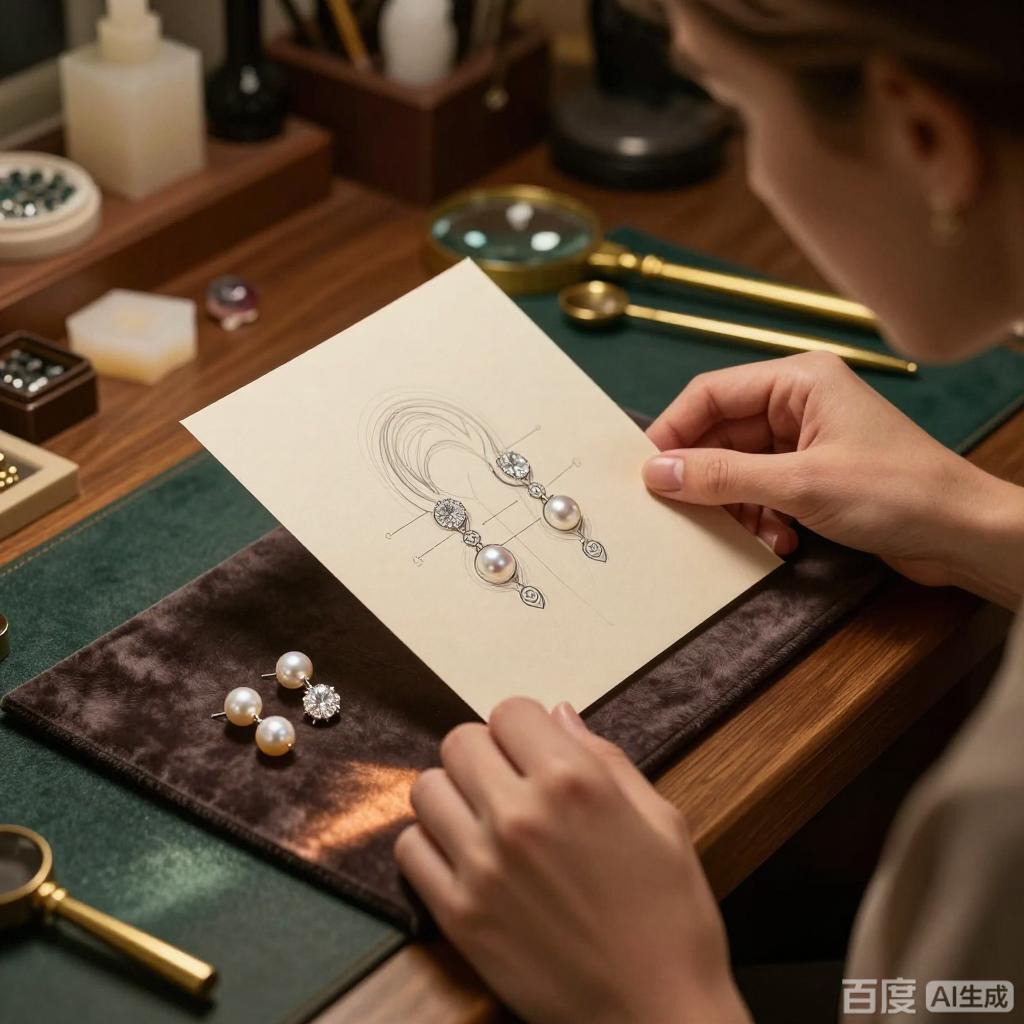
Why Earrings Need a Specialized Design Process
Earrings fail in ways that rings do not. A ring stays on a finger because the knuckle holds it; an earring stays on because a clutch grips a post, a lever-back snaps shut, or a French hook is held by gravity and a plastic back. Every component is a potential failure point, and earrings experience constant motion — talking, turning the head, putting on coats, hugging, brushing hair. Designing bespoke earrings requires attention to five specific factors.
Post perpendicularity. An earring post must be exactly 90 degrees to the earring face — even a 2-degree angle means the earring sits visibly crooked on the earlobe. We solder posts in dedicated jigs that hold the post at a precise right angle, verified with a digital angle gauge after soldering. This sounds obvious, but budget shops hand-solder posts by eye, and crooked posts are one of the top return reasons for custom earrings.
Pair matching. Mismatched pairs are the most common earring complaint. We match every pair by weight (within 0.1 grams), by stone diameter (within 0.02 mm for matched studs), by dimension (within 0.1 mm for studs, 0.3 mm for hoops), and by visual symmetry on a light pad. Mismatched pairs are split and re-paired during QC.
Finding function. The finding — the part that goes through the ear — must perform thousands of open/close cycles without failure. We test every French hook through 50 flex cycles, every clutch for pull-off force (6-9 Newton range), and every hinge mechanism on huggie hoops for proper click tension before a pair leaves our facility.
Weight balance. Dangle earrings that are top-heavy tip forward on the earlobe and look awkward. We balance every bespoke dangle so the center of gravity sits within 3 mm of the ear-wire attachment point. Heavy drops (over 3 grams per ear) use lever-back findings instead of French hooks for additional support.
Comfort edges. Earring posts and backings are in direct contact with skin. Post ends that are not rounded properly can pierce skin during insertion; clutch backs with sharp edges dig into the back of the earlobe. We ball-end all posts and deburr every finding component by hand.
Our Bespoke Earrings Design Process
Whether you are commissioning a single bespoke pair for a client or a full earring collection for your brand, we follow a consistent six-stage process.
Stage 1: Brief and Style Selection (Day 1-4)
We collect your design references, stone specifications, target price point, and intended wear profile. Are the earrings for daily wear, bridal, or red carpet? Bridal earrings worn for a single evening can tolerate more delicate construction; everyday earrings need posts that do not bend and settings that survive contact with hair and clothing. We recommend style, construction method, alloy, and finding type based on your use case. See our custom design guides for more on how we approach bespoke briefs.
Stage 2: CAD Modeling (Day 4-9)
Earrings are modeled in RhinoGold with specific attention to earring geometry: post placement (must align with the earring's balance point), wall thickness around post solder joints (minimum 0.8 mm to prevent breakage), hinge clearance for hoops (we model hinge pins in-situ to ensure free movement), and bail size for drops (must have 0.5 mm clearance over the ear wire). Clients receive four-angle renderings plus a close-up of the post/clutch interface.
Stage 3: Silver Prototype (Day 9-16)
We strongly recommend a silver prototype for all new earring designs, more so than for any other jewelry category. Earrings are judged by how they hang on a real ear — which no rendering or flat photo can fully capture. A silver prototype lets you (or your client) put the earrings on, see how they sit, check post length, feel the weight, and test the clutch or clasp. We cast the prototype in sterling silver with CZ stones in place of final gems, finished to production standard.
Stage 4: Stone Sourcing and Matching (Day 9-16, Parallel)
Stone sourcing runs alongside prototyping. Matched stud stones (diamond, pearl, or gemstone) are the most critical — we match pairs for size (±0.02 mm), color (within one GIA grade for diamonds), shape, and orientation (pearls must have matching drill hole positions). For dangle earrings with multiple stones, we group matched sets per pair. All stones are sourced conflict-free with available certification per the FTC Jewelry Guides.
Stage 5: Production (Day 16-30)
After prototype approval and stone receipt, we move to production in your chosen alloy (10K/14K/18K gold, platinum, sterling silver). Cast components are investment-cast in our workshop; stamped components (common for huggies and flat studs) are blanked from sheet stock; chains for dangles are either in-house produced or sourced from premium suppliers. Assembly uses post-soldering jigs for perpendicularity. Stone setting follows our standard 12-15% seat depth. Polishing is multi-stage with extra attention to interior edges and post ends. White gold pieces receive rhodium plating at 0.5-1.0 microns; silver pieces receive anti-tarnish e-coating.
Stage 6: Pair Matching QC and Delivery (Day 30-35)
Every pair goes through dedicated pair-matching QC before packaging: weight match, dimensional match, stone match, post alignment, clutch fit (6-9 N pull-off), finding function (hinge clicks, lever-back closure), and hallmarking (karat stamp and brand mark on both posts or hoop interiors). Pairs are packaged in individual anti-tarnish pouches with post protectors. Standard lead time for one-off bespoke pairs is 4-5 weeks; production runs for private-label collections are 15-25 days at MOQ depending on volume. For more on the full custom journey, see our consultation to delivery timeline.
Earring Style Comparison for Bespoke Design
| Style | Construction | Key QC Focus | Best Finding | MOQ (Production) |
|---|---|---|---|---|
| Studs (solitaire, halo) | Cast head + soldered post | Post perpendicularity; pair match | Screw-back or push clutch | 30 pairs gold / 100 silver |
| Huggie hoops | Tubing/cast half-rounds + hinge | Hinge tension; roundness | Click-top post closure | 50 pairs |
| Dangle/drop | Cast/fabricated element + ear wire | Weight balance; link security | Lever-back for heavy drops | 30 pairs |
| Chandelier | Multi-component assembled | Link solder joints; pair length | Lever-back or French hook + clutch | 50 pairs |
| Ear climbers | Long cast element + stabilizer | Ear curve; stone alignment | Post + stabilizer clutch | 50 pairs |
| Jackets (halos around studs) | Framing element that fits behind stud | Post slot alignment; fit to existing stud | Slides onto existing post | 30 pairs |
Finding Options: Choosing the Right Hardware
The finding determines both security and comfort. We recommend findings based on earring weight and target user.
- Push-on posts with friction clutches: Standard for lightweight studs under 2 grams. We recommend heavy-weight butterfly clutches (wider platform) for better weight distribution on the earlobe.
- Screw posts with threaded clutches: Most secure option. Mandatory for valuable diamond/gemstone studs over 0.5 ct and for any stud over 3 grams per piece. Cannot be pulled off accidentally.
- French hooks (fish hooks): Classic for dangles. Ball-end tips prevent piercing skin from behind. Add a silicone clutch for security on pieces over 2 grams.
- Lever backs: Hinged closure that snaps shut around the ear wire. Recommended for premium dangles and bridal earrings — cannot fall out. Easy to operate one-handed.
- Hinged huggie/click-top closures: For hoops and huggies. Must open and close with a firm click but not be so tight that customers struggle. We cycle-test every hinge 50 times before shipping.
- Kidney wires: Secure hook-and-loop closure for vintage-style lightweight dangles. Reliable and affordable.
All findings are available in hypoallergenic options (titanium posts, niobium ear wires, nickel-free alloys) for EU REACH compliance per EN 1811 nickel-release standards.
Real-World Project: Bespoke Bridal Earring Collection
A UK-based bridal accessories brand commissioned a 60-pair bespoke earring collection in early 2025 for their spring wedding season: three designs each in two sizes (30 pairs per size), all in 14K gold fill with freshwater pearls and CZ accents. The designs included a classic pearl drop on lever back, a CZ halo stud with removable pearl drop jacket, and a delicate CZ climber. Delivery was needed in 5 weeks.
Week 1: Design review and CAD. We adjusted the climber curve to match a more anatomically accurate ear profile (the client's original design had a curve that was too tight and would not sit flat against the ear for most wearers). We also recommended screw-back posts for the studs instead of push clutches because many brides remove their earrings only once after the wedding day and appreciate the security of screw backs during a long day of hugging, dancing, and outfit changes. CAD was approved on day 5.
Weeks 2-3: Silver prototypes for all six SKUs were produced and shipped to the client on day 12. The client tested them on models and requested that the pearl drops hang 3 mm shorter to keep the focus near the earlobe in close-up wedding photos. We revised the drop connector length and confirmed with updated photos. Pearls were sourced from our Zhuji supplier, matched by size (±0.3 mm) and luster grade.
Weeks 4-5: Full production run of 60 pairs. Casting, assembly, CZ setting, pearl mounting, polishing, gold-fill plating (verified at 2.5+ microns gold layer by XRF), and QC. QC rejected four pairs: one with a slightly crooked post, one mismatched pearl size pair, one with a hinge that did not click firmly, and one with minor plating unevenness. All four were reworked. The order shipped on day 34, one day ahead of deadline. The collection sold through 70% of stock within the first month post-launch, and the client reordered before the wedding season ended.
For pricing details on bespoke earring production, see our pricing guide.
Common Bespoke Earring Design Pitfalls
Over 12 years of production, we see the same handful of recurring design issues from studios that do not specialize in earrings.
Under-specifying post thickness. Posts thinner than 0.7 mm (gold) or 0.8 mm (silver) bend when customers push clutches on too hard. We specify minimum thicknesses by alloy and use even thicker posts for heavy earrings.
Using hard alloys for huggie hinges. 18K gold is relatively soft, and huggie hinges in 18K loosen with wear. For 18K huggies, we use a 14K hinge pin inside 18K tubes for the best combination of exterior color and mechanical durability.
Unsoldered jump rings on dangles. Open jump rings pull open under the weight of drops and snag on sweaters. We solder every structural jump ring closed on dangle earrings, no exceptions.
Cheap clutches that lose tension. The cheapest component causes the most returns. We batch-test clutches on a force gauge to ensure pull-off force stays in the 6-9 N range — tight enough to stay on, easy enough to remove.
Ignoring asymmetrical ear anatomy. Most people have slightly different earlobe positions on each ear. Designs with long drops that must sit level need to account for this — we recommend slightly different connector lengths for left and right when necessary, or adjustable connector positions.
Frequently Asked Questions
What is the MOQ for bespoke earring production?
For private-label production runs: 30 pairs per SKU for gold studs and simple drops; 50 pairs per SKU for huggie hoops, chandeliers, and climbers; 100 pairs per SKU for sterling silver fashion earrings. For platinum pieces we accept 20-pair MOQs due to higher per-pair value. One-off bespoke pairs for individual clients have no MOQ.
Can you match earring finishes to our existing jewelry collections?
Yes. We maintain physical finish samples for repeat clients, documenting polish level, brushing direction and grit, plating thickness, and specialty finishes (hammered, oxidized, sandblasted). Send us a sample piece and we will match the finish exactly across your entire earring production run.
Do you offer hypoallergenic earring options?
Yes. We offer titanium posts, niobium ear wires, and nickel-free gold alloys for clients with metal sensitivities. All our production meets EU REACH and FTC nickel-release standards for pierced earrings. Nickel-release testing certification per EN 1811 is available on request for production runs.
Can you set customer-supplied stones or work with heirloom pearls?
Yes. We accept customer-supplied diamonds, gemstones, and pearls. All incoming stones are inspected, measured, photographed, and documented on receipt; we carry insurance for materials in our possession up to $50,000 per parcel. For heirloom pearls, we take special care with pearl drilling and mounting — old pearls can be brittle from decades of wear.
How are bespoke earrings packaged?
Standard packaging is individual anti-tarnish pouch per pair with post protectors and a QC card. Branded packaging (custom-printed earring cards, velvet pads, logo boxes) is available with setup fees of $150-400 and per-pair packaging costs of $1-5. We drop-ship to multiple addresses under your brand name with no HOLYCOME external markings.
Commission Your Bespoke Earrings
Bespoke earrings are among the most personal pieces in jewelry — worn every day, seen at every conversation, and tied to specific memories. Getting the details right — post straightness, pair matching, finding security, weight balance — is what makes a pair feel like a treasured object rather than a production afterthought. HOLYCOME's specialized earring design process, pair-matching QC, and 12+ years of production experience give you the confidence to commission custom earrings that perform as beautifully as they look. Start a design consultation through our contact page with your sketches, reference photos, or inspiration images, and we will respond with a feasibility assessment and quote within 48 hours. Explore our other custom categories including rings, necklaces, and bracelets, or browse our advice journal for more design guidance.