Most ring sizing assumes a simple cylinder. You slide a mandrel up the finger, read a number, and that is your size. Real fingers do not work that way. For a large share of clients, the knuckle is the widest point, not the base of the finger, and trying on a stock ring becomes a small negotiation: the band that passes the knuckle spins around loose on the finger. The band that stays put on the finger cannot make it over the knuckle at all. Add arthritis, morning swelling, or joint changes with age, and the stock-size system stops pretending it is useful.
The good news is that bespoke design was built for exactly this problem. A ring made for your hand does not have to compromise between the knuckle and the base. It can be engineered for both.
Measure twice, measure at the right time
Start with honest sizing. Measure at the end of the day, when your fingers are at their largest, and measure warm rather than cold. If you exercise, measure after exercise. If you are pregnant, expect your fingers to change and plan the piece as a post-pregnancy commission rather than a same-week gift. Our walkthrough of how to measure ring size at home covers the tape and string method; for knuckle-driven fingers, measure both the knuckle and the base and report both numbers to your jeweler.
The two numbers are the whole story. If your knuckle is a size eight and the base of your finger is a size six and a half, that is not a problem to solve by guessing. It is a design brief.
The hinged shank, done well
The classic solution is a hinged shank — a band that opens like a small clasp at the bottom, passes the knuckle, and closes around the base. Done cheaply, a hinged shank feels flimsy and catches on gloves. Done properly by a bench jeweler, the hinge is barely visible, the clasp snaps with a reassuring firmness, and the outside profile of the ring reads as a continuous band. This is the right answer for a permanently enlarged knuckle, and it is far more comfortable than squeezing a one-size band over the joint every morning.
Comfort fit, wider profile, lower settings
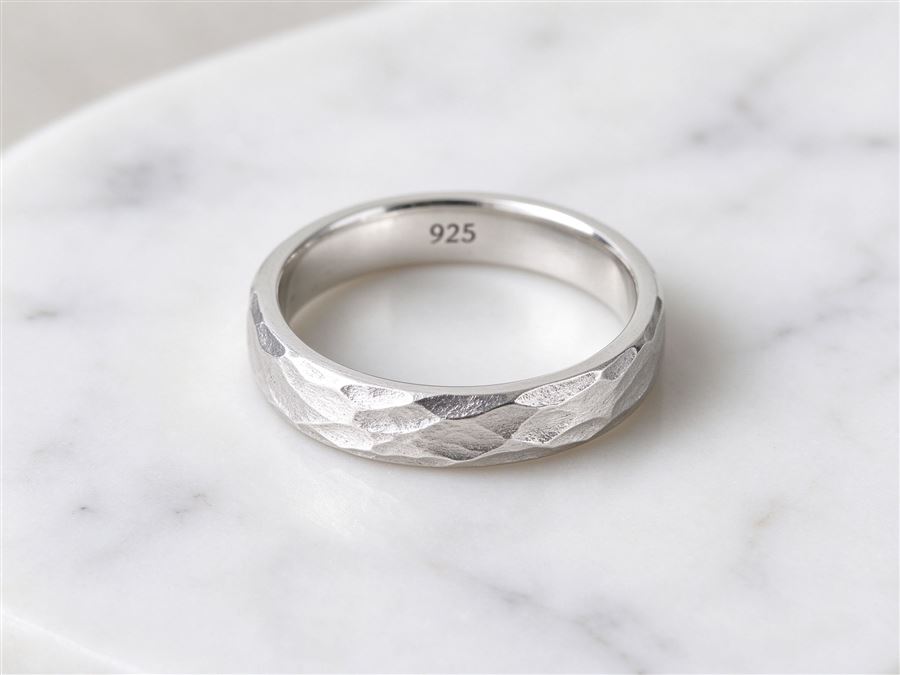
For fingers that swell and shrink by the day, the move is comfort-fit sizing combined with a slightly wider band. Comfort fit means the inside of the band is rounded rather than flat, so the ring glides over the knuckle with less resistance. A wider band (four to six millimeters) actually feels more stable on a knuckle-driven finger than a narrow one, because the weight distributes over more surface. Narrow bands dig.
Settings matter too. A high, pricked-up stone catches on everything and tugs on a tender joint. Low-profile settings, bezel settings, and flush-set stones all sit closer to the finger and move with the hand rather than against it. If your daily hand is one that opens jars, types, and carries groceries, this is the difference between a ring you forget you are wearing and one you take off by noon.
Materials and what to avoid
Platinum and 18k gold are denser and more rigid than thin 14k, which sounds counterintuitive but helps a hinged shank hold its shape for decades. Avoid plated pieces, because the plating wears off fastest on rings that are being worked on and off the knuckle daily. If budget is a consideration, solid 14k is the workhorse. Our notes on resizing a custom ring explain why a well-made piece can be adjusted as your hands change, rather than retired.
A note on arthritis and change over time
Fingers change. Joints enlarge over years, knuckles can thicken, and swelling patterns shift with seasons and medications. A ring commissioned in your thirties will likely not fit the same way in your sixties. The bespoke advantage here is that a well-constructed band can be opened, narrowed, or converted to a hinged shank later in life, rather than discarded. Choose a jeweler who expects that future. A ring should age with you, not against you.
When to stop and ask for help
If putting on a ring has started to cause pain, or if you have ever had to resort to soap, string, or a jeweler's saw to remove a stuck band, stop forcing it. A custom piece designed for your actual geometry costs less over a decade than a series of ill-fitting rings you cannot wear. Bring both measurements, bring the old ring that does not fit, and let the bench solve the math. The result is a band that stays on, stays comfortable, and stops being a small daily argument between you and your own hand.
A final detail that people forget: if you wear gloves for work or for cold weather, the interior diameter matters more than you think. A hinged shank that closes flush against the finger slips on under a glove without catching. A hinged shank with a protruding clasp will fray leather and knit in a single winter. Tell us if gloves are part of your daily life, and we will spec the clasp accordingly. It is a tiny engineering choice that makes a real difference by January.