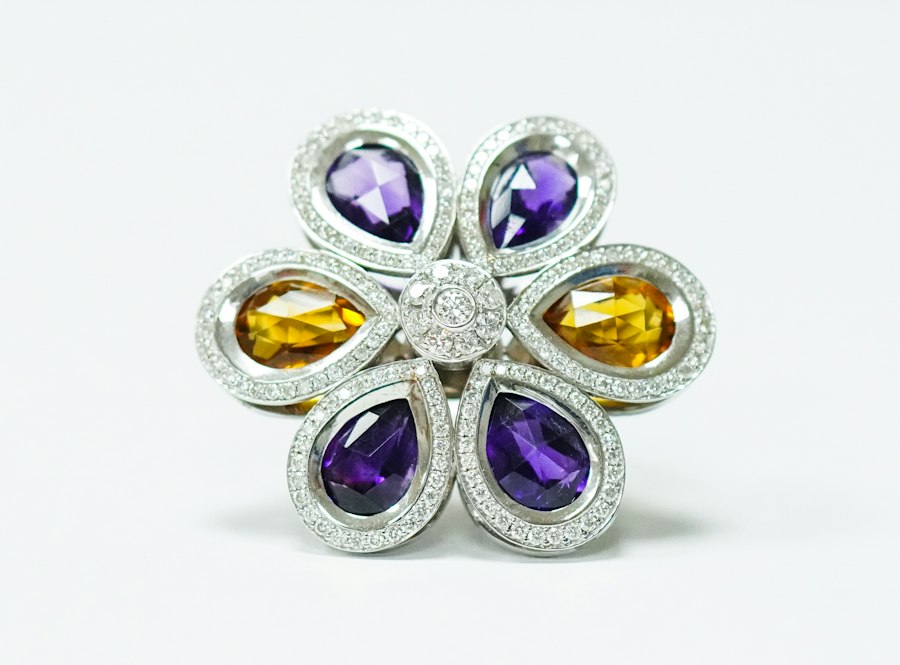
The left hand, for many people, is already taken. An engagement ring sits there. A wedding band stacks against it. The left hand speaks to other people's decisions. The right hand, by contrast, is yours. A right-hand ring—the dress ring, the statement ring, the occasional ring—is the one piece of fine jewelry a woman can design with zero obligation to anyone's taste but her own.
That freedom is exactly why these rings become favorites. They are not chosen by a partner, not gifted on a date, not dictated by tradition. They are chosen, deliberately, by the person who will wear them.
What a dress ring actually is
A dress ring is the piece you reach for when the outfit is already fine and you want one more idea. It can be a colored gemstone, a wide sculptural band, a cluster, or a single unusual stone in a quiet setting. It is usually worn on the right hand because the left is occupied, and it is usually designed to be noticed without needing to be large. A great dress ring reads as confident; a loud one reads as costume.
Scale: the line between statement and costume
The hardest decision is size. A dress ring on a small hand wants presence without sprawl. One well-proportioned stone at two to three carats reads as a statement; five thin stones across the knuckle reads as trying. Our general rule is that the ring should sit on the finger without overhanging the sides. If you look down and the ring is the first thing you see before your hand, it is probably too much. If it is the second thing, it is right.
Color is where you get to play
This is the freedom the left hand does not usually allow. Engagement rings default to white stones for practical, historical reasons. A dress ring can be blue, green, pink, yellow or cognac. A sapphire, a tourmaline, a morganite, a ruby or an unheated emerald all become options. The color should relate to your wardrobe. If you live in navy and cream, a deep blue sapphire will live in every outfit. If you wear warm neutrals, a peach morganite or a yellow sapphire will feel like a natural extension. Our guide to colored gemstones applies in spirit, even though this ring is not an engagement.
Metal: don't default to yellow gold
Because a dress ring is a self-purchase, clients sometimes assume they want the warmest gold possible. Often the more interesting choice is a cool metal against a colored stone, or a mixed-metal construction. A soft rose gold band beneath a teal sapphire, a platinum setting around a warm amber stone—these combinations read as designed rather than bought. The metal decision is part of the statement, not a frame afterthought.
Durability for a ring you actually wear
A dress ring that lives in a jewelry box is a failed project. The design should assume real life. Pick a hard stone if the ring goes to the office, the gym, the airport. Avoid high, thin prongs on a ring you will not baby. A bezel setting around a colored stone is both protective and modern, and it is one of the most popular choices we build for right-hand wear. If you want the setting options laid out, our setting types guide is the place to start.
Stack it or keep it alone
Some right-hand rings are designed to stack with a thin band on the same finger. Others are built to stand alone, with a shaped edge that reads clean from every angle. Decide this at the start, because the silhouette changes. A standalone ring wants a finished outer edge. A stacker wants a flat side that kisses the next band.
The point of the thing
What about the left hand?
Not everyone keeps the two hands separate. Some clients design a dress ring that deliberately echoes the engagement ring on the left—a matching metal, a related shape, a complementary color—and wear it on the same opposite hand to create a quiet pair. That works well when the two rings share a language. It reads as chaos when they do not. If you want the right-hand piece to talk to your left-hand set, bring the engagement ring to the consultation so we can design around it rather than guess. Our notes on matching your ring to your personal style cover the wider styling questions.
The point of the thing
A right-hand ring is not about anyone asking what it means. It is about you knowing. It can mark a promotion, a milestone, a divorce, a recovery, or simply a Tuesday when you decided to buy yourself something beautiful. Those reasons are enough. The ring will be on your hand for the next decade. Design it like the person you actually are.